250.64(D)(1)(3) Building or Structure with Multiple Disconnecting Means in Separate Enclosures. Common Grounding Electrode Conductor and Taps.
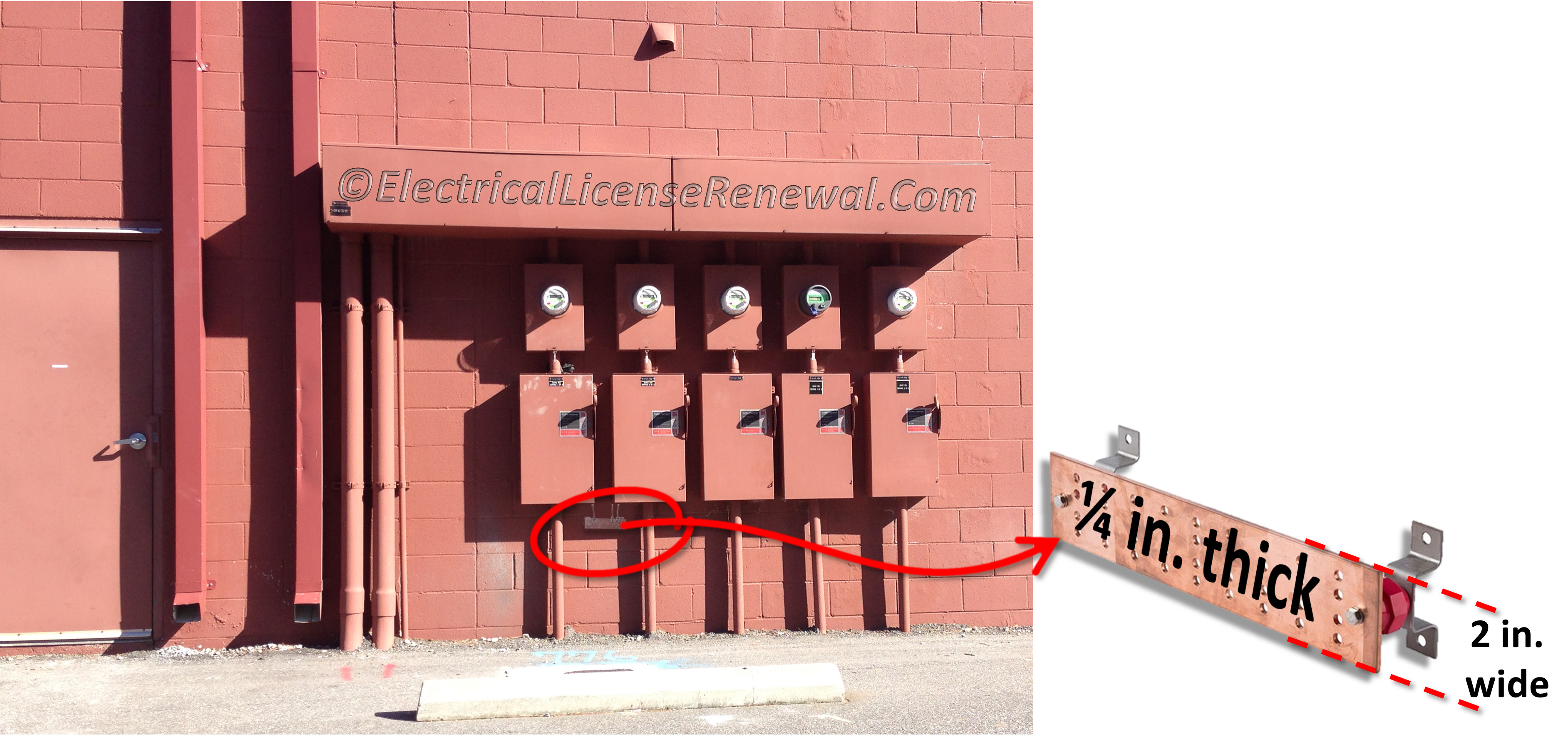
Code Change Summary: A clarification was made on the minimum dimensions of a busbar used to join a common grounding electrode conductor (GEC) to GEC taps when a building has more than one disconnecting means in a separate enclosure.
Not all disconnects for a building are required to be in the same distribution panel or enclosure. Many buildings have one common hot gutter that supplies several individual separate disconnect enclosures, grouped in one location.
For this type of installation, one grounding electrode system can be installed and shared by all of the separate service disconnect switches. One way to accomplish this is to use a single grounding electrode conductor, run from the grounding electrode system up to a common busbar of a certain dimension, and then individual GEC taps can be made from the busbar to each individual disconnecting means enclosure.
The prior code language required the GEC busbar to be at least ¼ in. X 2 in.
The new code language requires the GEC busbar to be at least ¼ in. thick X 2 in. wide and of sufficient length to accommodate the number of terminations needed for the installation. This eliminates the argument that a .25 in. X .25 in. X 2 in. wide busbar can be used to accomplish the same purpose.
Below is a preview of the NEC®. See the actual NEC® text at NFPA.ORG for the complete code section. Once there, click on the “free access” tab and select the applicable year of NFPA 70 (National Electrical code).
2011 Code Language:
250.64(D)(1) Common Grounding Electrode Conductor and Taps.
(3) Connections to an aluminum or copper busbar not less than 6 mm × 50 mm (1⁄4 in. × 2 in.). The busbar shall be securely fastened and shall be installed in an accessible location. Connections shall be made by a listed connector or by the exothermic welding process. If aluminum busbars are used, the installation shall comply with 250.64(A).
2014 Code Language:
250.64(D)(1) Common Grounding Electrode Conductor and Taps.
(3) Connections to an aluminum or copper busbar not less than 6 mm thick × 50 mm wide (1⁄4 in. thick × 2 in. wide) and of sufficient length to accommodate the number of terminations necessary for the installation. The busbar shall be securely fastened and shall be installed in an accessible location. Connections shall be made by a listed connector or by the exothermic welding process. If aluminum busbars are used, the installation shall comply with 250.64(A).