225.19 Clearances from Buildings for Conductors of Not over 1000 Volts, Nominal.
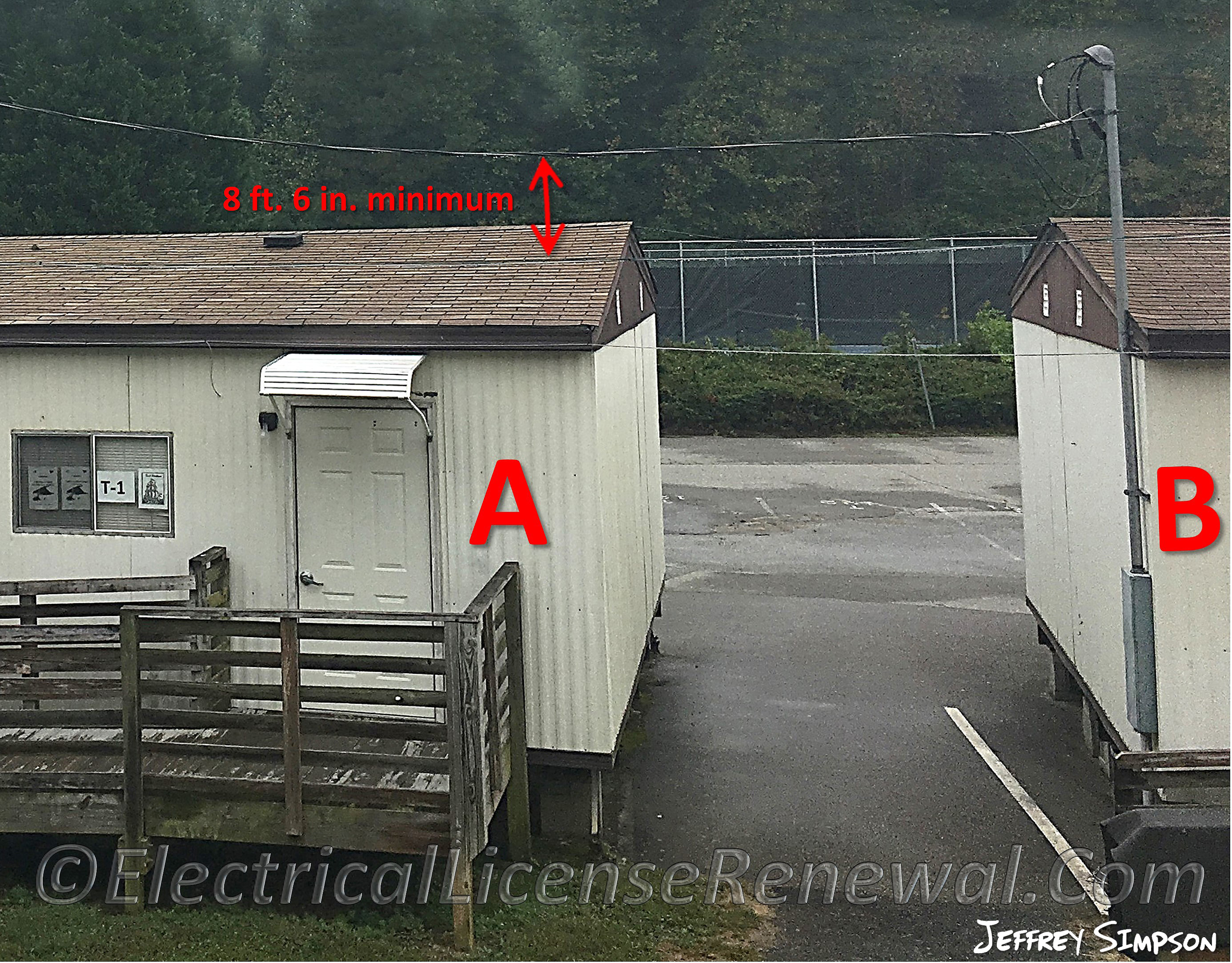
Code Change Summary: The minimum required distance for overhead feeders above a roof surface has been increased.
When supplying a building with electric power, downstream of the main electrical service, the most common installation is an underground feeder.
Once in a while, a building is supplied by an overhead feeder like in the image. For these rare occurrences, the NEC® provides minimum safe distances that the overhead feeder must be kept above a roof surface in the event that the feeder happens to cross over a building.
In the 2017 NEC® this minimum vertical distance for an overhead feeder above a roof surface has been increased from 8 ft. to 8 ft. 6 in.
Below is a preview of Article 225. See the actual NEC® text at NFPA.ORG for the complete code section. Once there, click on their link to free access to the 2017 NEC® edition of NFPA 70.
2014 Code Language:
225.19 Clearances from Buildings for Conductors of Not over 1000 Volts, Nominal.
(A) Above Roofs. Overhead spans of open conductors and open multiconductor cables shall have a vertical clearance of not less than 2.5 m (8 ft) above the roof surface. The vertical clearance above the roof level shall be maintained for a distance not less than 900 mm (3 ft) in all directions from the edge of the roof.
2017 Code Language:
225.19 Clearances from Buildings for Conductors of Not over 1000 Volts, Nominal.
(A) Above Roofs. Overhead spans of open conductors and open multiconductor cables shall have a vertical clearance of not less than 2.7 m (8 ft 6 in.) above the roof surface. The vertical clearance above the roof level shall be maintained for a distance not less than 900 mm (3 ft) in all directions from the edge of the roof.
