110.27(A) Live Parts Guarded Against Accidental Contact.
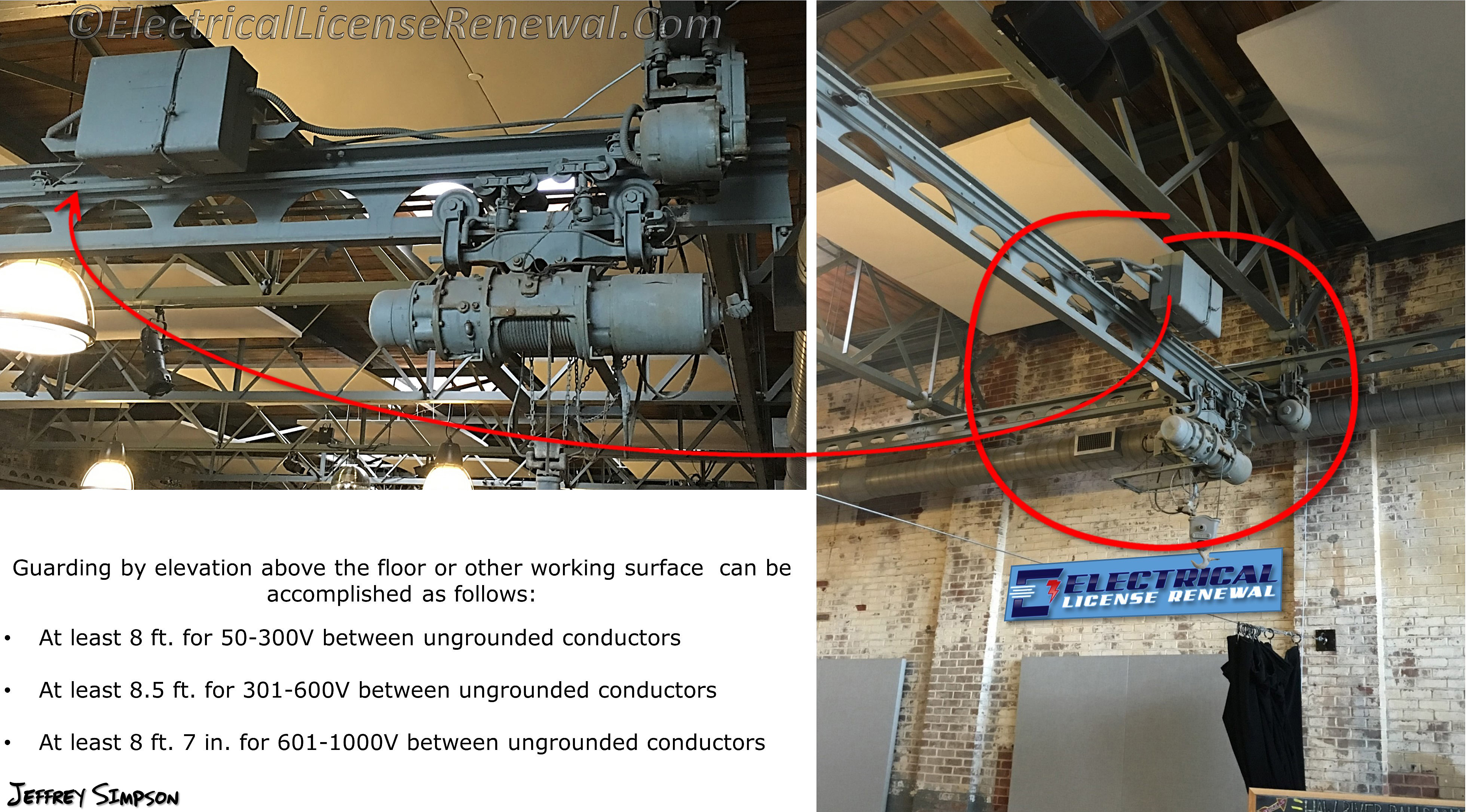
Code Change Summary: Measurements have been added to address guarding of live parts up to 1000 volts.
There are many ways that exposed live parts can be guarded from accidental contact.
The NEC® defines “exposed” and “live parts” as follows:
- Exposed (as applied to live parts). Capable of being inadvertently touched or approached nearer than a safe distance by a person.
- Live Parts. Energized conductive components.
Section 110.27 provides the following methods for the guarding of live parts:
- Guarding by using enclosures, rooms or vaults.
- Guarding by using partitions or screens.
- Guarding by locating equipment on balconies or elevated platforms.
- Guarding by specific dimensions above the floor or work surface based on voltage levels of the live parts.
In the 2017 NEC®, Item 4 above was modified to address live parts operating between 601 volts and 1000 volts. If item 4 above is used as a method to guard the live parts from accidental contact, then the live parts between 601 and 1000 volts must be at least 8 ft. 7 in. above floor.
Below is a preview of Article 110. See the actual NEC® text at NFPA.ORG for the complete code section. Once there, click on their link to free access to the 2017 NEC® edition of NFPA 70.
2014 Code Language:
110.27(A)(4) Live Parts Guarded Against Accidental Contact.
By elevation above the floor or other working surface as shown in 110.27(A)(4)(a) or (b) below:
a. A minimum of 2.5 m (8 ft) for 50 to 300 volts
b. A minimum of 2.6 m (8 ½ ft) for 301 to 600 volts.
2017 Code Language:
110.27(A)(4) Live Parts Guarded Against Accidental Contact.
By elevation above the floor or other working surface as follows:
a. A minimum of 2.5 m (8 ft) for 50 volts to 300 volts between ungrounded conductors
b. A minimum of 2.6 m (8 ft 6 in.) for 301 volts to 600 volts between ungrounded conductors
c. A minimum of 2.62 m (8 ft 7 in.) for 601 volts to 1000 volts between ungrounded conductors.
