270.24 Grounding Service-Supplied Alternating Current Systems.
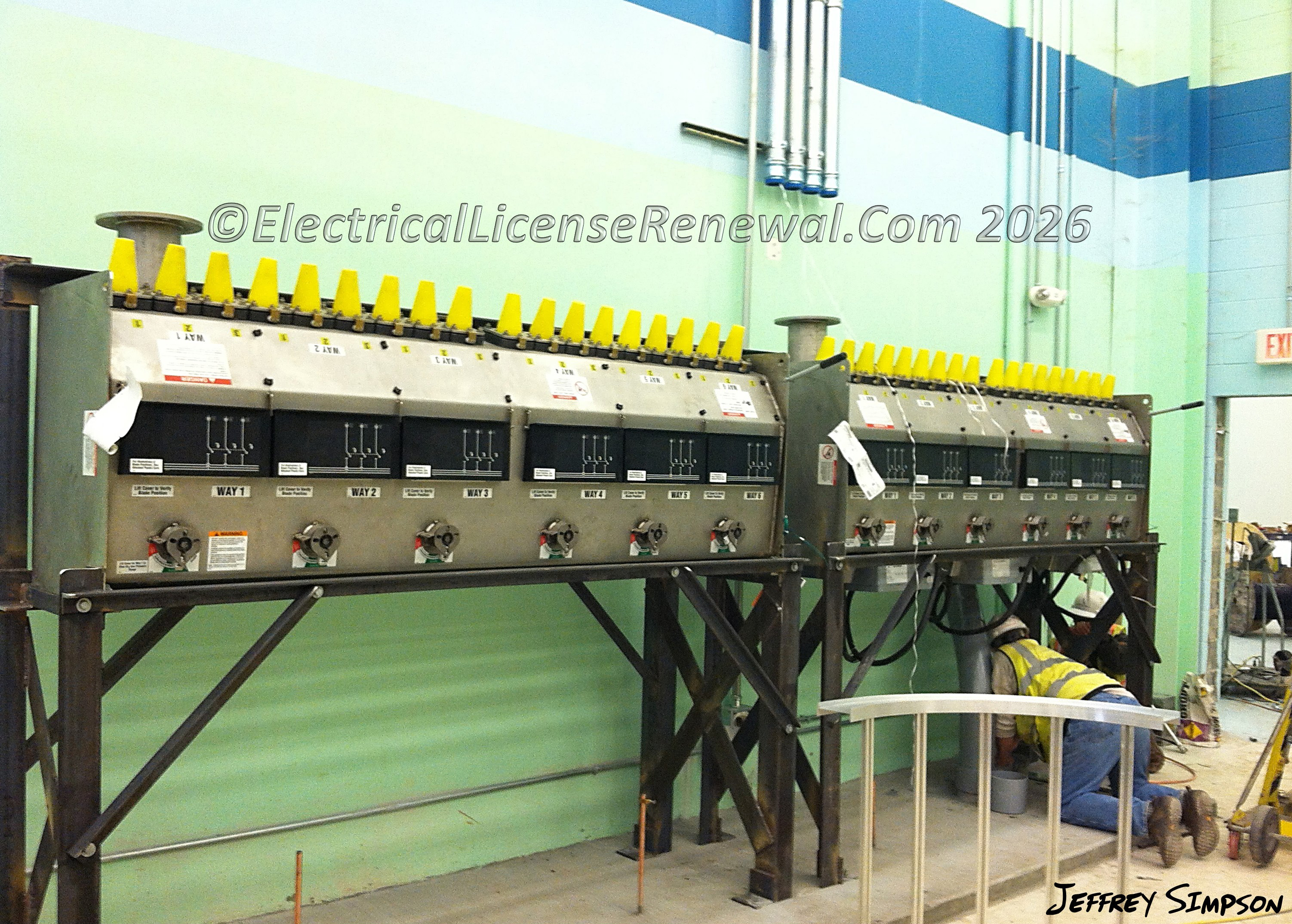
In this 2011 image, the 12,470-volt, fully submersible electric service was just set in place. This service only supplied 3-phase industrial loads that did not use a grounded neutral conductor. If installed according to the 2026 NEC, a grounded conductor would have been required to be run to the equipment.
Section 270.24 is located in Part II of Article 270 which applies to the grounding of systems and circuits over 1000 volts.
This section provides similar requirements to what is mentioned in section 250.24(D) for the grounding of electrical systems of 1000 volts or less. One rule in 270.24 requires a grounded neutral conductor to be run to the service disconnect for grounded electrical systems over 1000 volts, even if the electrical system has only three-phase loads that do not utilize a neutral conductor.
Often, the loads connected to higher voltage services will not even use a grounded neutral conductor. Consider a 12,470-volt electrical service at a wastewater treatment plant for example. Most of the loads connected to the electrical service will be three-phase motor loads that do not use a grounded neutral conductor. Why then would a grounded conductor need to be run to the service enclosure?
The grounded conductor provides a low impedance ground fault return path back to the utility transformer in the event of a phase-to-ground fault condition. This enables the overcurrent device ahead of the faulted circuit to trip.
Section 270.24(A) applies to grounded electrical systems over 1000 volts with a grounded conductor at the service point. If a grounded conductor for these systems is provided at the service point (usually by the utility company), then a grounded conductor must also be installed and routed with the ungrounded conductors to the grounded terminal bar in each service disconnect. From there, a main bonding jumper connects the grounded conductor terminal bar to the service disconnect enclosure.
Section 270.24(B) applies when an AC system operates over 1000 volts and is grounded at any point but is NOT provided with a grounded conductor at the service point. In this case, a supply side bonding jumper must be installed and routed with the ungrounded conductors to each service disconnect enclosure and connected to the equipment grounding conductor terminal.
Below is a preview of the NEC®. See the actual NEC® text at NFPA.ORG for the complete code section. Once there, click on their link to free access to NFPA 70.
2026 Code Language:
270.24 Grounding Service-Supplied Alternating-Current Systems.
(A) Systems with a Grounded Conductor at the Service Point. If an ac system is grounded at any point and provided with a grounded conductor at the service point, a grounded conductor(s) shall be installed and routed with the ungrounded conductors to each service disconnecting means and be connected to each disconnecting means grounded conductor(s) terminal or bus. A main bonding jumper shall connect the grounded conductor(s) to each service disconnecting means enclosure. The grounded conductor(s) shall be installed in accordance with 270.24(A)(1) through 270.24(A)(4). The size of the solidly grounded circuit conductor(s) shall be the larger of that determined by 270.27, 270.24(A)(1), or 270.24(A)(2).
(B) Systems Without a Grounded Conductor at the Service Point. If an ac system is grounded at any point and is not provided with a grounded conductor at the service point, a supply-side bonding jumper shall be installed and routed with the ungrounded conductors to each service disconnecting means and be connected to each disconnecting means equipment grounding conductor terminal or bus. The supply-side bonding jumper shall be installed in accordance with 270.24(B)(1) through 270.24(B)(3).
