620.16 Elevators. Short-Circuit Current Rating.
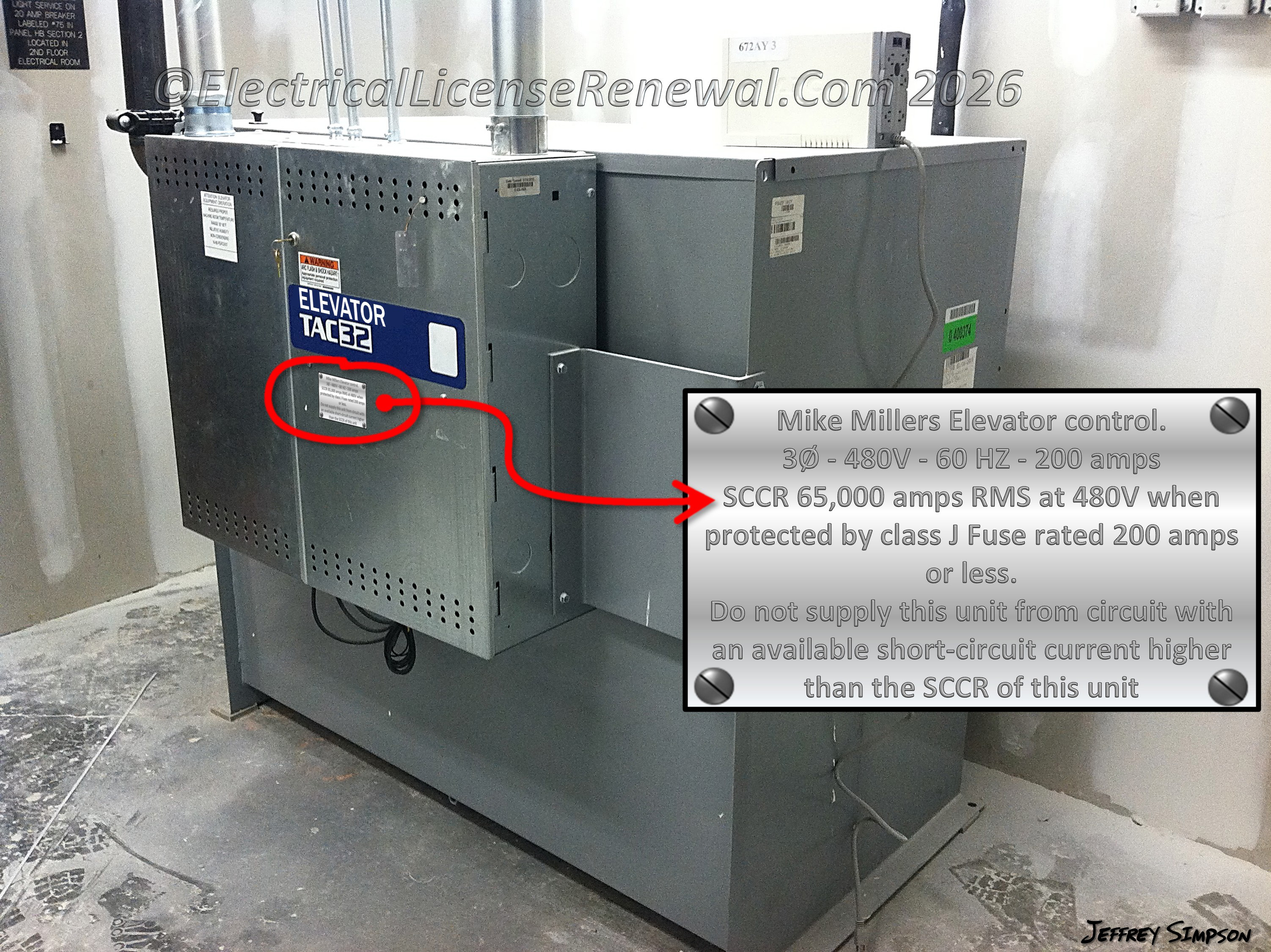
The elevator control panel shall not be installed where the available fault current exceeds its short-circuit current rating.
NEC Section 620.16(A) requires the short-circuit current rating (SCCR) to be marked on elevator control panels. There are two methods permitted in 620.16(A) for the required SCCR marking:
1. Use a listed and labeled elevator control panel assembly that will already be marked with the SCCR as part of the product listing requirement.
2. Determine the SCCR of the elevator control panel using an approved method and mark it on the control panel. NEC® Article 100 defines the term “Approved” as “Acceptable to the authority having jurisdiction” (the inspector).
The inspector may or may not want to be responsible for allowing item 2 above since it leaves liability in the hands of the inspection agency. The informational note mentions Supplement SB in UL 508A as one example of an “approved” method. The city inspector will generally not have a copy of the standard in order to know what Supplement SB actually says.
NEC Section 620.16(B) has similar language to what is found in 409.22 for industrial control panels. Elevator control panels shall not be installed where the available fault current exceeds the SCCR of the control panel, as marked in accordance with 620.16(A).
NEC 620.16(C) is new in 2026 and requires elevator control panels to be legibly marked in the field with the available fault current at their line terminals. The field marking shall include the date the available fault current calculation was performed and shall meet the requirements of 110.21(B). The calculation shall be documented and made available to those authorized to design, install, inspect, maintain, or operate the system.
Additionally, when modifications to the electrical system occur that affect the available fault current at the elevator control panel, the available fault current shall be verified or recalculated as necessary to ensure the elevator control panel’s short-circuit current rating is sufficient for the available fault current at the line terminals of the equipment. The required field marking shall be adjusted to reflect the new level of available fault current.
See the actual NEC® text at NFPA.ORG for the complete code section. Once there, click on the “free access” tab and select the applicable year of NFPA 70 (National Electrical code).
2026 Code Language:
620.16 Short-Circuit Current Rating.
(A) Marking. Where an elevator control panel is installed, it shall be marked with its short-circuit current rating, based on one of the following:
(1) Short-circuit current rating of a listed assembly
(2) Short-circuit current rating established utilizing an approved method
Informational Note: UL 508A-2013, Standard for Industrial Control Panels, Supplement SB, is an example of an approved method.
(B) Installation. The elevator control panel shall not be installed where the available fault current exceeds its short-circuit current rating, as marked in accordance with 620.16(A).
(C) Available Fault Current Field Marking. The elevator control panel shall be legibly marked in the field with the available fault current at its line terminals. The field marking(s) shall include the date the available fault current calculation was performed and shall meet the requirements of 110.21(B). The calculation shall be documented and made available to those authorized to design, install, inspect, maintain, or operate the system.
When modifications to the electrical system occur that affect the available fault current at the elevator control panel, the available fault current shall be verified or recalculated as necessary to ensure the elevator control panel’s short-circuit current rating is sufficient for the available fault current at the line terminals of the equipment. The required field marking(s) shall be adjusted to reflect the new level of available fault current.
