240.86(C) Series Ratings. Motor Contribution Exercise 1.
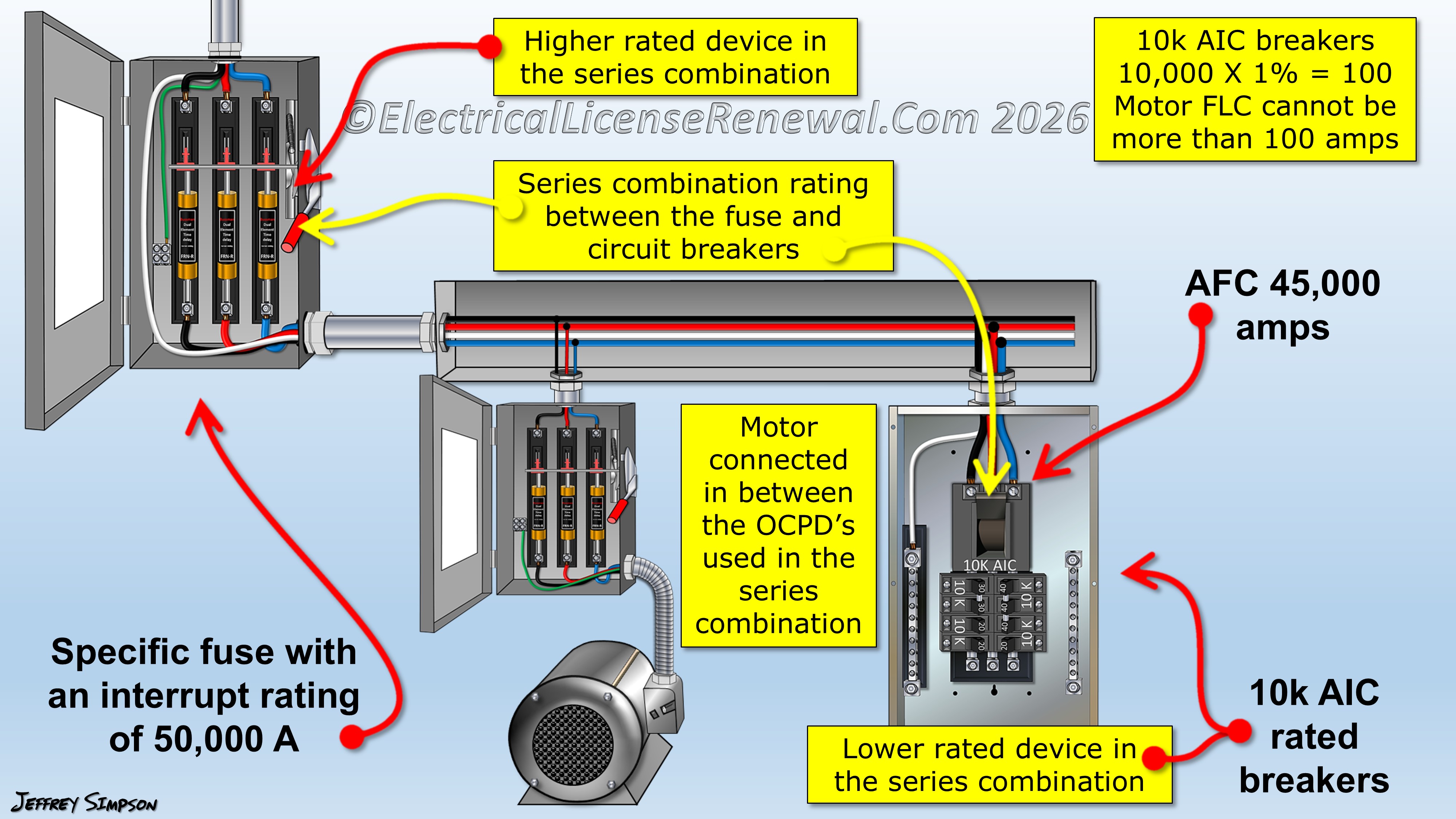
In order to use a series combination here, since the motor is connected between the devices that are part of the series combination, the motor full load current would not be able to exceed 1% of the AIC rating of the 10k breakers.
When deciding to go with a series rated combination over a fully rated system, motor contribution needs to be considered if motors are located in specific locations relative to the overcurrent devices that are part of a series combination.
The reason: If a fault occurs such as a short-circuit, running motors can momentarily contribute current to the short-circuit condition (four to six times the motor full load current rating).
The additional motor contribution can result in a short-circuit current exceeding what the load side (protected) circuit breaker was tested to handle during the series rated combination testing.
NEC 240.86(C) does not allow a series rated system to be used if motors are connected between overcurrent devices used in a series combination where the sum of all motor full load current (FLC) exceeds 1% of the interrupting rating (AIC rating) of the lowest rated circuit breaker in the series combination.
See the actual NEC® text at NFPA.ORG for the complete code section. Once there, click on the “free access” tab and select the applicable year of NFPA 70 (National Electrical code).
2026 Code Language:
240.86(C) Motor Contribution. Series ratings shall not be used in the following situations:
(1) Where motor circuits are connected between the higher-rated OCPD of a series-rated combination and on the lower-rated circuit breaker, and
(2) Where the sum of these motor full-load currents exceeds 1 percent of the interrupting rating of the lower-rated circuit breaker.
