Available Fault Current and Equipment Selection.
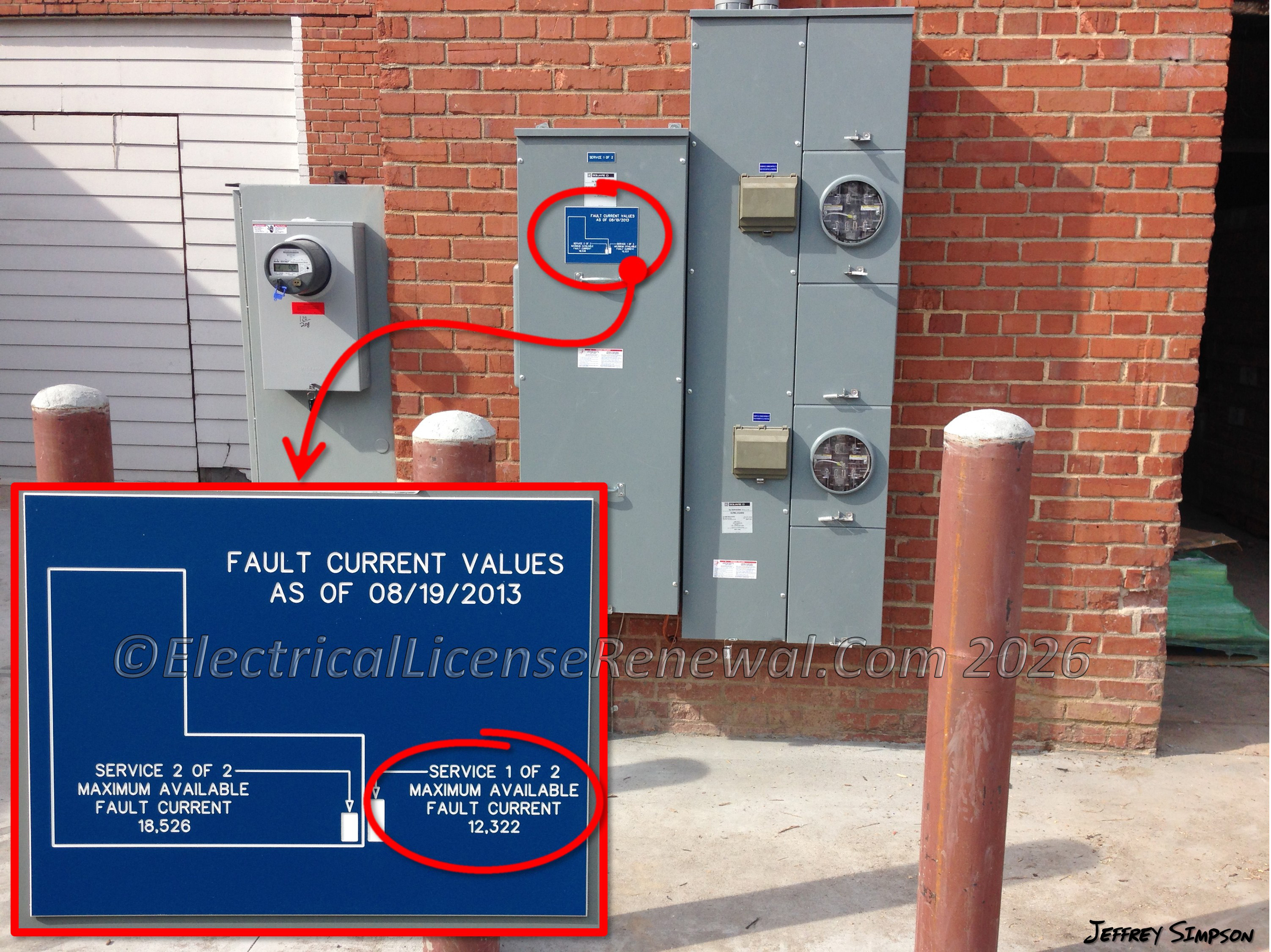
Available Fault Current values at the service equipment can be obtained from the electric utility company.
There has been ongoing confusion surrounding the term “Available Fault Current” (AFC) since it was introduced in the 2011 NEC® through Section 110.24. This section requires service equipment, other than dwelling units, to be marked with the maximum available fault current and the date the calculation was performed.
This marking provides the installer with a usable value when selecting equipment that must comply with other NEC® requirements, such as 110.9 and 110.10, which address interrupting ratings and circuit protection. Without this information, proper equipment selection becomes more difficult and can lead to installations that are not adequately protected.
Available fault current is also commonly referred to as available short-circuit current (ISC).
The terms “fault current” and “available fault current” are defined in Article 100 as follows:
Fault Current. The current delivered at a point on the system during a short-circuit condition.
Fault Current, Available (Available Fault Current). The largest amount of current capable of being delivered at a point on the system during a short-circuit condition.
Service equipment is required to be protected against overcurrent conditions through the use of overcurrent protective devices (OCPDs), such as fuses and circuit breakers. These devices are designed to interrupt fault current, but they do so at different speeds depending on the magnitude of the fault.
With thermal-magnetic circuit breakers, higher levels of fault current will cause the magnetic portion of the breaker to operate almost instantaneously, rapidly opening the circuit. Lower levels of overcurrent rely on the thermal portion, which responds more slowly as heat builds within the device. This relationship between fault magnitude and clearing time is critical when considering how effectively a device will protect equipment.
Some OCPDs are specifically listed as “current-limiting.” To qualify for this listing, the device must interrupt the fault within the first half-cycle of the waveform. This prevents the fault current from reaching its maximum available value. Other OCPDs may operate quickly, but not fast enough to limit the peak fault current seen at the equipment terminals.
When utility transformers are located close to the service equipment, the available fault current is typically higher. As the distance between the transformer and the service increases, impedance in the conductors reduces the available fault current. This relationship is based on fundamental electrical principles, including resistance and impedance, and is an important consideration when evaluating real-world installations.
