760.41(B) NPLFA Circuit Power Source Branch Circuit.
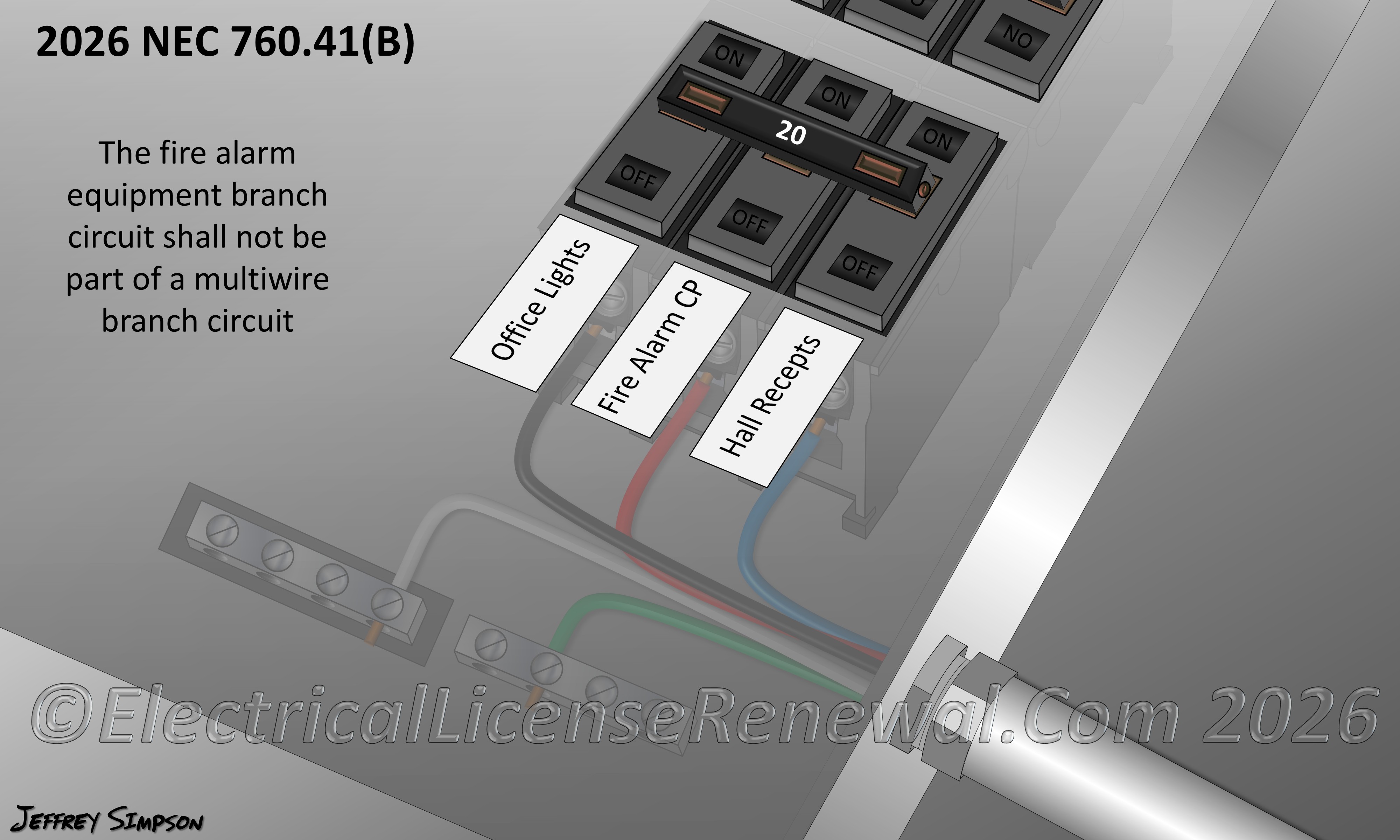
The fire alarm equipment branch circuit shall not be part of a multiwire branch circuit.
Code Change Summary: Section 760.41(B) was revised to prohibit supplying fire alarm equipment from a multiwire branch circuit.
SME commentary: The 2026 NEC® revision to 760.41(B) addresses an installation practice that has created reliability and operational concerns for fire alarm systems. While prior NEC® editions already required that the branch circuit supplying fire alarm equipment “shall supply no other loads,” the revised language closes a loophole that allowed installers to technically comply while still placing fire alarm equipment on a multiwire branch circuit shared with unrelated loads. The added clarification in the 2026 NEC® states that the fire alarm branch circuit “shall not be part of a multiwire branch circuit” which removes ambiguity and reinforces the intent of an independent, uninterrupted power source.
Without any previous restriction on multiwire branch circuits, many fire alarm control panels (FACP) have frequently been supplied from multiwire branch circuits that also serve lighting, receptacles, or other utilization equipment, particularly in the same room or electrical space as the FACP. Although these installations may appear economical or convenient, they defeat the functional purpose of a dedicated fire alarm circuit. A fault, overload, or maintenance activity on the non-fire-alarm portion of the multiwire branch circuit can directly affect the fire alarm system, even when the fire alarm conductors themselves are intact.
Multiwire branch circuits commonly incorporate common-trip circuit breakers or handle ties. Under these conditions, a fault on a lighting or receptacle circuit can cause the shared overcurrent device to open all ungrounded conductors simultaneously. When the fire alarm circuit is part of that arrangement, the fire alarm control unit becomes deenergized, often without any issue originating in the fire alarm system itself. The revision eliminates this scenario by ensuring that fire alarm equipment is not exposed to disconnection events driven by unrelated loads.
The change also improves operational control during maintenance and troubleshooting. Fire alarm circuits are required to have a circuit disconnecting means with red identification, accessible only to qualified personnel, and clearly marked “FIRE ALARM CIRCUIT.” Requiring that disconnect to control only the fire alarm circuit ensures that service work on adjacent systems does not require disabling the fire alarm system, and conversely, that fire alarm service does not interrupt other building loads. This separation supports both life safety continuity and practical field operations.
Importantly, the revision does not alter existing prohibitions on supplying fire alarm branch circuits through ground-fault circuit interrupters or arc-fault circuit interrupters. Instead, it strengthens the overall reliability of the power source by addressing a configuration that could bypass the intent of those protections through shared circuit arrangements. For installers and inspectors, this change provides a clear enforcement line by removing subjective interpretation and confirming that a fire alarm branch circuit must remain electrically independent from any shared neutral or common disconnecting means.
Below is a preview of the NEC®. See the actual NEC® text at NFPA.ORG for the complete code section. Once there, click on their link to free access to the 2026 NEC® edition of NFPA 70.
2023 Code Language:
760.41(B) Branch Circuit. The branch circuit supplying the fire alarm equipment(s) shall supply no other loads. The location of the branch-circuit overcurrent protective device shall be permanently identified at the fire alarm control unit. The circuit disconnecting means shall have red identification, shall be accessible only to qualified personnel, and shall be identified as “FIRE ALARM CIRCUIT.” The red identification shall not damage the overcurrent protective devices or obscure the manufacturer's markings. This branch circuit shall not be supplied through ground-fault circuit interrupters or arc-fault circuit-interrupters.
2026 Code Language:
760.41(B) Branch Circuit. The branch circuit supplying the fire alarm equipment(s) shall supply no other loads. The location of the branch-circuit OCPD shall be permanently identified at the fire alarm control unit. The circuit disconnecting means shall have red identification, shall be accessible only to qualified personnel, and shall be identified as “FIRE ALARM CIRCUIT.” The red identification shall not damage the OCPDs or obscure the manufacturer’s markings. This branch circuit shall not be part of a multiwire branch circuit and shall not be supplied through ground-fault circuit interrupters or arc-fault circuit-interrupters.
