706.15(B) ESS Disconnecting Means Location and Control.
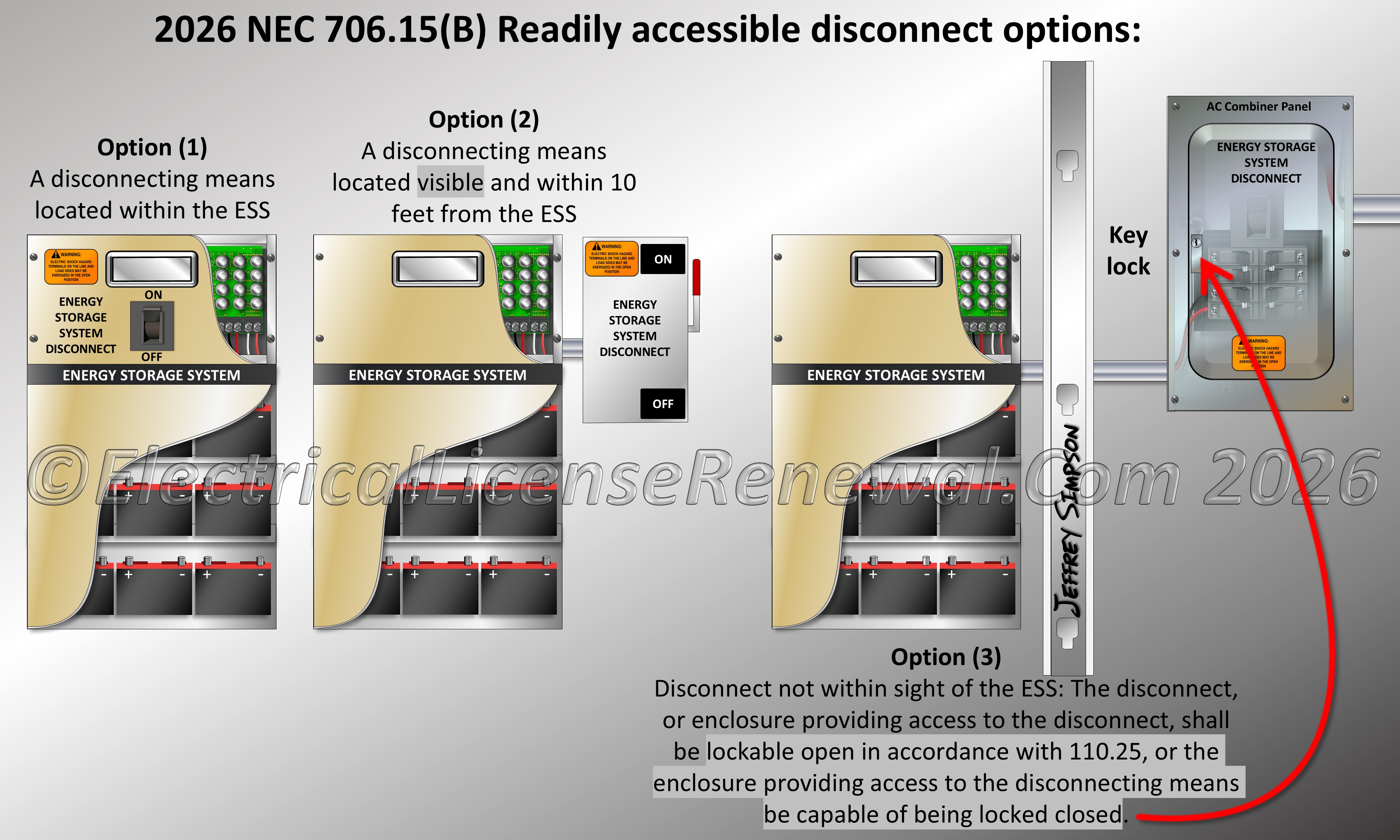
Switching the breaker off and locking the panel cover satisfies the requirement in 706.15(B)(3).
Code Change Summary: Section 706.15(B) was revised to clarify visibility requirements for ESS disconnecting means and to distinguish between locking the disconnect in the open position and locking the enclosure to prevent unauthorized access to the disconnecting means.
SME commentary: The 2026 NEC® revisions to Section 706.15(B) refine both the placement requirements and the locking concepts associated with energy storage system (ESS) disconnecting means. These changes are primarily clarifying in nature, but they resolve several points of confusion that had developed under prior language and improve alignment with general NEC® principles governing disconnecting means.
One significant 2026 revision replaces the phrase “within sight” with the term “visible” in 706.15(B)(2). Under the previous NEC®, the disconnecting means was required to be “within sight and within 10 feet from the ESS,” a phrase that conflicted with established NEC® definitions. Section 110.29 makes it clear that “within sight” means visible and not more than 50 feet from the equipment. This created an internal inconsistency by pairing a term that implies a 50-foot allowance with a separate 10-foot distance limitation. By using the word “visible” instead of “within sight,” the 2026 language in 706.15(B)(2) eliminates that conflict and makes it clear that the ESS disconnecting means must be “visible and within 10 feet from the ESS” when this option is used. An informational note was added to reference Article 100 and 90.4(C), recognizing that Special Permission from the authority having jurisdiction may be considered where strict application of the 10-foot limitation is impractical.
Another important clarification appears in 706.15(B)(3), which now clearly distinguishes between the disconnecting mechanism itself and the enclosure that houses it. The revised language recognizes two different compliance paths for this option. The disconnecting means must either “be lockable open in accordance with 110.25, or the enclosure providing access to the disconnecting means be capable of being locked closed” (locked shut).
This distinction helps avoid misinterpretation where the requirement in 110.25 to lock a disconnecting means in the open, or off position can get confusing with some enclosure-based disconnect designs. Some disconnecting means are constructed such that access to the operating handle or switching mechanism requires opening a hinged cover or door, rather than having a permanently exposed external handle as found on typical general-duty safety switches.
In these designs, the act of opening the enclosure is necessary to access and operate the disconnect. The revised language in 706.15(B)(3) recognizes that, once the disconnect has been opened (switched off), locking the enclosure shut prevents the disconnecting means from being accessed and re-energized while work is being performed. This provides an equivalent level of control by ensuring that the switching mechanism cannot be accessed without removing the lock.
Section 110.25 applies only to the requirement for a disconnecting means to be capable of being locked in the open position when such locking is required by the Code. It does not address disconnecting means designs where enclosure access is integral to operating the switch. By explicitly permitting either a lockable-open disconnecting means or a disconnect enclosure capable of being locked shut, 706.15(B)(3) accommodates different equipment designs while preserving the intent of maintaining control of the disconnecting means during servicing.
These clarifications reduce ambiguity in both disconnect placement, and locking compliance. Visibility is no longer tied to the broader “within sight” language, and locking requirements are clearly distinguished between disconnect operation and enclosure access control.
Below is a preview of the NEC®. See the actual NEC® text at NFPA.ORG for the complete code section. Once there, click on their link to free access to the 2026 NEC® edition of NFPA 70.
2023 Code Language:
706.15(B) Location and Control. The disconnecting means shall be readily accessible and shall comply with one or more of the following:
(1) Located within the ESS
(2) Located within sight and within 10 feet from the ESS
(3) Where not located within sight of the ESS, the disconnecting means, or the enclosure providing access to the disconnecting means, shall be capable of being locked in accordance with 110.25
2026 Code Language:
706.15(B) Location and Control. The disconnecting means shall be readily accessible and comply with one or more of the following:
(1) Be located within the ESS
(2) Be located visible and within 10 feet from the ESS
Informational Note: See Article 100 and 90.4(C) for information on special permission.
(3) Be lockable open in accordance with 110.25, or the enclosure providing access to the disconnecting means be capable of being locked closed.
