705.32 Ground-Fault Protection.
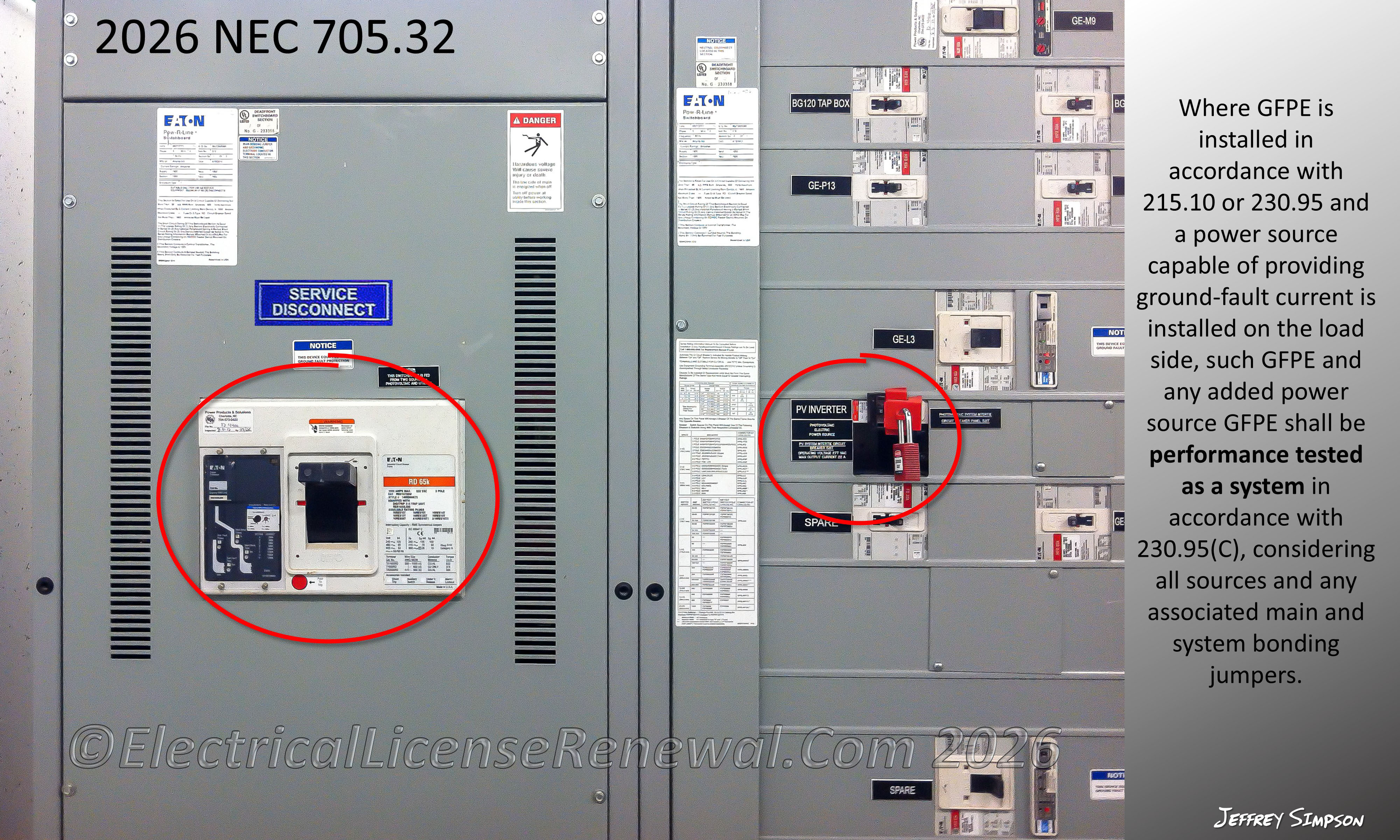
Where GFPE is installed in accordance with 215.10 or 230.95 and a power source capable of providing ground-fault current is installed on the load side, such GFPE and any added power source GFPE shall be performance tested as a system in accordance with 230.95(C), considering all sources and any associated main and system bonding jumpers.
Code Change Summary: Section 705.32 was revised to focus on the performance of any installed GFPE rather than where a power production source is interconnected.
SME commentary: The 2026 NEC® revision to Section 705.32 refocuses this requirement on its core purpose, ensuring that ground-fault protection of equipment (GFPE) operates correctly when interconnected power sources are installed on the load side of the service disconnect. The change addresses a growing mismatch between traditional ground-fault protection assumptions and modern electrical systems that incorporate distributed energy resources such as photovoltaic systems, energy storage systems, and other power production equipment installed under Article 705.
For years, Section 705.32 simply required that if GFPE was present as required elsewhere in the NEC®, the backfed point of interconnection of a PV system or other interconnected power production equipment was to be made on the supply side of the GFPE. An exception permitted a load side connection downstream of the existing GFPE as long as ground-fault protection for equipment was provided for all ground-fault current sources.
The growing use of load-side interconnected power production sources power permitted by 705.12 introduces scenarios where power production equipment such as a PV system can also potentially contribute ground-fault current back into the system. This backfeed can interfere with the sensing and operation of existing GFPE equipment.
The revised language in 2026 NEC® 705.32 removes the prior connection-based prescriptive approach and replaces it with a performance-based requirement. Where ground-fault protection of equipment is installed in accordance with 215.10 or 230.95 and a power source capable of providing ground-fault current is installed on the load side, such GFPE and any added power source GFPE shall be performance tested as a system in accordance with 230.95(C), considering all sources and any associated main and system bonding jumpers.
The requirement for performance testing recognizes that adding an interconnected power source can alter current paths, neutral loading, and sensing relationships that the existing GFPE was not originally designed and performance tested to accommodate. Performance testing all installed GFPE together as a system under 230.95(C) confirms that the protection scheme responds correctly with all contributing power sources present, including during simulated or actual fault conditions, rather than relying solely on design assumptions.
The new informational note brings attention to practical design considerations, including current sensor placement, neutral-to-ground bonding location, and the recognition that even ungrounded inverter-based sources can contribute current to a ground fault. Collectively, these revisions align Section 705.32 with real-world system behavior and provide clearer direction for designers, installers, and inspectors tasked with integrating power production equipment into grounded electrical systems without compromising ground-fault protection performance.
Note: Because Section 705.32 applies only to power sources capable of sourcing ground-fault current, its applicability depends on how the interconnected power source is grounded and how it behaves during a ground fault, not simply on the presence of inverter-based equipment in the system design.
In general, 705.32 will apply where a load-side interconnected power source establishes or relies on a grounded reference capable of sustaining ground-fault current. Common examples include systems with a solidly grounded wye output, inverter systems with a grounded neutral, or installations that use grounding transformers or similar means that create a low-impedance path to ground. These configurations can drive fault current into the grounding and bonding system and affect the operation of ground-fault protection of equipment.
By contrast, 705.32 will typically not apply to ungrounded or floating inverter outputs, transformerless inverters, or most functionally grounded PV systems, where grounding is provided for reference or detection purposes and does not establish a low-impedance fault-current path. In these installations, a line-to-ground fault does not result in sustained ground-fault current, and the power source does not materially affect ground-fault protection performance.
For installers and inspectors, the practical question is whether the interconnected power source can actively feed a ground fault through an intentional reference to ground. If it can, performance testing of ground-fault protection as a system is required by 705.32. If it cannot, the section does not apply.
Below is a preview of the NEC®. See the actual NEC® text at NFPA.ORG for the complete code section. Once there, click on their link to free access to the 2026 NEC® edition of NFPA 70.
2023 Code Language:
705.32 Ground-Fault Protection. Where ground-fault protection of equipment is installed in ac circuits as required elsewhere in this Code, the output of interconnected power production equipment shall be connected to the supply side of the ground-fault protection equipment.
Exception: Connection of power production equipment shall be permitted to be made to the load side of ground-fault protection equipment where installed in accordance with 705.11 or where there is ground-fault protection for equipment from all ground-fault current sources.
2026 Code Language:
705.32 Ground-Fault Protection of Equipment. Where ground-fault protection of equipment is installed in accordance with 230.95 or 215.10 and a power source capable of providing ground-fault current is installed on the load side, such ground-fault protection of equipment and any added power source ground-fault protection of equipment shall be performance tested as a system in accordance with 230.95(C), considering all sources and any associated main and system bonding jumpers.
Informational Note: Current-carrying neutral conductors from power sources connected on the load side of ground-fault protection can result in the over-sensitization or de-sensitization of ground-fault protection due to circulating neutral currents. Common measures used to prevent this are alternative ground-fault current sensor placements, proper location of neutral-to-ground bonding, and power source tripping functions provided by the ground-fault protection scheme.
