705.13 Power Control Systems (PCSs).
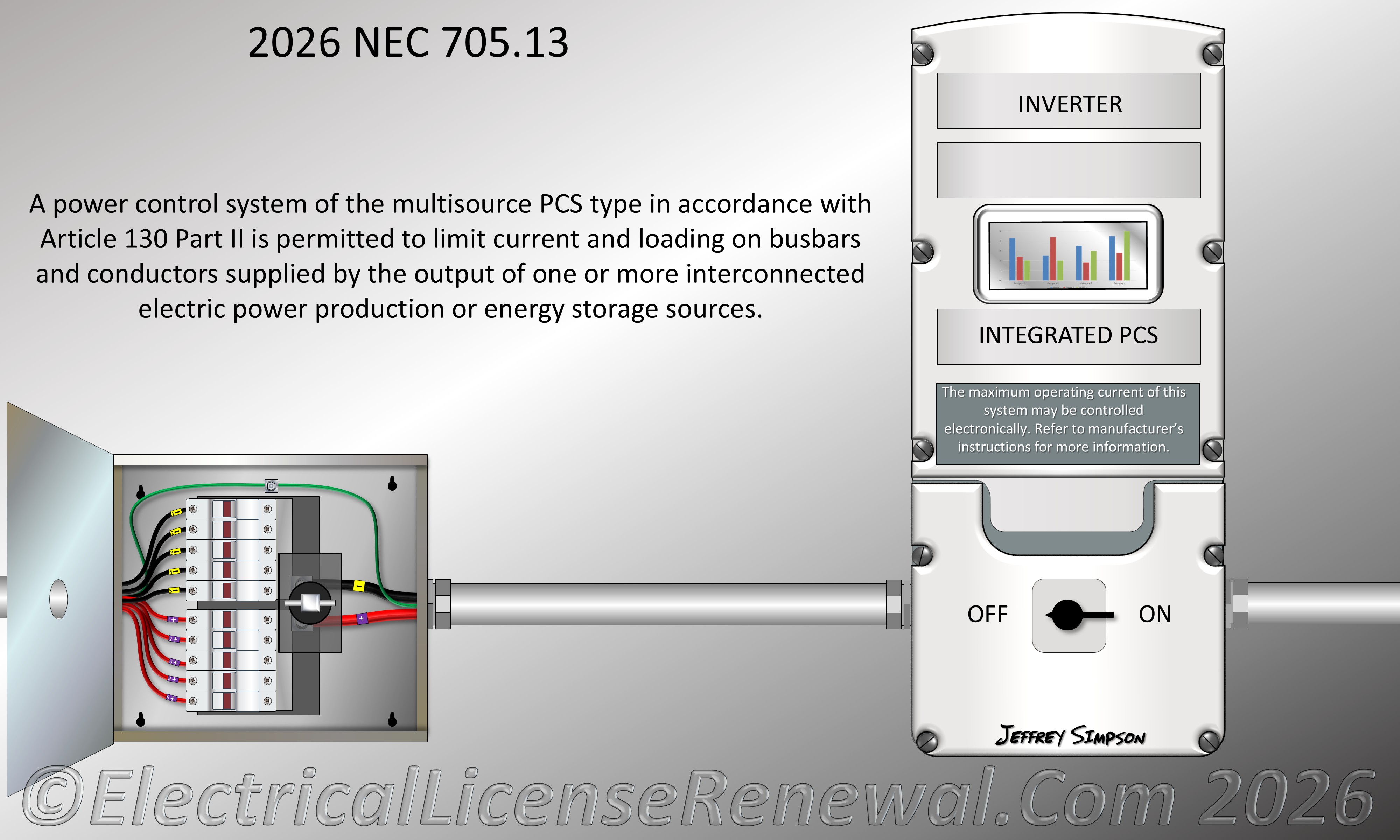
A multisource PCS limits current and loading from multiple interconnected power sources.
Code Change Summary: Section 705.13 was revised to restore the correct focus on Power Control Systems, clarify their role relative to energy management systems, and update informational notes to reference the appropriate UL standards.
SME commentary: An energy management system (EMS) monitors and controls power within an electrical system, typically for purposes that are not primarily safety related. These systems may be intended to reduce energy consumption, lower operating costs, improve occupant comfort, or shift loads away from peak demand periods. Energy management systems are commonly used in both residential and industrial applications and are generally focused on optimization rather than protection of the electrical distribution system.
A power control system (PCS), by contrast, is a specific subset of an EMS that performs an active safety function. A PCS monitors and controls power within a system specifically to prevent overload of the service, conductors, or power distribution equipment. Unlike general EMS equipment, a PCS is designed to actively limit or control current or power in response to system conditions. Its purpose is system-level overload prevention, particularly where traditional overcurrent devices alone may not be sufficient. Power control systems regulate the output of one or more power production sources, such as photovoltaic systems, energy storage systems, and electric vehicle supply equipment, to maintain operation within defined electrical limits.
The following revised language in Section 705.13 reinforces this distinction by clearly tying the code requirements to multisource PCS equipment evaluated for that purpose: Power control systems of the multisource PCS type in accordance with Article 130 Part II shall be permitted to limit current and loading on busbars and conductors supplied by the output of one or more interconnected electric power production or energy storage sources.
To support this clarification, the 2026 NEC® updates the informational notes associated with Section 705.13. Informational Note No. 1 now references UL 3141, Outline of Investigation for Power Control Systems, along with UL 1741. UL 3141 describes how PCS equipment is evaluated when used to control power for overload prevention, while UL 1741 remains relevant for inverters, converters, controllers, and interconnection system equipment used with distributed energy resources. Together, these references help distinguish PCS products from general energy management equipment that is not intended to perform a safety related control function.
Informational Note No. 2 further reminds users that bidirectional power sources can act as either a load or a source depending on operating conditions. This distinction is particularly important in systems with interconnected production and storage, where power flow direction may change during normal operation.
These 2026 revisions to Section 705.13 provide clearer boundaries between optimization equipment and safety related control systems. By correcting the terminology, restoring focus to PCS, and pointing users to the appropriate product standards, the NEC® improves consistency in application and helps avoid misusing general energy management equipment in roles it was never intended to fill.
Below is a preview of the NEC®. See the actual NEC® text at NFPA.ORG for the complete code section. Once there, click on their link to free access to the 2026 NEC® edition of NFPA 70.
2023 Code Language:
705.13 Energy Management Systems (EMS). An EMS in accordance with 750.30 shall be permitted to limit current and loading on the busbars and conductors supplied by the output of one or more interconnected electric power production or energy storage sources.
Informational Note: A listed power control system (PCS) is a type of EMS that is capable of monitoring multiple power sources and controlling the current on busbars and conductors to prevent overloading. See UL 1741, Inverters, Converters, Controllers and Interconnection System Equipment for Use with Distributed Energy Resources, and UL 916, Energy Management Equipment, for information on PCS and EMS.
2026 Code Language:
705.13 Power Control Systems (PCSs). Power control systems (PCSs) of the multisource PCS type in accordance with Article 130 Part II shall be permitted to limit current and loading on busbars and conductors supplied by the output of one or more interconnected electric power production or energy storage sources.
Informational Note No. 1: See UL 3141-2024, Outline of Investigation for Power Control Systems, and UL 1741, Inverters, Converters, Controllers and Interconnection System Equipment for Use with Distributed Energy Resources, for information on PCSs. A listed PCS is a type of EMS that is capable of monitoring multiple power sources and controlling the current on busbars and conductors to prevent overloading. A multisource PCS might include a connection to an electric power production and distribution network.
Informational Note No. 2: See 120.7 and 705.28(A) for more information. Bidirectional power production sources act as a load and a source depending on their operational state.
