705.11 Source Connections to a Service.
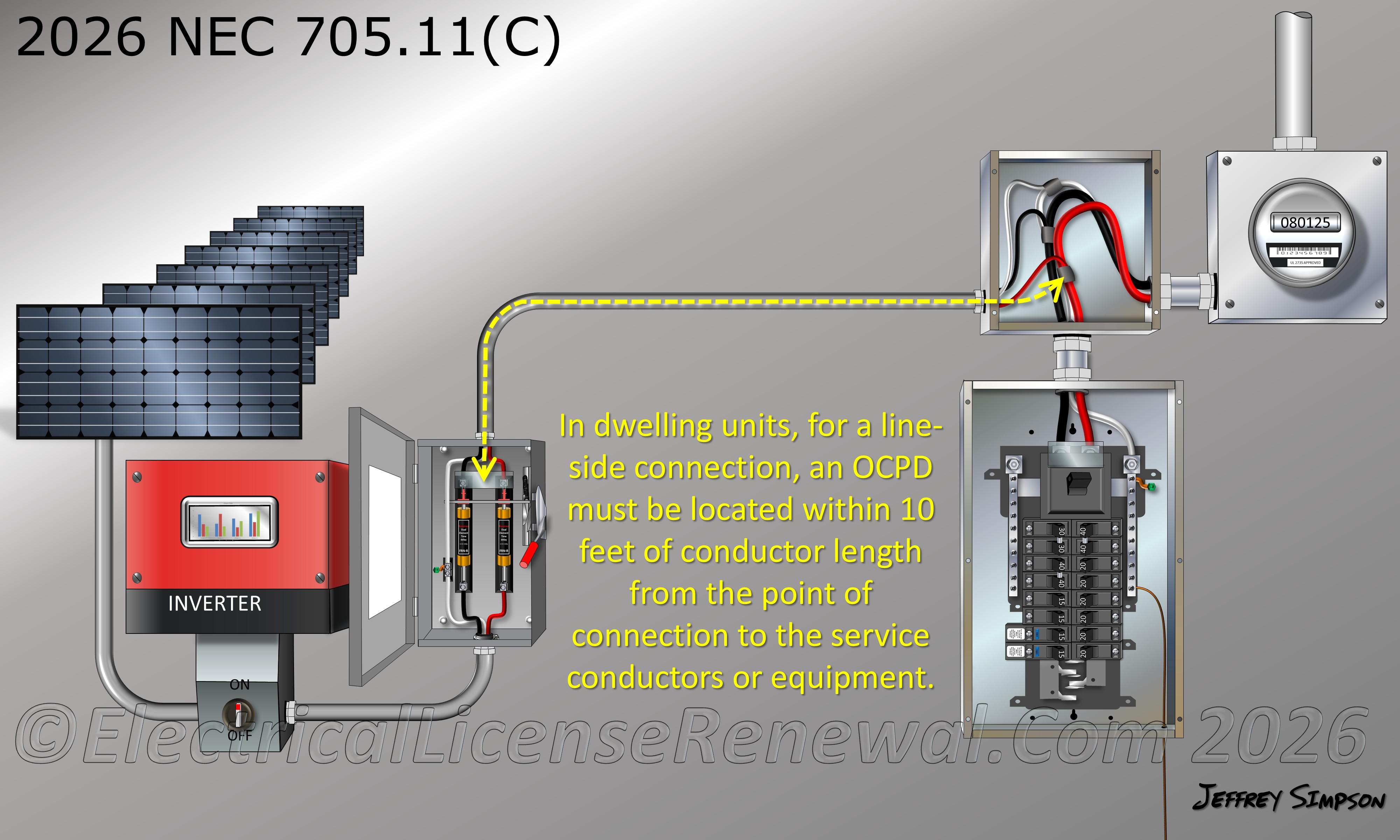
Clear measurements were brought back in the 2026 NEC.
Code Change Summary: Section 705.11 was revised to remove redundant language, tighten references, and better align service conductor connection requirements with the NEC’s overall structure.
SME commentary: The 2026 NEC® revisions to Section 705.11 continue the broader effort to clean up the line-side connection rules by removing language that simply repeated requirements already found elsewhere in the Code. Much of the prior text restated general rules from Chapters 1 through 4, which already apply unless specifically modified by another article. Rather than improving clarity, that repetition often created circular references and added confusion about which requirements were actually unique to power source connections ahead of a service disconnect.
One of the more noticeable updates appears in 705.11(B), which was retitled Service Conductors Connected to Power Sources. The revised title more accurately reflects what the subsection addresses and removes the unnecessary use of the word “production” from the term “power production source.” Several smaller edits were also made in this subsection to improve clarity and consistency. For example, the phrase “the sum of” was removed from 705.11(B)(1) because the requirement is already established in 705.28(A). References were adjusted and duplicated language removed to avoid restating the same requirements multiple times in different locations of the NEC®.
A larger structural change occurred by deleting the previous language in 705.11(C), (D), and (E) since it was basically a repeat of existing requirements already found in the first four NEC® chapters. Section 705.11(C) now focuses on overcurrent protection.
The revised provisions in 705.11(C)(1) through (C)(3) address previous confusion regarding how far unprotected power source service conductors are permitted to run inside buildings. Distance limits were previously specified in the NEC® but removed in 2023 without sufficient technical substantiation. In the 2026 NEC®, clear distance measurements are now provided once again, with new options added for installations under engineering supervision:
(1) In dwelling units, an OCPD must be located within 10 feet of conductor length from the point of connection to the service conductors or equipment.
(2) In other than dwelling units, an OCPD must be located within 16.5 feet of conductor length from the point of connection to the service conductors or equipment.
(3) Under engineering supervision for services not over 1000 volts ac, in other than dwelling units in accordance with the following:
a. With one cable limiter per ungrounded conductor, located within switchgear or similar enclosures, and within 16.5 feet of conductor length from the point of connection to service conductors or equipment.
b. With an OCPD located within 66 feet of conductor length from the point of connection to service conductors or equipment.
These distances reflect practical field experience and common equipment layouts, rather than leaving installers to interpret vague references elsewhere in the Code. The accompanying informational note reinforces that these limits are intended to provide practical guidance, not arbitrary restrictions.
The 2026 revisions to 705.11 intend to reduce unnecessary duplication, clarify where specific requirements actually belong, and make the section easier to apply to line-side connections in real installations. By relying on the NEC’s existing structure instead of repeating it, the Code provides clearer direction for both installers and inspectors while maintaining the same underlying safety intent.
Below is a preview of the NEC®. See the actual NEC® text at NFPA.ORG for the complete code section. Once there, click on their link to free access to the 2026 NEC® edition of NFPA 70.
2023 Code Language:
705.11(B) Conductors. Service conductors connected to power production sources shall comply with the following:
See the actual NEC® for remaining text in (B)
2026 Code Language:
705.11(B) Service Conductors Connected to Power Sources. Service conductors connected to power sources shall comply with all of the following:
See the actual NEC® for remaining text in (B)
705.11(C) Overcurrent Protection. Power source service conductors shall have overcurrent protection in accordance with 705.30.
N (1) Power Source Connections in Buildings. Power source service conductors located within buildings and connected to existing service conductors or equipment shall be protected in accordance with one of the following methods:
(1) In dwelling units, with an OCPD located within 10 feet of conductor length from the point of connection
(2) In other than dwelling units, with an OCPD located within 16.5 feet of conductor length from the point of connection
(3) Under engineering supervision for services not over 1000 volts ac, nominal, in other than dwelling units in accordance with the following:
a. With one cable limiter per ungrounded conductor, located within switchgear or similar enclosures, and within 16.5 feet of conductor length from the point of connection
b. With an OCPD located within 66 feet of conductor length from the point of connection
Informational Note: The limits in 705.11(C)(1) are intended to provide guidance on practical distances for unprotected power source service conductors inside buildings.
N (2) Ground-Fault Protection of Equipment. The rating of OCPDs of power source service disconnecting means shall be used to determine if ground-fault protection of equipment is required in accordance with 230.95.
