702.4(A) System Capacity and Multimode Inverter-Based Systems.
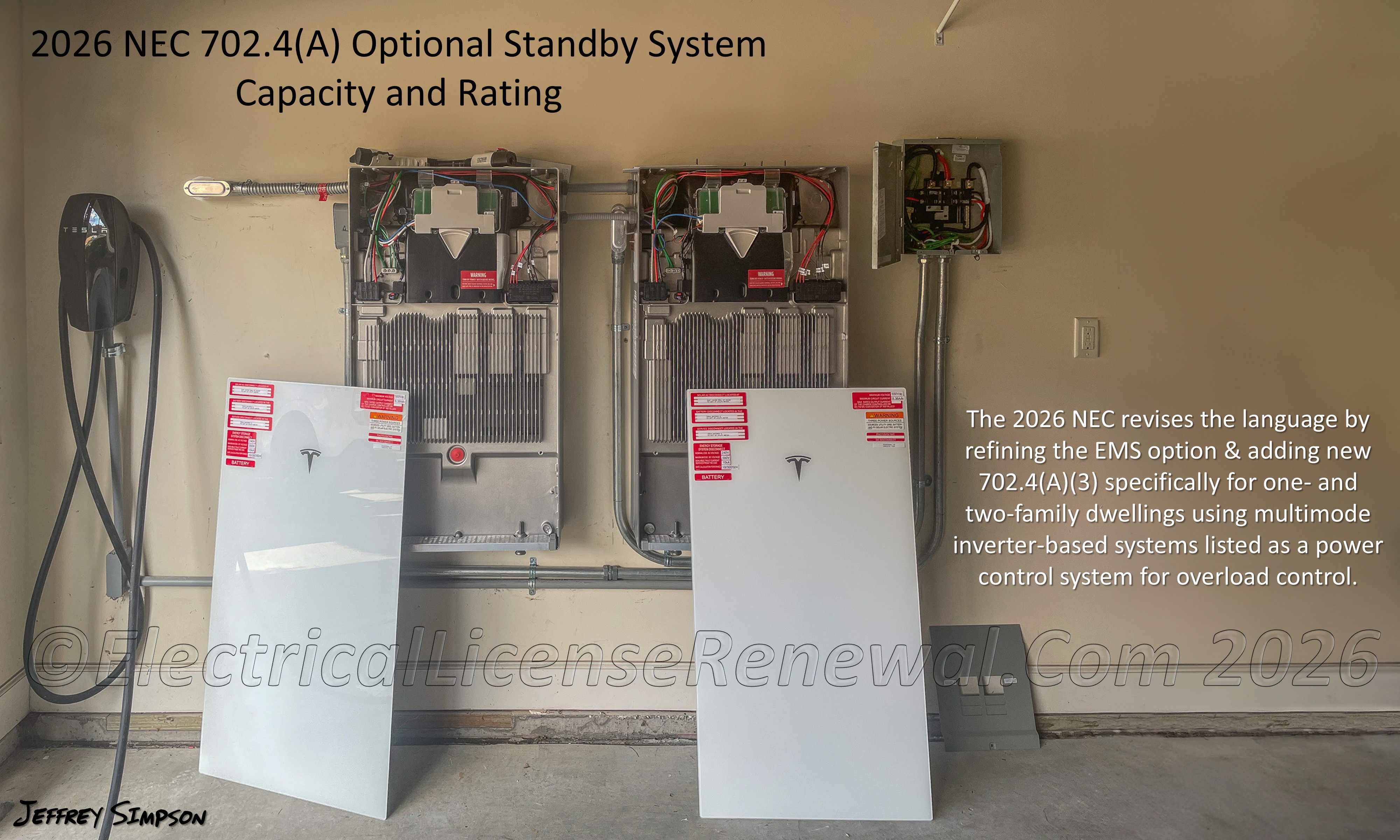
The 2026 NEC revised the language by refining the EMS option & adding new 702.4(A)(3) specifically for one- and two-family dwellings using multimode inverter-based systems listed as a power control system for overload control.
Code Change Summary: The 2026 NEC® adds a third compliance option in 702.4(A)(3) that permits certain multimode inverter-based systems listed as power control systems to control automatically connected loads under defined overload control and manual reset conditions.
SME commentary: Section 702.4(A) addresses optional standby systems where loads are connected manually, nonautomatically, and automatically upon loss of normal power. In the 2023 NEC®, compliance for automatically connected loads was limited to two paths in 702.4(A)(2). Either the standby source had to be sized for the full automatically connected load, or an energy management system installed in accordance with Article 750 could be used, provided the standby source was capable of supplying the maximum load connected to the EMS. While this approach worked well for traditional generators and load shedding systems, it created practical limitations for modern residential inverter-based energy storage systems that are designed to operate interactively with the utility when normal power is present and transition to island mode for standby operation during power outages.
The 2026 NEC® revises the language by refining the EMS option and adding new 702.4(A)(3) specifically for one- and two-family dwellings using multimode inverter based systems listed as a power control system for overload control. The revised language aligns the load management provisions with the relocation of load calculation rules into Article 120 and the power control system requirements into Article 130, Part II. This coordination reflects the increasing use of PCS functionality to actively regulate power flow rather than simply disconnecting loads.
For one- and two-family dwellings, new 702.4(A)(3) permits a multimode inverter-based system, listed as a PCS for overload prevention, to automatically control loads if the minimum standby source capacity is equal to the PCS control setting of the standby source in accordance with Article 130 Part II, and is no less than the load imposed by the largest single utilization equipment connected to the system. This establishes a clear and enforceable threshold that ensures the inverter can support the most demanding single load connected to the system without immediately entering an overload condition. The requirement is intentionally tied to the PCS control settings, not nameplate ratings alone, reinforcing that overload protection must be inherent to the listed system configuration.
An additional safety provision requires that if the multimode system shuts down in response to an overload condition, reconnection of the supply must be performed manually. This prevents repeated automatic restart attempts under high demand conditions that could stress equipment or create unsafe operating scenarios. The new informational notes further clarify that multimode inverters are typically grid interactive but capable of providing standby power within their rated capacity, and that PCS functionality may be applied at the branch circuit level, feeder level, or a combination of both.
This new compliance path brings additional flexibility in standby system capacity while maintaining clear safeguards. It recognizes how residential energy storage and inverter systems are designed, listed, and installed, and provides inspectors and installers with objective criteria for evaluating automatic load connection when PCS based overload control is used.
Below is a preview of the NEC®. See the actual NEC® text at NFPA.ORG for the complete code section. Once there, click on their link to free access to the 2026 NEC® edition of NFPA 70.
2023 Code Language:
Section 702.4(A)(3) did not exist.
2026 Code Language:
N 702.4(A)(3) Multimode Inverter-Based Systems in One- and Two-Family Dwellings. For one- and two-family dwellings, multimode inverter-based systems listed as a PCS for overload control shall have a minimum capacity equal to the PCS control setting of the standby source in accordance with Article 130 Part II and no less than the load posed by the largest single utilization equipment connected to the system. If a shutdown occurs in response to an overloaded condition, reconnection of the supply shall only be performed nonautomatically.
Informational Note No. 1: Multimode inverter-based systems often function primarily as interactive systems and are capable of providing standby supply continuity within their capacity. Multimode inverters are listed to control the voltage and frequency within prescribed limits and ratings. Multimode inverters with PCS cease operation safely in an overload condition.
Informational Note No. 2: PCS functionality is typically used to control loads at the branch circuit, feeder distribution level, or combination of both to prevent branch circuits, feeders, standby sources, and equipment from being overloaded upon connection of the load onto the standby source.
