700.11(D) Wiring Protection of Class 2 and Class 4 Powered Emergency Lighting Systems.
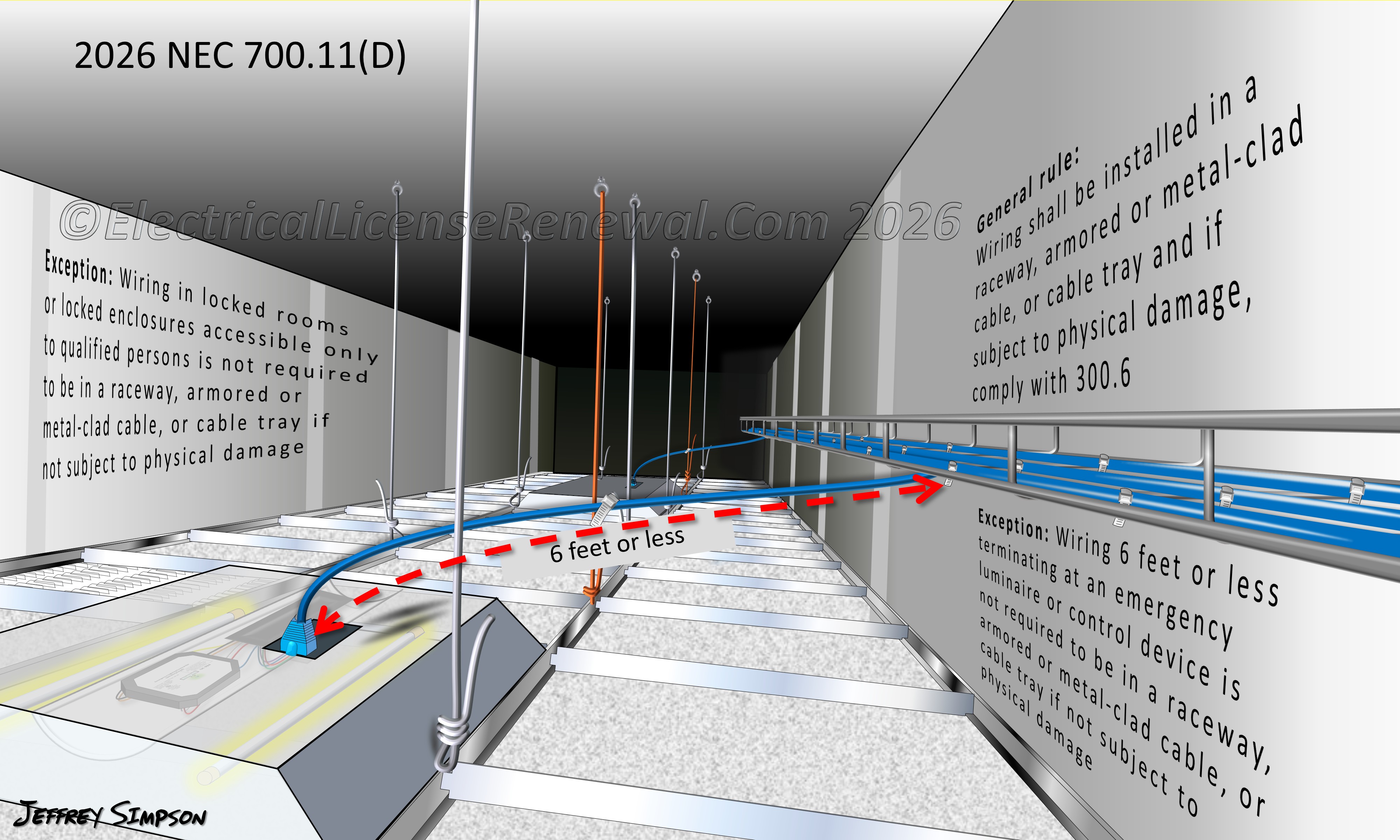
Wiring 6 feet or less terminating at an emergency luminaire or control device is not required to be in a raceway, armored or metal-clad cable, or cable tray if not subject to physical damage.
Code Change Summary: Revisions to 700.11(D) clarify when Class 2 and Class 4 powered emergency lighting circuits must be installed in protective wiring methods and refine the exceptions and explanatory notes.
SME commentary: Section 700.11(D) was revised in the 2026 NEC® to provide clearer direction on when Class 2 and Class 4 powered emergency lighting circuits must be protected. The 2023 language created uncertainty because its sentence structure contained two separate mandatory requirements blended into one: first, compliance with the protection methods in 300.4 where applicable, and second, the mandatory use of a raceway, armored cable, metal-clad cable, or cable tray even when the Class 2 or Class 4 powered emergency lighting circuits were not subject to physical damage. The grammatical structure allowed some jurisdictions to interpret the text as requiring all Class 2 emergency lighting circuits to be placed in a raceway, armored or metal clad cable, or cable tray for their entire length even when the installation was not subject to physical damage. The 2026 revision addresses that issue directly by restructuring the language with additional detail.
The main charging statement in 700.11(D) now presents two clearly separated requirements: that “wiring shall be installed in a raceway, armored or metal-clad cable, or cable tray and if subject to physical damage, comply with the requirements of 300.6”. Section 300.6 (previously 300.4) covers nail protection, bushings in metal stud holes for cable protection, installation practices where cables interface with ceiling tiles, and the like. This is now followed by a new exception with previous provisions carried forward from the 2023 edition but structured so their application is clearer:
Exception: If not subject to physical damage, wiring shall not be required to be installed in a raceway, armored or metal-clad cable, or cable tray under the following conditions:
(1) The wiring does not exceed 6 feet in length and terminates at an emergency luminaire or an emergency lighting control device.
(2) The wiring is installed in locked rooms or locked enclosures that are accessible only to qualified persons.
The changes also respond to concerns raised within the PoE emergency lighting industry. Unlike traditional line voltage emergency lighting circuits, PoE luminaires and network switches rely on RJ-45 connectors and are not designed to interface with raceways or metal-clad cable systems. If the 2023 wording were interpreted as requiring all Class 2 circuits to be installed in these wiring methods from end-to-end, many PoE emergency systems would face significant installation barriers without demonstrated safety benefits. From a field perspective, the revised language and structure of 700.11(D) make it clear that typical Class 2 or Class 4 powered emergency lighting circuits, except in locked rooms accessible only to qualified persons, will most often consist of a continuous cable tray run with only the final 6 feet of cable left outside the tray before it terminates at an emergency luminaire or emergency lighting control device.
A new informational note reinforces the purpose of the permitted wiring methods by stating that installing the wiring in a raceway, armored or metal-clad cable, or cable tray enhances emergency circuit reliability. This clarification helps distinguish between the base requirement to use a raceway, armored or metal-clad cable, or cable tray, the situations where 300.6 applies, and the conditions in the exception that allow a simplified approach without compromising system performance.
Below is a preview of the NEC®. See the actual NEC® text at NFPA.ORG for the complete code section. Once there, click on their link to free access to the 2026 NEC® edition of NFPA 70.
2023 Code Language:
700.11(D) Protection. Wiring shall comply with the requirements of 300.4 and be installed in a raceway, armored or metal-clad cable, or cable tray.
Exception No. 1: Section 700.11(D) shall not apply to wiring that does not exceed 6 feet in length and that terminates at an emergency luminaire or an emergency lighting control device.
Exception No. 2: Section 700.11(D) shall not apply to locked rooms or locked enclosures that are accessible only to qualified persons.
Informational Note: Locked rooms accessible only to qualified persons include locked telecommunications rooms, locked electrical equipment rooms, or other access-controlled areas.
2026 Code Language:
700.11(D) Protection. Wiring shall be installed in a raceway, armored or metal-clad cable, or cable tray and if subject to physical damage, comply with the requirements of 300.6.
Exception: If not subject to physical damage, wiring shall not be required to be installed in a raceway, armored or metal-clad cable, or cable tray under the following conditions:
(1) The wiring does not exceed 6 feet in length and terminates at an emergency luminaire or an emergency lighting control device.
(2) The wiring is installed in locked rooms or locked enclosures that are accessible only to qualified persons.
Informational Note No. 1: Locked rooms accessible only to qualified persons include locked telecommunications rooms, locked electrical equipment rooms, or other access-controlled areas.
Informational Note No. 2: Wiring installed in a raceway, armored or metal-clad cable, or cable tray is to enhance emergency circuit reliability.
