700.10(D) Fire Protection.
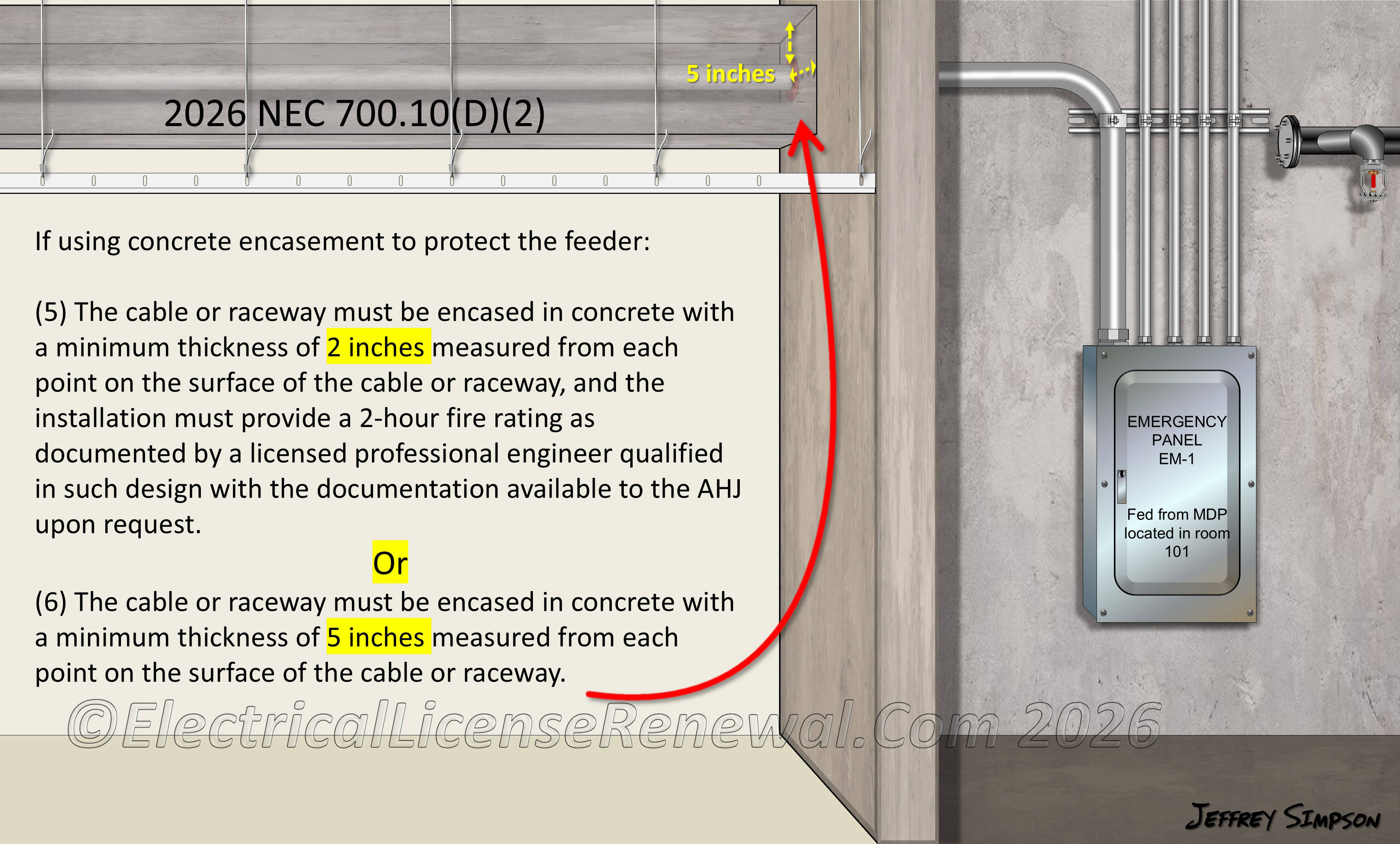
Changes were made to the option to use concrete encasement for protecting feeder conductors for an emergency system.
Code Change Summary: Section 700.10(D) was revised to update occupancy terminology and expand acceptable fire-resistive wiring methods, including significant changes to concrete encasement provisions.
SME commentary: Revisions to 700.10(D) in the 2026 NEC® refine when additional fire protection measures apply to emergency systems and clarify the wiring methods that qualify for a 2-hour fire rating.
The basic rule in 700.10(D)(1) requires emergency systems to meet the additional protection requirements in 700.10(D)(2) through 700.10(D)(4) in specific occupancies. For many code cycles, “buildings above 75 feet in height” were included in the list without further explanation on how the 75-foot measurement was taken. The revised 2026 NEC® language addresses this by using terminology consistent with the International Building Code and NFPA 5000. The new language in 700.10(D)(2) was changed to “A building where the floor of an occupiable story is greater than 75 feet above the lowest level of fire department vehicle access”. This provides a measurable trigger for applying the additional protection requirements in 700.10(D)(2) through (4).
More significant changes appear in 700.10(D)(2), which reorganizes the permitted fire-resistive wiring methods and brings them into alignment with the work completed in 695.7 and 695.14 for fire pump circuits. Historically, multiple wiring methods have been permitted to achieve a 2-hour rating, including listed circuit protective systems, listed fire-resistive cable systems, and installations located within spaces fully protected by automatic sprinkler systems. Concrete encasement was also listed as an option, but past NEC® editions allowed a uniform 2-inch minimum thickness without supporting technical evidence regarding its performance across different aggregate types.
Recent research from the Fire Protection Research Foundation (FPRF) demonstrated that 2 inches of concrete encasement often fails to provide consistent thermal protection for conductors under fire exposure. Temperature rise at the conductor interface exceeded insulation ratings in less than two hours for many concrete mixes, and in numerous cases exceeded 250 degrees Fahrenheit above ambient in under one hour. Additional conductor heating from normal load current would only compound this. These findings prompted the changes adopted in 700.10(D)(2).
The 2026 NEC® retains concrete encasement as a permitted option in 700.10(D)(2) but now divides it into two clearly defined conditions. New item (5) permits 2 inches of concrete only when a licensed professional engineer, qualified in fire-resistive concrete design, documents that the installation meets a 2-hour rating and provides that documentation to the AHJ upon request. Section 700.10(D)(2)(6) introduces a new prescriptive option that requires 5 inches of concrete cover measured from each point on the surface of the cable or raceway. This thickness reflects the consistent performance level identified by the research and offers installers a straightforward method that avoids engineering analysis.
These revisions improve the reliability of emergency feeder-circuit wiring by ensuring that concrete-encased installations better reflect real-world fire conditions and provide a level of protection equal to the other listed methods.
Below is a preview of the NEC®. See the actual NEC® text at NFPA.ORG for the complete code section. Once there, click on their link to free access to the 2026 NEC® edition of NFPA 70.
2023 Code Language:
700.10(D) Fire Protection.
(1) Occupancies. Emergency systems shall meet the additional requirements in 700.10(D)(2) through 700.10(D)(4) in the following occupancies:
(2) Buildings above 75 feet in height
(2) Feeder-Circuit Wiring. Feeder-circuit wiring shall meet one of the following conditions:
See the actual NEC® for items (1) through (4)
(5) The cable or raceway is encased in a minimum of 2 inches of concrete.
2026 Code Language:
700.10(D) Fire Protection.
(1) Occupancies. Emergency systems shall meet the additional requirements in 700.10(D)(2) through 700.10(D)(4) in the following occupancies:
(2) A building where the floor of an occupiable story is greater than 75 feet above the lowest level of fire department vehicle access
(2) Feeder-Circuit Wiring. Feeder-circuit wiring shall meet one of the following conditions:
No changes to items (1) through (4)
(5) The cable or raceway is encased in concrete with a minimum thickness of 2 inches measured from each point on the surface of the cable or raceway, and the installation provides a 2-hour fire rating as documented by a licensed professional engineer qualified in such design with the documentation available to the AHJ upon request.
(6) The cable or raceway is encased in a minimum thickness of 5 inches of concrete measured from each point on the surface of the cable or raceway.
