700.4(F) Temporary Source of Power for Servicing of the Alternate Source of Power.
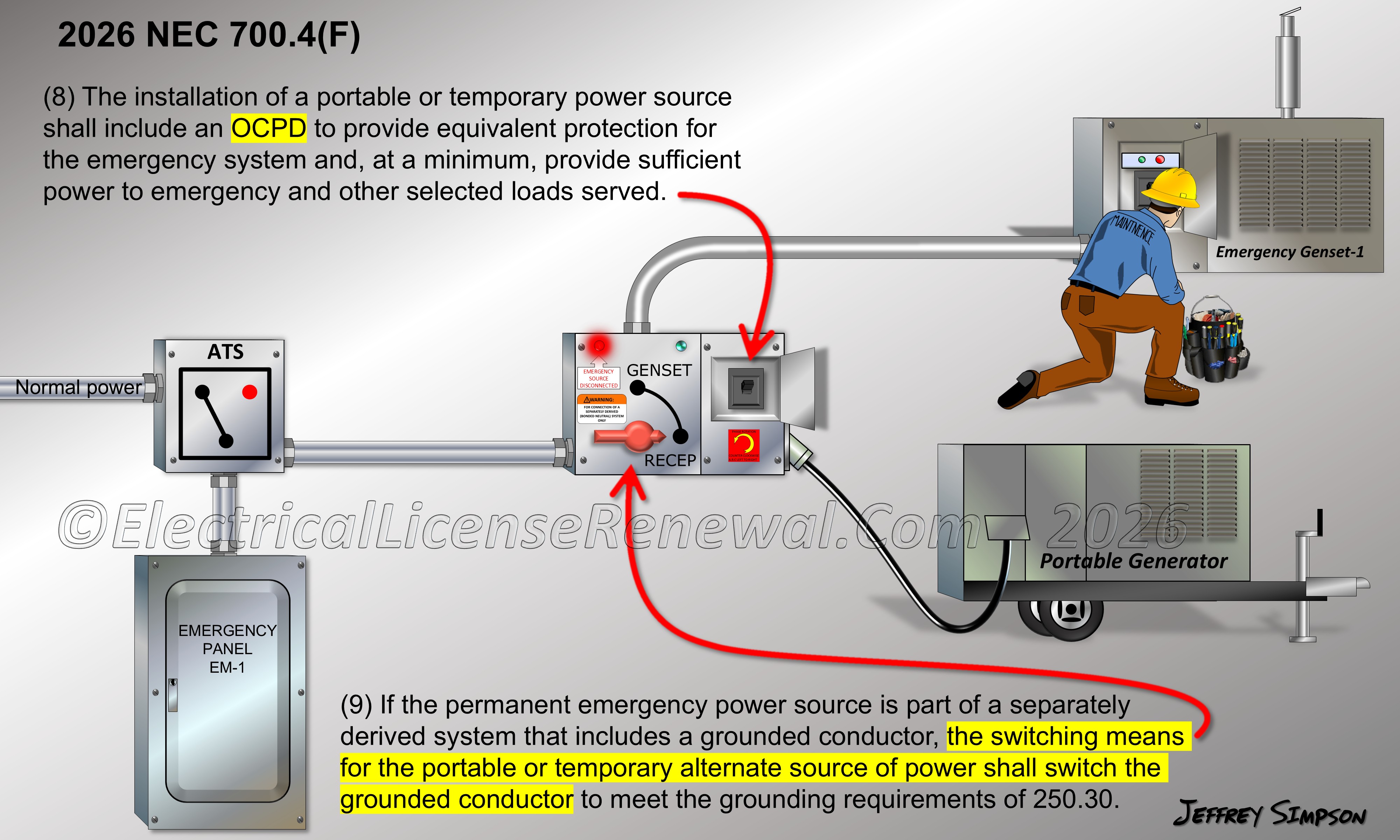
The permanent switching means must provide OCPD protection for the temporary source and switch the grounded conductor where the permanent system is separately derived.
Code Change Summary: The rules for providing a temporary power source during servicing of the alternate source were relocated to 700.4(F) and expanded with new requirements.
SME commentary: The 2026 NEC® revision to 700.4(F) represents a significant refinement in how emergency systems prepare for conditions when the permanent alternate source must be removed from service. Emergency systems that rely on a single alternate source, typically an onsite generator, can be left vulnerable during servicing if no provisions exist for a temporary power source while the servicing occurs. Earlier editions addressed this scenario in 700.3(F), but the 2026 reorganization moves the rules to 700.4(F) and expands them to improve clarity and enforceability.
The first significant revision is the CMP decision to change the term “maintenance or repair” to “servicing” to align with terminology used throughout the NEC®. This wording reflects the full range of activities that may require the alternate source to be taken offline.
New list item (8) introduces a key protective measure. It requires an overcurrent device at the permanent switching means for the temporary source of power. The code language states that “the installation of a portable or temporary power source shall include an OCPD to provide equivalent protection for the emergency system and, at a minimum, provide sufficient power to emergency and other selected loads served”. The term “equivalent protection” was carefully chosen to ensure that the temporary power source maintains the same level of overcurrent protection that the system relies on when connected to the permanent emergency source. This supports maintaining selective coordination that aligns with the original intended design when connected to a portable or temporary source during servicing.
New item (9) refines the system bonding and switching requirements for installations where the permanent emergency source operates as a separately derived system that includes a grounded conductor. For these installations, the switching means for the portable or temporary alternate source of power shall switch the grounded conductor to meet the grounding requirements of 250.30. When a permanently installed generator derives its own grounded conductor and uses a system bonding jumper at the generator or first disconnecting means, the switching means required by 700.4(F) must be capable of switching that grounded conductor. This ensures that the grounding and bonding arrangement remains correct whether power is supplied from the permanent generator or a temporary generator.
New item (10) clarifies that the monitoring requirements in 700.10(D)(4)(b) do not apply during servicing because the temporary generator connection may not support identical monitoring functions.
These expansions to 700.4(F) provide greater detail for OCPD placement, intended function, and proper switching arrangement. The revisions deliver clearer expectations for designers and installers while ensuring that emergency systems remain protected and functional throughout the servicing of the permanently installed alternate emergency power source.
Below is a preview of the NEC®. See the actual NEC® text at NFPA.ORG for the complete code section. Once there, click on their link to free access to the 2026 NEC® edition of NFPA 70.
2023 Code Language:
700.3(F) Temporary Source of Power for Maintenance or Repair of the Alternate Source of Power. If the emergency system relies on a single alternate source of power, which will be disabled for maintenance or repair, the emergency system shall include permanent switching means to connect a portable or temporary alternate source of power that shall be available for the duration of the maintenance or repair. The permanent switching means to connect a portable or temporary alternate source of power shall comply with the following:
See the actual NEC® for items (1) through (7).
2026 Code Language:
700.4(F) Temporary Source of Power for Servicing of the Alternate Source of Power. If the emergency system relies on a single alternate source of power, which will be disabled for servicing, the emergency system shall include permanent switching means to connect a portable or temporary alternate source of power that shall be available for the duration of the servicing. The permanent switching means to connect a portable or temporary alternate source of power shall comply with the following:
Items (1) through (7) are unchanged from 2023 to 2026.
(8) The installation of a portable or temporary power source shall include an OCPD to provide equivalent protection for the emergency system and, at a minimum, provide sufficient power to emergency and other selected loads served.
(9) If the permanent emergency power source is part of a separately derived system that includes a grounded conductor, the switching means for the portable or temporary alternate source of power shall switch the grounded conductor to meet the grounding requirements of 250.30.
(10) Section 700.10(D)(4)(b) shall not apply.
