695.7(A) Power Wiring.
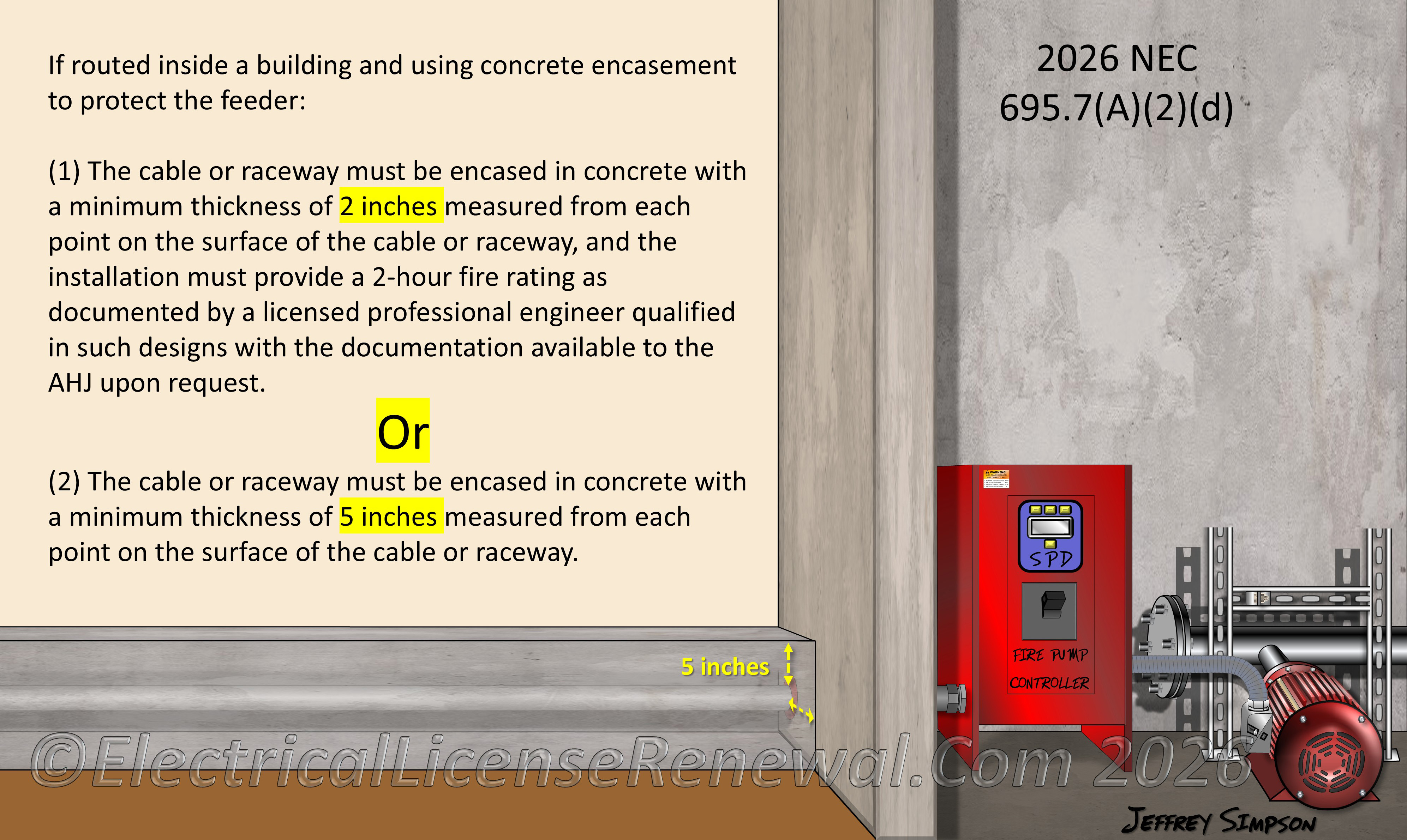
Changes were made to the option to use concrete encasement for protecting the fire pump feeder.
Code Change Summary: Revisions to fire pump feeder protection were relocated from 695.6 to new Section 695.7 and expanded to clarify acceptable fire-resistive concrete encasement methods.
SME commentary: In the 2026 NEC®, the requirements for protecting fire pump supply conductors on the load side of the final disconnecting means were reorganized and refined. Former Section 695.6(A)(2) has been relocated to 695.7(A)(2), and the major revisions appear in 695.7(A)(2)(d). These changes address long-standing concerns about whether a simple 2-inch concrete encasement provides sufficient thermal protection to maintain circuit integrity during a fire. Fire pumps must remain operational throughout fire events, making the reliability of these conductors a critical life safety function.
The prior code language permitted concrete encasement, listed fire-resistive cable systems, and listed electrical circuit protective systems as equivalent protection methods. However, the 2-inch concrete encasement option had been accepted without supporting data, even though the other methods require testing and listing. In 2018, the Fire Protection Research Foundation published “Fire Resistance of Concrete for Electrical Conductors”, which analyzed the thermal behavior of various concrete types and identified significant limitations with using only 2 inches of concrete as a universal solution.
The research showed that 2 inches of concrete would not keep conductor temperatures within their insulation ratings for a full two hours. For many aggregate types, the temperature rise at only 2 inches of cover exceeded 250 degrees Fahrenheit above ambient in less than one hour. Electrical conductors would also experience internal heat from load current, further increasing temperatures beyond acceptable limits. The study concluded that approximately 5 inches of concrete cover is necessary to provide consistent 2-hour thermal protection without requiring specific aggregate selection.
These findings shaped the revisions to 695.7(A)(2)(d). Item (d)(1) now permits 2 inches of concrete encasement only when a licensed professional engineer, qualified in fire-resistive concrete design, validates through analysis that the installation achieves a 2-hour rating. Additionally, for this option, documentation must be made available to the AHJ upon request. Section 695.7(A)(2)(d)(2) introduces a new prescriptive option: 5 inches of concrete encasement measured from each point on the surface of the cable or raceway. This reflects the research foundation’s conclusion that 5 inches of cover provides consistent performance across common concrete types.
Two additional protection methods remain unchanged: listed fire-resistive cable systems and listed electrical circuit protective systems. The reorganization also adds a new exception to clarify that underground installations are not considered “inside the building”.
The revised language in the 2026 NEC® improves reliability and aligns the concrete encasement provisions with the same performance expectations required of listed fire-resistive wiring methods. Installers now have clearer guidance supported by engineering analysis and research, while inspectors have a stronger basis for evaluating field installations.
Similar changes occurred in 690.14(F) for control conductors installed between the fire pump power transfer switch and a standby generator supplying a fire pump.
Below is a preview of the NEC®. See the actual NEC® text at NFPA.ORG for the complete code section. Once there, click on their link to free access to the 2026 NEC® edition of NFPA 70.
2023 Code Language:
695.6(A)(2) Feeders. Fire pump supply conductors on the load side of the final disconnecting means and overcurrent device(s) permitted by 695.4(B) or conductors that connect directly to an on-site standby generator shall comply with all of the following:
(4) Inside of a Building. Where routed through a building, the conductors shall be protected from fire for 2 hours using one of the following methods:
a. The cable or raceway is encased in a minimum 2 inches of concrete.
b. The cable or raceway is part of a listed fire-resistive cable system.
c. The cable or raceway is protected by a listed electrical circuit protective system.
Exception to 695.6(A)(2)(4): The supply conductors located in the electrical equipment room where they originate and in the fire pump room shall not be required to have the minimum 2-hour fire separation or fire-resistance rating unless otherwise required by 700.10(D) of this Code.
2026 Code Language:
695.7(A)(2) Feeders. Fire pump supply conductors on the load side of the final disconnecting means and overcurrent device(s) permitted by 695.5(B) or conductors that connect directly to an on-site standby generator shall comply with 695.7(A)(2)(a) through 695.7(A)(2)(d).
(d) Inside of a Building. Where routed through a building, the conductors shall be protected from fire for 2 hours using one of the following methods:
(1) The cable or raceway is encased in concrete with a minimum thickness of 2 inches measured from each point on the surface of the cable or raceway, and the installation provides a 2-hour fire rating as documented by a licensed professional engineer qualified in such designs with the documentation available to the AHJ upon request.
(2) The cable or raceway is encased in concrete with a minimum thickness of 5 inches measured from each point on the surface of the cable or raceway.
Informational Note: See Fire Protection Research Foundation Report FPRF-2018-16, “Fire Resistance of Concrete for Electrical Conductors,” for information about concrete fire resistance.
(3) The cable or raceway is part of a listed fire-resistive cable system.
(4) The cable or raceway is protected by a listed electrical circuit protective system.
Exception No. 1: Cables and raceways installed underground shall not be considered to be inside the building.
Exception No. 2: The supply conductors located in the electrical equipment room where they originate and in the fire pump room shall not be required to have the minimum 2-hour fire separation or fire-resistance rating unless otherwise required by 700.10(D) of this code.
