690.33 Mating Connectors.
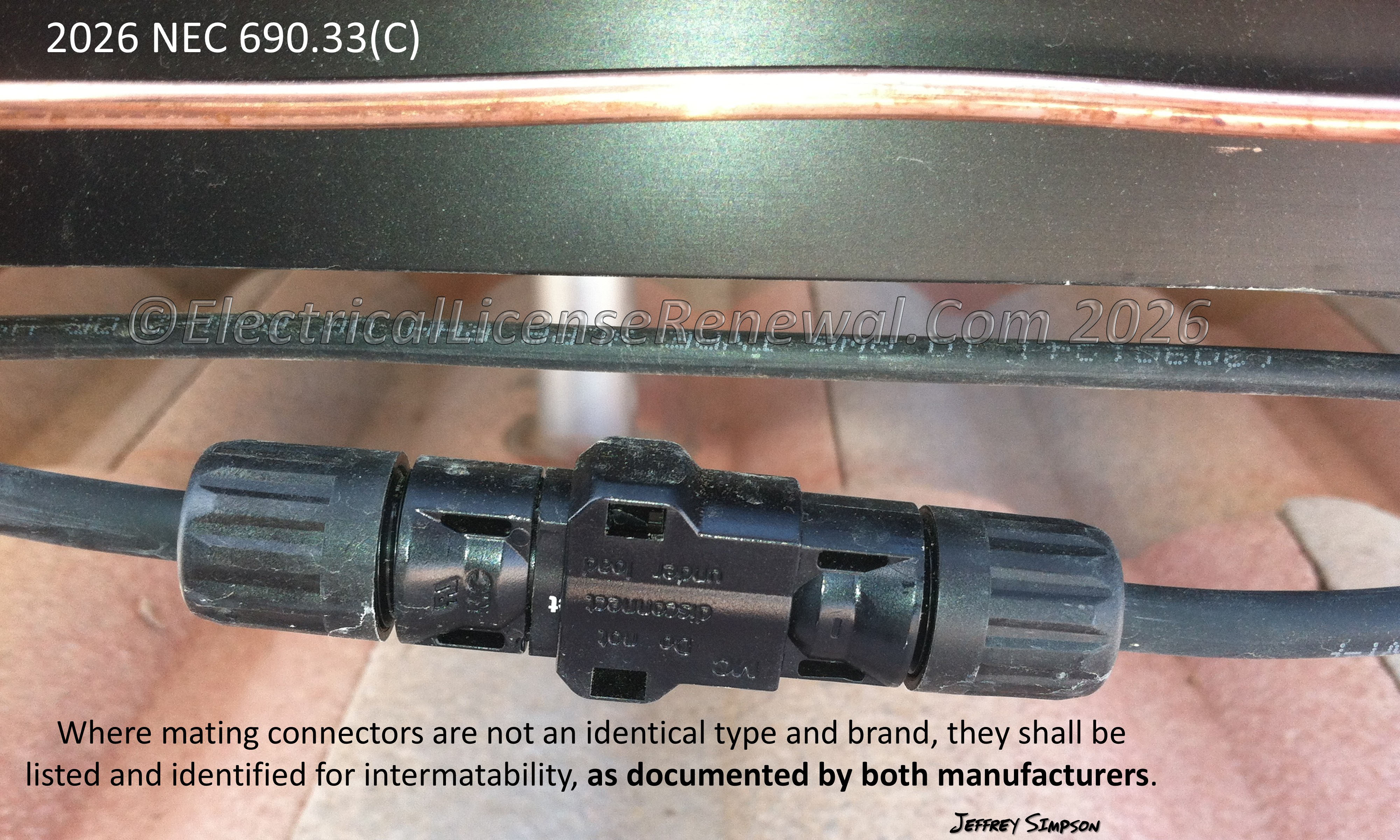
Where mating connectors are not an identical type and brand, they shall be listed and identified for intermatability, as documented by both manufacturers.
Code Change Summary: Revisions to 690.33(C) strengthen the requirements for documenting connector compatibility by ensuring both manufacturers identify their mating connectors as interoperable.
SME commentary: In the 2026 NEC®, Section 690.33(C) was revised to address compatibility concerns surrounding the mating connectors commonly used in PV dc circuits. These connectors are routinely installed in PV module strings that often involve locking connectors sourced from multiple manufacturers. For many years the NEC® relied on a simple requirement that nonidentical connectors be “listed and identified for intermatability” as described in the manufacturer’s instructions. That approach assumed that a single manufacturer’s documentation was sufficient to confirm proper mating with the other connector from a different manufacturer, but field experience has shown that the instructions for some products do not provide the level of detail needed to ensure sufficient compatibility.
PV dc source circuits operate under conditions where connector reliability is critical. The PV modules typically come with a pre-installed length of positive and negative conductor and associated locking connectors, most common is the industry-standard MC4 connector, allowing for quick "plug-and-play" connections between solar panels (PV modules) and for connecting to other components. When modules are wired in series, the integrity of every connector becomes critical, and mismatched components can introduce resistance, overheating, or other failure modes.
The previous 2023 NEC® language placed the responsibility for identifying intermatable connectors largely on one manufacturer. If that manufacturer later revised their connector design, changed suppliers, or updated test data, the other manufacturer’s connector might no longer be intermatable even though the manufacturer was unaware of the change. In such cases, the installer could unknowingly mate two connectors that are no longer listed together as compatible, creating an unsafe condition and compromising the intended design.
The 2026 revision to 690.33(C) clarifies this with carefully worded code language: “Where mating connectors are not an identical type and brand, they shall be listed and identified for intermatability, as documented by both manufacturers”.
This added requirement creates shared responsibility and ensures that a connector cannot be represented as intermatable unless each manufacturer has evaluated the pairing and listed it accordingly. If one manufacturer modifies its connector, the listing relationship should be reconfirmed. This approach removes the uncertainty that previously existed when manufacturers changed designs or materials without coordinating with other manufacturers whose connectors were commonly mated in the field.
With this revision, Section 690.33(C) now provides a clearer framework for installers and inspectors. The change does not alter the fundamental requirement that mating connectors must be of the latching or locking type and readily accessible where used in circuits operating above 30 volts dc or 15 volts ac. Instead, it strengthens the documentation component to reflect how these products are used in real installations.
Below is a preview of the NEC®. See the actual NEC® text at NFPA.ORG for the complete code section. Once there, click on their link to free access to the 2026 NEC® edition of NFPA 70.
2023 Code Language:
690.33 Mating Connectors.
(C) Type. Where mating connectors are not of the identical type and brand, they shall be listed and identified for intermatability, as described in the manufacturer’s instructions.
2026 Code Language:
690.33 Mating Connectors.
(C) Type. Where mating connectors are not an identical type and brand, they shall be listed and identified for intermatability, as documented by both manufacturers.
