690.31(B) PV Circuit Identification and Grouping.
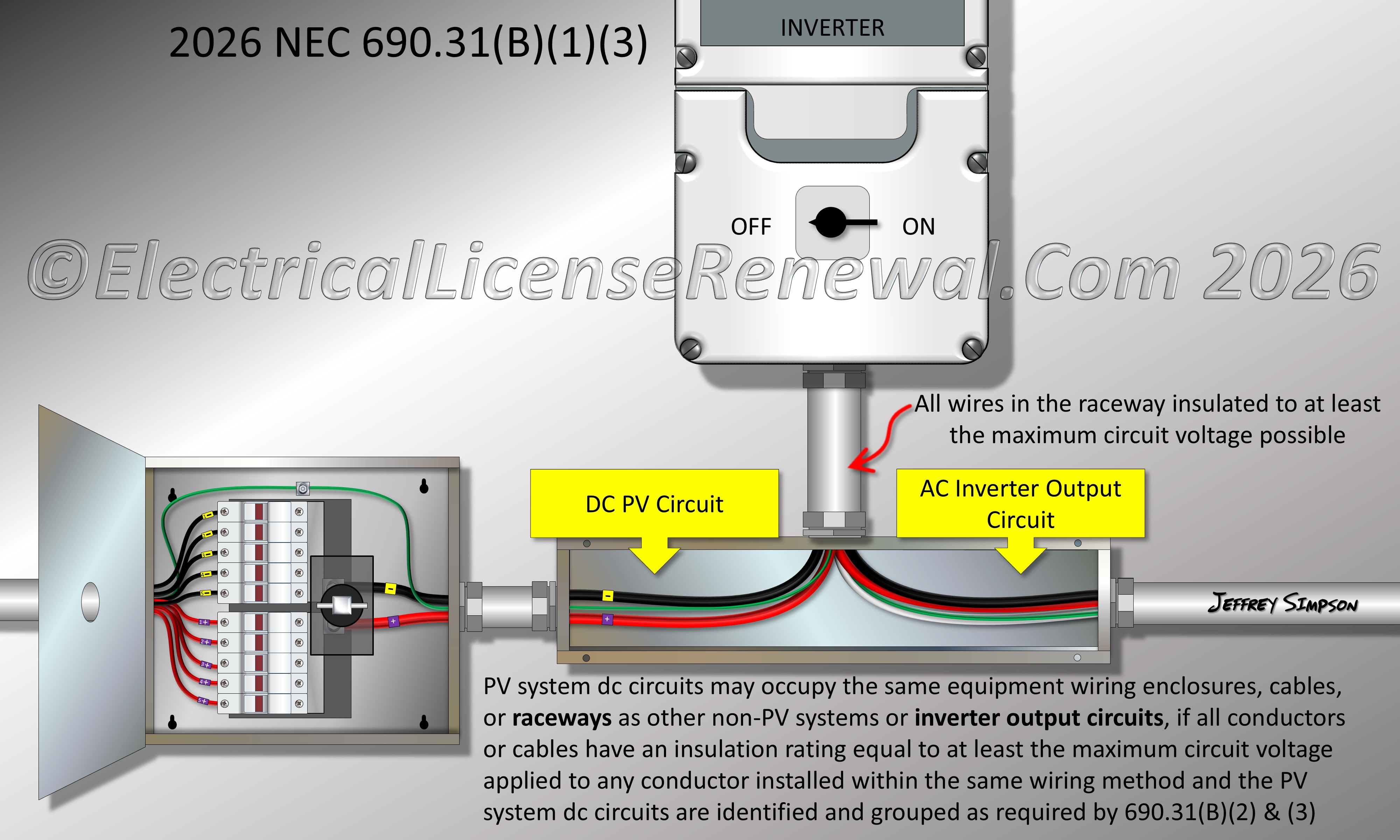
PV system dc circuits may occupy the same enclosures and raceways as inverter output circuits, if the insulating rating of all conductors is equal to at least the maximum circuit voltage applied to any conductor installed within the same wiring method and the PV system dc circuits are identified and grouped as required by 690.31(B)(2) & (3).
Code Change Summary: Section 690.31(B) was restructured into positive text and revised to include energy management system conductors among the permitted circuit types in item (4).
SME commentary: In the 2026 NEC®, Section 690.31(B) received a full reorganization that converts the prior exception into positive text and refines how PV system dc circuits may be installed with other circuit types. This revision improves usability while intending to preserve the practical allowances that appeared in the 2023 NEC®. The Code Panel also expanded the list of permitted circuits in item (4) to include conductors associated with energy management systems, recognizing their increasing presence in PV and inverter-based installations.
The 2026 revision lifts the barrier and partition allowance from the parent text and places it into new option (1).
The same occurred with new option (2) which allows the installation of other circuit conductors where permitted by the equipment listing.
Option (3) now permits PV system dc circuits to occupy the same equipment wiring enclosures, cables, or raceways as other non-PV systems or inverter output circuits, if all conductors or cables have an insulation rating equal to at least the maximum circuit voltage applied to any conductor installed within the same wiring method and the PV system dc circuits are identified and grouped as required by 690.31(B)(2) and 690.31(B)(3).
Option (4) retains the multiconductor jacketed cable allowance and expands its applicability by specifically recognizing conductors associated with energy management systems. The addition acknowledges that EMS conductors are often routed alongside PV system dc circuits to support monitoring and control functions.
An interesting observation for new option (3): While changing the exception methods into positive text had good intent, the language structure was also modified in the process and revised option (3) ended up allowing PV DC conductors to co-mingle in “raceways” with AC inverter output circuits provided all conductors have an insulation rating no less than the maximum circuit voltage applied to any conductor installed within the same wiring method. This may not have been what the code panel was aiming for.
One CMP member voted against the revision and expressed that the lack of separation within a raceway can lead to a hazardous condition and could allow catastrophic failures should there be a breakdown of conductor insulation. The CMP member felt this should be discussed separately and not lumped in with all of the other editorial changes.
The previous 2023 language structure in the parent text required a barrier for dc and ac conductor separation but through item (2) in the exception, permitted ac inverter output circuits to occupy the same “junction box”, “pull box”, or “wireway” with PV system dc circuits if they were identified and grouped. Nothing in item (2) under the 2023 exception permitted this same allowance for a “raceway” to contain both PV system dc circuits and ac inverter output circuits. There is considerably more space in a “junction box, pull box, or wireway” to identify and group dc circuits from ac circuits compared to the direct contact that occurs when dc and ac conductors occupy the same raceway such as EMT.
The code change proposal substantiation and CMP statement at the 2026 NEC® first draft both make it clear that the changes made to the section intend to maintain similar requirements that were in the 2023 NEC® so it seems that the raceway issue may have been an unintended consequence. Additionally, at 2nd draft, a public comment was submitted to correct this issue but was rejected by the code panel who reiterated that the requirements remain consistent with the allowances previously included in the multiple exceptions present in the previous 2023 code edition. Strangely enough, when modifying 690.31(B) in the 2023 NEC®, the CMP statement at first draft stated that an allowance for AC inverter output circuits to be located with PV system dc conductors was added in item (2) under the exception in 690.31(B) “in limited applications where boxes or wireways are used”, (raceways were not mentioned).
It is likely that this raceway issue will be brought up again for the 2029 NEC®. Until then, the 2026 NEC® language appears to allow PV system dc circuits and ac inverter output circuits to be installed in the same “wiring enclosures, cables, or raceways.”
Below is a preview of the NEC®. See the actual NEC® text at NFPA.ORG for the complete code section. Once there, click on their link to free access to the 2026 NEC® edition of NFPA 70.
2023 Code Language:
690.31(B) Identification and Grouping.
(1) Conductors of Different Systems. Where not otherwise allowed in an equipment’s listing, PV system dc circuits shall not occupy the same equipment wiring enclosure, cable, or raceway as other non-PV systems or inverter output circuits unless separated from other circuits by a barrier or partition.
Exception: Where all conductors or cables have an insulation rating equal to at least the maximum circuit voltage applied to any conductor within the same wiring method, the following shall be permitted:
(1) Multiconductor jacketed cables for remote control, signaling, or power-limited circuits shall be permitted within the same wiring enclosure, cable, or raceway as PV system dc circuits where all circuits serve the PV system.
(2) Inverter output circuits shall be permitted to occupy the same junction box, pull box, or wireway with PV system dc circuits that are identified and grouped as required by 690.31(B)(2) and (B)(3).
(3) PV system dc circuits utilizing multiconductor jacketed cable or metal-clad cable assemblies or listed wiring harnesses identified for the application shall be permitted to occupy the same wiring method as inverter output circuits and other non-PV systems.
2026 Code Language:
690.31(B) Identification and Grouping.
(1) Conductors of Different Systems. PV system dc circuits shall not occupy the same equipment wiring enclosures, cables, or raceways as other non-PV systems or inverter output circuits unless installed in accordance with one or more of the following:
(1) A barrier or partition separates the PV system dc circuits from the other circuits.
(2) The installation of other circuit conductors is permitted by the equipment listing.
(3) All conductors or cables have an insulation rating equal to at least the maximum circuit voltage applied to any conductor installed within the same wiring method and the PV system dc circuits are identified and grouped as required by 690.31(B)(2) and 690.31(B)(3).
(4) The other circuit conductors are part of a multiconductor jacketed cable with a jacket insulation rating equal to at least the maximum circuit voltage applied to any conductor installed within the same wiring method, and are used for remote control, signaling, or a Class 1 power-limited circuit associated with the PV system or energy management system.
