690.12 Rapid Shutdown of PV Systems on Buildings.
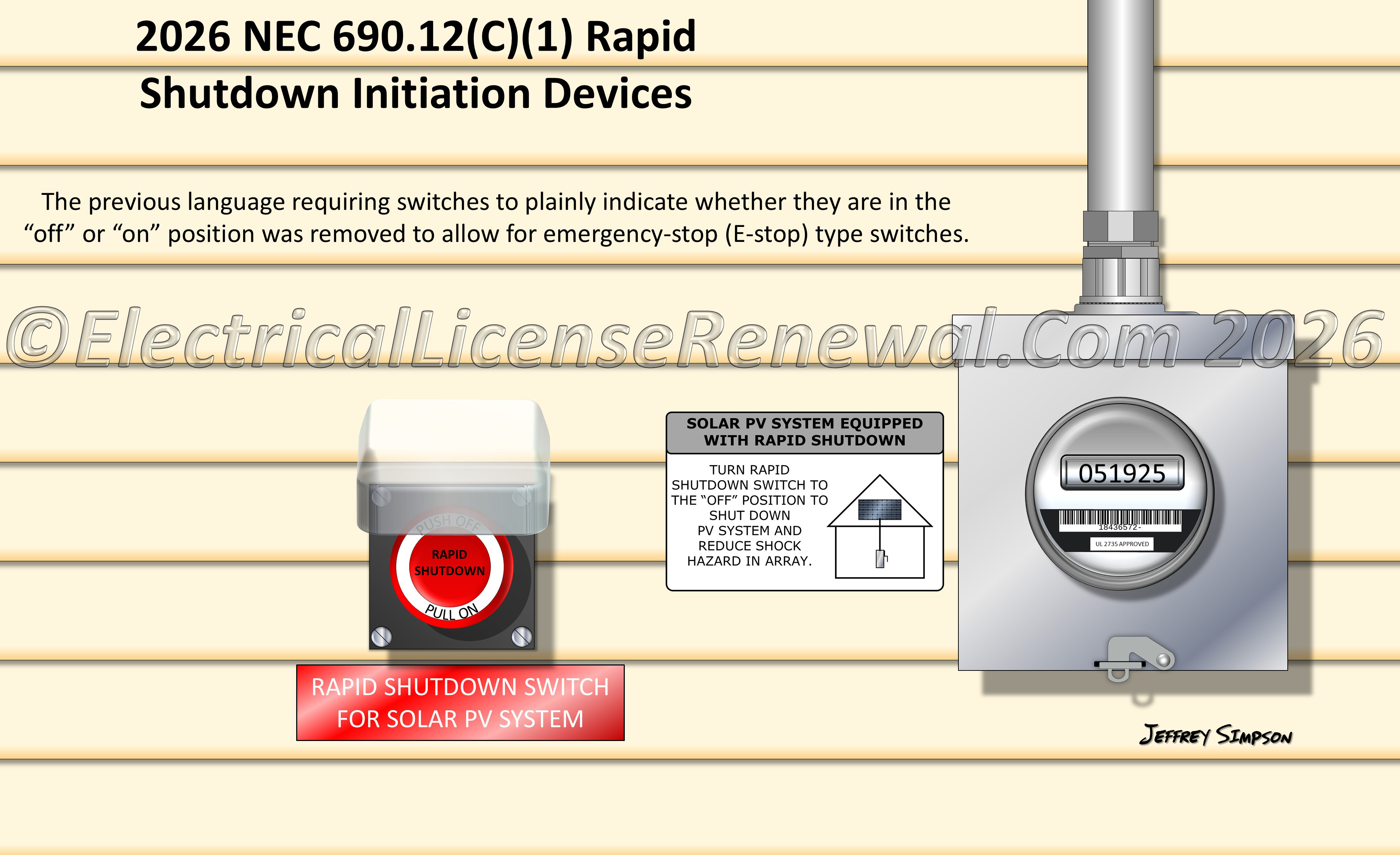
The previous language requiring switches to plainly indicate whether they are in the “off” or “on” position was removed to allow for emergency-stop (E-stop) type switches.
Code Change Summary: Several revisions were made to 690.12(B) and 690.12(C) to improve clarity, reorganize requirements, and align the rapid shutdown provisions with the NEC® Style Manual.
SME commentary: The 2026 NEC® cycle saw notable refinements with the rapid shutdown requirements for PV systems in Sections 690.12(B) and 690.12(C). Most of the work focused on reorganizing the text so that installers and inspectors can more easily determine where voltage control must occur, how shock hazard protection is achieved, and what constitutes an acceptable rapid shutdown initiation method. None of these revisions change the established rapid shutdown performance targets, but they greatly improve how those expectations are presented.
Section 690.12(B) retains the distinction between conductors outside the array boundary and those inside the boundary. Controlled conductors outside the array boundary are still required to be reduced to not more than 30 volts within 30 seconds. Inside the array boundary, PV systems must continue to provide firefighter shock hazard control by using either listed PVHCS equipment or by limiting voltages to not more than 80 volts within 30 seconds. The difference for 2026 is mainly organizational.
The most extensive revision occurs in Section 690.12(C). The 2026 edition reorganizes the initiation device requirements into subdivisions covering type and location, operation, and the rules for multiple PV systems. This improves usability and better aligns with the format required by the NEC® Style Manual. The phrase “readily accessible” now sits in a generalized location that applies to all initiation devices, which eliminates redundant wording and clarifies that device accessibility applies across the entire group of acceptable initiation methods.
The list of permissible rapid shutdown initiation devices in 690.12(C)(1) was simplified to service disconnecting means, PV system disconnecting means, and listed switches. The previous language requiring switches to plainly indicate whether they are in the “off” or “on” position was removed to allow for emergency-stop (E-stop) type switches. E-stops have historically been used in the field, and since the basic function of these switch types is easily evident, the previous marking requirement for a plain indication of the switch positions was not needed.
For installations with multiple PV systems in 690.12(C)(3), the 2026 NEC® rewrites the earlier text to make it clearer that the combined operation of up to six grouped rapid shutdown initiation devices satisfies the requirement to initiate rapid shutdown for all interconnected PV systems.
The reorganization and clarified language in 690.12(B) and 690.12(C) intend to create a more usable framework for installers and inspectors while retaining the same performance goals for rapid shutdown.
Below is a preview of the NEC®. See the actual NEC® text at NFPA.ORG for the complete code section. Once there, click on their link to free access to the 2026 NEC® edition of NFPA 70.
2023 Code Language:
690.12(C) (In part)
Initiation Device. For a single PV system, the rapid shutdown initiation shall occur by the operation of any single initiation device. Devices shall consist of at least one or more of the following:
(1) Service disconnecting means
(2) PV system disconnecting means
(3) Readily accessible switch that plainly indicates whether it is in the “off” or “on” position
2026 Code Language:
690.12(C) (In part)
Initiation Devices. Where circuits identified in 690.12(A) are required to meet the requirements in 690.12(B), initiation devices meeting the requirements in 690.12(C)(1) through 690.12(C)(3) shall be provided to initiate the rapid shutdown function.
(1) Type and Location.
(a) Initiation devices shall be readily accessible and consist of one or more of the following as specified in the rapid shutdown equipment instructions:
(1) Service disconnecting means
(2) PV system disconnecting means
(3) Listed switches
(b) For one- and two-family dwellings, initiation devices, where required, shall be located at an outdoor location.
