690.8(A) Calculation of Maximum Circuit Current.
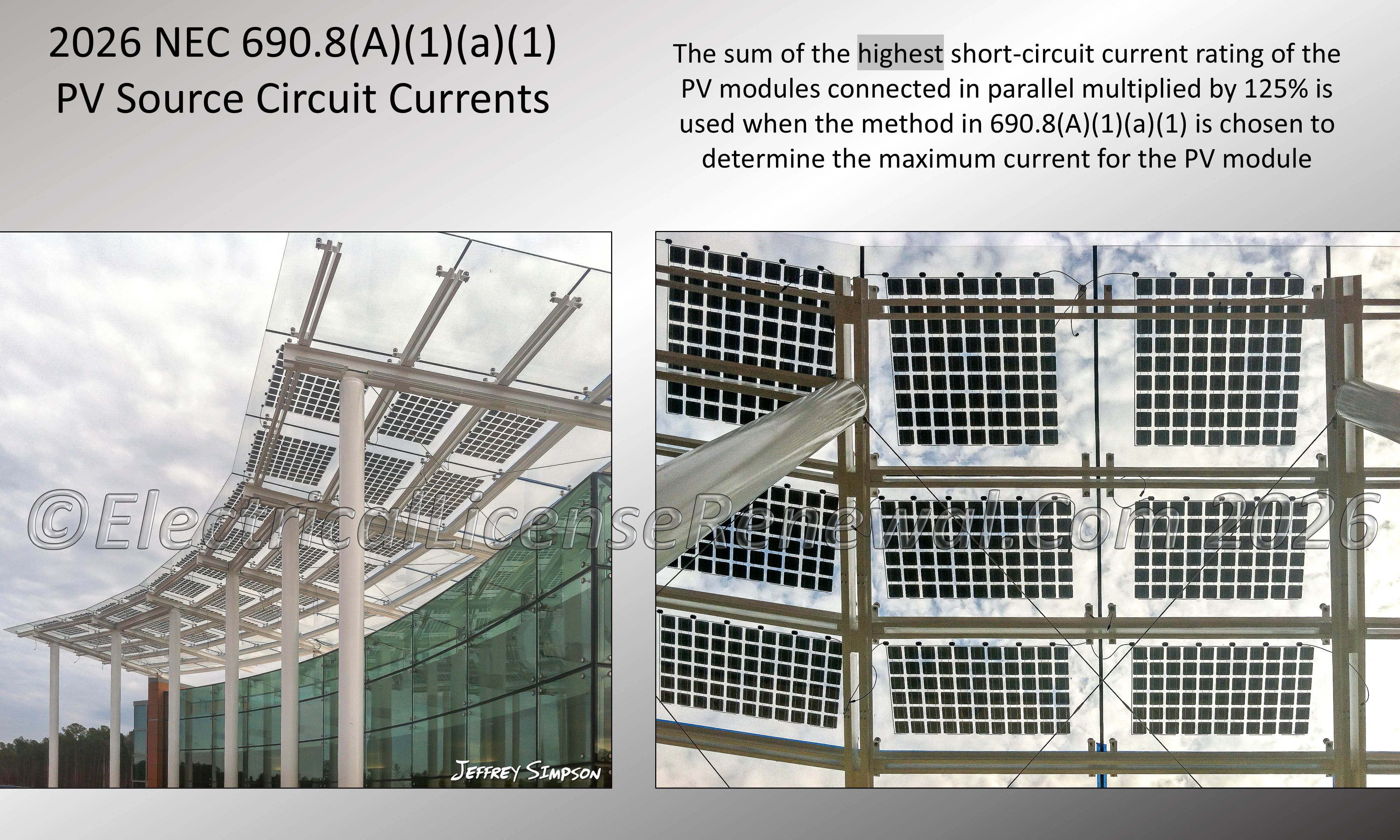
The sum of the highest short-circuit current rating of the PV modules connected in parallel multiplied by 125% is used when the method in 690.8(A)(1)(a)(1) is chosen to determine the maximum current for the PV module.
Code Change Summary: Changes to 690.8(A)(1) clarify how maximum circuit current is calculated for PV source circuits and recognize that PV module listings may specify an alternative method that differs from 690.8(A)(1)(a)(1).
SME commentary: Section 690.8(A)(1) in the 2026 NEC® has been revised to address growing variability in PV module design, particularly bifacial modules (two-sided) which can produce power from both sides of the PV module. Traditional modules have an opaque backing sheet under the PV cells whereas bifacial modules can be frameless allowing exposure to the top and bottom of the PV module permitting significant gains in additional power produced by the module. This is beneficial for PV module installations where adjacent building surfaces are highly reflective (see image).
PV modules capable of producing electricity when exposed to light on multiple surfaces may have higher short-circuit current ratings (ISC) than those with an ISC rating based only on front-side exposure.
Bifacial modules are marked with an ISC value for the front side and are provided with additional values in the instructions to calculate additional current that can be gained from rear-side sunlight exposure. Several values to determine the rear-side gain are typically provided and each is dependent on how much sunlight exposure is expected to reach the rear side of the module.
Previous NEC® editions relied primarily on a simple ISC-based calculation in 690.8(A)(1)(a)(1), which did not always capture the highest current contribution possible under certain installation configurations. These variations created uncertainty during plan review and field inspection when the rear-side irradiance could not be predicted with confidence.
The Code Making Panel clarified this point by adding the word “highest” to the beginning of Section 690.8(A)(1)(a)(1). This makes it clear that “the sum of the highest short-circuit current rating of the PV modules connected in parallel multiplied by 125 percent” is used when this method is chosen to determine the maximum current for the module. This ensures conductor ampacity and overcurrent protective devices are selected based on the most demanding operating condition the module could reasonably experience. The informational note from the 2023 NEC® addressing modules with multiple short-circuit ratings has been relocated into a second informational note under 690.8(A)(1)(a), making the guidance more visible. This note explains that modules capable of producing electricity on multiple surfaces will be labeled with applicable short-circuit current values and that instructions included in the listing provide necessary guidance for determining the ISC.
Another significant update appears in 690.8(A)(1)(a)(2). This new item recognizes that the installation instructions included with a module’s listing may provide a different method of calculating maximum circuit current than the traditional 125 percent short-circuit current approach. Some manufacturers may choose to have their modules listed using prescribed current calculation procedures that account for their specific performance characteristics, including modules that exhibit substantial variation based on rear-surface gain. The 2026 NEC® acknowledges these instructions and permits their use as a valid method for current calculation. This provides the designer the ability to follow listing-based values rather than applying a single generalized formula across all module technologies.
Lastly, the licensed-engineer method has been revised and renumbered as item 690.8(A)(1)(a)(3) to align with a similar structural change made in 690.7(A)(3). This section previously applied only to systems 100 kW and larger but now applies to any PV system regardless of size.
The restructuring of 690.8(A)(1) provides installers and inspectors with more precise code language that aligns with current PV module technologies, improves consistency during design, and better ensures that conductor ampacity and OCPD selection reflect the actual capabilities of the PV array.
Below is a preview of the NEC®. See the actual NEC® text at NFPA.ORG for the complete code section. Once there, click on their link to free access to the 2026 NEC® edition of NFPA 70.
2023 Code Language:
690.8(A)(1) PV System Circuits. The maximum current shall be calculated in accordance with 690.8(A)(1)(a) through (A)(1)(c).
(a) Photovoltaic Source Circuit Currents. The maximum current shall be as calculated in either of the following:
(1) The maximum current shall be the sum of the short-circuit current ratings of the PV modules connected in parallel multiplied by 125 percent.
(2) For PV systems with an inverter generating capacity of 100 kW or greater, a documented and stamped PV system design, using an industry standard method maximum current calculation provided by a licensed professional electrical engineer, shall be permitted. The calculated maximum current value shall be based on the highest 3-hour current average resulting from the simulated local irradiance on the PV array accounting for elevation and orientation. The current value used by this method shall not be less than 70 percent of the value calculated using 690.8(A)(1)(a)(1).
Informational Note: See SAND 2004-3535, Photovoltaic Array Performance Model, for one industry standard method for calculating maximum current of a PV system. This model is used by the System Advisor Model simulation program provided by the National Renewable Energy Laboratory.
2026 Code Language:
690.8(A)(1) PV System Circuits. The maximum current shall be calculated in accordance with 690.8(A)(1)(a) through 690.8(A)(1)(c).
(a) Photovoltaic Source Circuit Currents. Maximum current shall be calculated using one of the following methods:
(1) The sum of the highest short-circuit current rating of the PV modules connected in parallel multiplied by 125 percent
(2) The sum of the short-circuit current ratings of the PV modules connected in parallel calculated in accordance with the instructions included in the listing or labeling of the module
(3) Documented and stamped PV system design, using an industry standard method maximum current calculation provided by a licensed professional electrical engineer, as follows:
a. The calculated maximum current value shall be based on the highest 3-hour current average resulting from the simulated local irradiance on the PV array accounting for elevation and orientation.
b. The current value used by this method shall not be less than 70 percent of the value calculated using 690.8(A)(1)(a)(1).
Informational Note No. 1: See SAND 2004-3535, Photovoltaic Array Performance Model, for one industry standard method for calculating maximum current of a PV system. This model is used by the System Advisor Model simulation program provided by the National Renewable Energy Laboratory.
Informational Note No. 2: Modules that can produce electricity when exposed to light on multiple surfaces are labeled with applicable short-circuit currents. Additional guidance is provided in the instructions included with the listing.
