690.7(A) Determining Maximum DC Voltage in PV Source Circuits.
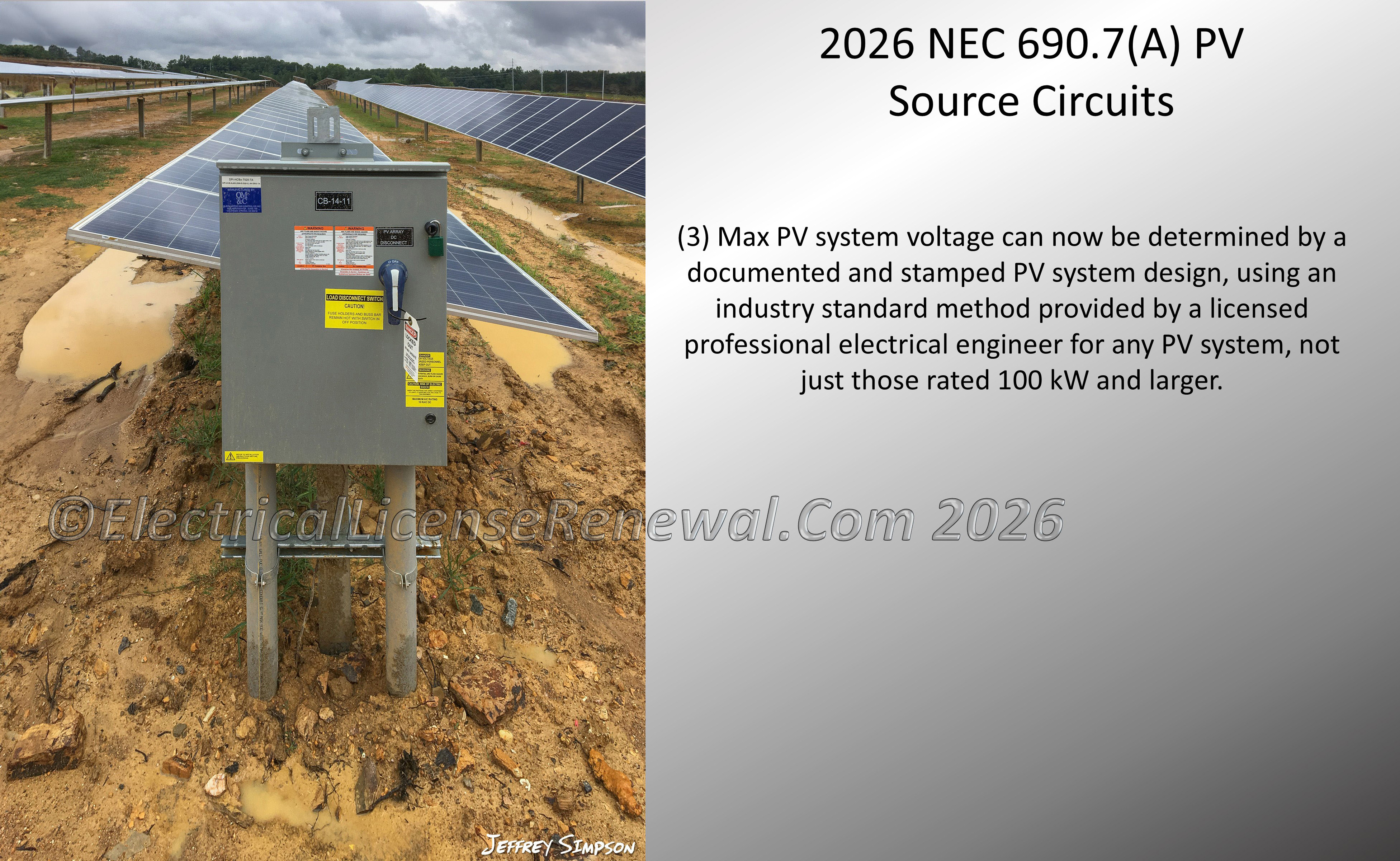
Max PV system voltage can now be determined by a documented and stamped PV system design, using an industry standard method provided by a licensed professional electrical engineer for any PV system, not just those rated 100 kW and larger.
Code Change Summary: The 2026 NEC® removes the 100 kW threshold and allows a licensed professional electrical engineer to use an industry standard method to determine maximum PV source circuit voltage for systems of any size.
SME commentary: In the 2026 NEC®, Section 690.7(A)(3) was revised to permit a “documented and stamped PV system design, using an industry standard method maximum voltage calculation provided by a licensed professional electrical engineer” for any PV system, not just those rated 100 kW and larger. Under the 2023 NEC®, this option was limited to PV systems with an inverter generating capacity of 100 kW or greater. Designers of smaller systems were obligated to use only the prescriptive open-circuit voltage method that relies on the sum of series-connected module voltages corrected for the expected ambient temperature. The updated text recognizes that licensed professional electrical engineers regularly use validated performance modeling software and nationally accepted methods for calculating maximum voltage across projects of all sizes, not only larger commercial PV system designs.
The substantiation for this revision makes clear that the 100 kW threshold was originally introduced as an arbitrary boundary, not because smaller PV systems require a different technical approach. Performance modeling tools widely used in the PV industry incorporate historical weather data, module test information, and standardized engineering assumptions to determine voltage behavior in cold-weather conditions. These tools do not differentiate between a 10 kW rooftop array and a 100 kW ground-mounted installation. In both cases, a licensed PE producing a stamped design would rely on the same process, the same software, and the same engineering principles to determine the maximum DC voltage.
The new language therefore removes an artificial distinction and acknowledges that the suitability of an engineered voltage calculation depends on the qualifications of the licensed professional, not on the system capacity. If a project is designed and stamped by a PE who applies an industry standard method accepted throughout the PV sector, the calculation is suitable for any system size. Plan reviewers and inspectors retain the ability to request supporting documentation if needed, but the Code no longer limits the option to systems above the former 100 kW threshold.
Safety is preserved by ensuring that any engineering calculation used in lieu of the prescriptive temperature-correction approach is performed by an individual licensed to take professional responsibility for the design. Installers can build according to a stamped plan set without concern that the overall system size affects the allowed voltage calculation method. The Code Making Panel agreed with this reasoning and removed the threshold to provide consistent treatment of PV systems while maintaining confidence in the accuracy of the engineered voltage determination.
Below is a preview of the NEC®. See the actual NEC® text at NFPA.ORG for the complete code section. Once there, click on their link to free access to the 2026 NEC® edition of NFPA 70.
2023 Code Language:
690.7(A) Photovoltaic Source Circuits. The maximum dc voltage for a PV source circuit shall be calculated in accordance with one of the following methods:
(3) For PV systems with an inverter generating capacity of 100 kW or greater, a documented and stamped PV system design, using an industry standard method maximum voltage calculation provided by a licensed professional electrical engineer
2026 Code Language:
690.7(A) PV Source Circuits. The maximum dc voltage for PV source circuits shall be the sum of the series-connected PV module rated open-circuit voltages corrected for ambient temperature using one of the following methods:
(3) Documented and stamped PV system design, using an industry standard method maximum voltage calculation provided by a licensed professional electrical engineer
