680.26(B)(5) Metal Fittings and Metal Structures.
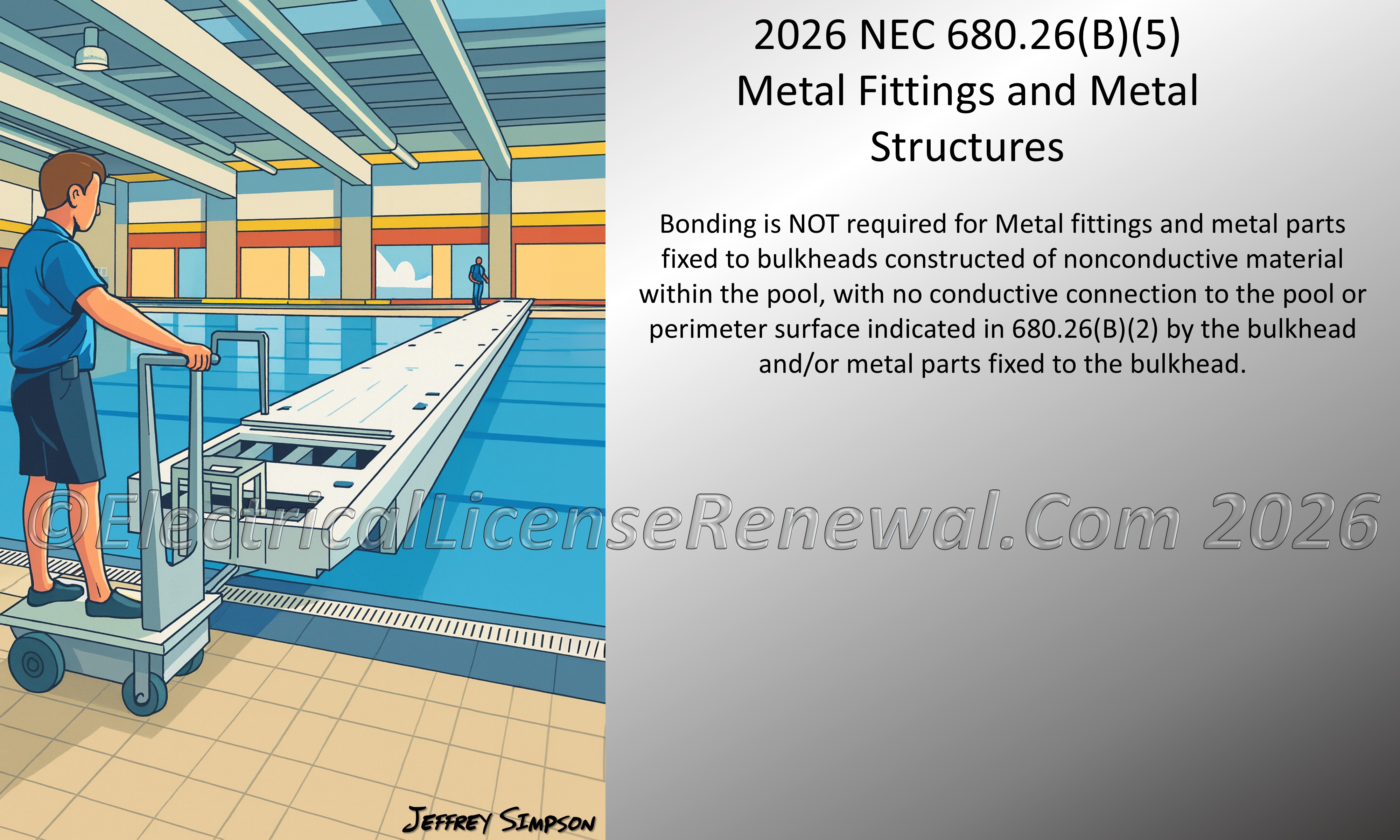
Bonding is NOT required for Metal fittings and metal parts fixed to bulkheads constructed of nonconductive material within the pool, where no conductive connection exists to the pool or perimeter surface indicated in 680.26(B)(2) by the bulkhead and/or metal parts fixed to the bulkhead.
Code Change Summary: Section 680.26(B)(5) was revised to clarify bonding requirements for metal structures and metal parts fixed to nonconductive bulkheads.
SME commentary: In the 2026 NEC®, Section 680.26(B)(5) broadens the coverage of “Metal Fittings” to include metal structures within or attached to the pool or perimeter surface. This adjustment responds to questions raised during the previous cycle regarding components installed in or around commercial pools that were not specifically addressed in the prior terminology. The intent is to provide clear direction for bonding metal parts that may become energized and create voltage gradients in areas accessible to swimmers or occupants on the pool deck.
A significant portion of the revision centers on pool bulkheads, which are movable structures used to divide competitive or instructional pools into separate lanes or activity zones. Many of these bulkheads are constructed from fiberglass or other nonconductive materials, with metal fittings or hardware used as connection points, adjustment mechanisms, tracks, or anchoring components. The 2023 NEC® did not explicitly address how bonding rules apply to these mixed-material structures, leading to interpretations that varied across jurisdictions.
The revised text now makes it clear that all metal fittings and metal structures within or attached to the pool or perimeter surface indicated in 680.26(B)(2) shall be bonded, unless they qualify under one of the listed exceptions. This includes metal parts fixed to bulkheads, even when the bulkhead itself is nonconductive. The addition of new item (4) in the exception clarifies that bonding is NOT required for Metal fittings and metal parts fixed to bulkheads constructed of nonconductive material within the pool, with no conductive connection to the pool or perimeter surface indicated in 680.26(B)(2) by the bulkhead and/or metal parts fixed to the bulkhead. In these cases, the NEC® recognizes that the metal components are effectively isolated from a conductive path back to the pool structure, and therefore do not introduce a shock hazard under normal conditions.
The revision also reorganizes the existing exception list by moving the new bulkhead language into the exception structure, helping inspectors and installers determine when bonding applies and when it does not. CMP statements note that the change is intended to address the growing use of moveable bulkheads and the variety of materials used in their construction. The added clarity ensures that metal components which can create parallel conductive paths are properly incorporated into the equipotential bonding system, while components that are isolated on nonconductive supports are treated differently.
Below is a preview of the NEC®. See the actual NEC® text at NFPA.ORG for the complete code section. Once there, click on their link to free access to the 2026 NEC® edition of NFPA 70.
2023 Code Language:
680.26(B)(5) Metal Fittings. All metal fittings within or attached to the pool structure shall be bonded.
Exception: The following shall not be required to be bonded:
(1) Isolated parts that are not over 4 inches in any dimension and do not penetrate into the pool structure more than 1 inch.
(2) Metallic pool cover anchors intended for insertion in a concrete or masonry deck surface, 1 inch or less in any dimension and 2 inches or less in length.
(3) Metallic pool cover anchors intended for insertion in a wood or composite deck surface, 2 inches or less in any flange dimension and 2 inches or less in length.
2026 Code Language:
680.26(B)(5) Metal Fittings and Metal Structures. All metal fittings and metal structures within or attached to the pool or perimeter surface indicated in 680.26(B)(2) shall be bonded.
Exception: The following shall not be required to be bonded:
(1) Isolated parts that are not over 4 inches in any dimension and do not penetrate into the pool structure more than 1 inch.
(2) Metallic pool cover anchors intended for insertion in a concrete or masonry deck surface, 1 inch or less in any dimension and 2 inches or less in length.
(3) Metallic pool cover anchors intended for insertion in a wood or composite deck surface, 2 inches or less in any flange dimension and 2 inches or less in length.
(4) Metal fittings and metal parts fixed to bulkheads constructed of nonconductive material within the pool, with no conductive connection to the pool or perimeter surface indicated in 680.26(B)(2) by the bulkhead and/or metal parts fixed to the bulkhead.
