680.26(B)(2) Perimeter Surfaces.
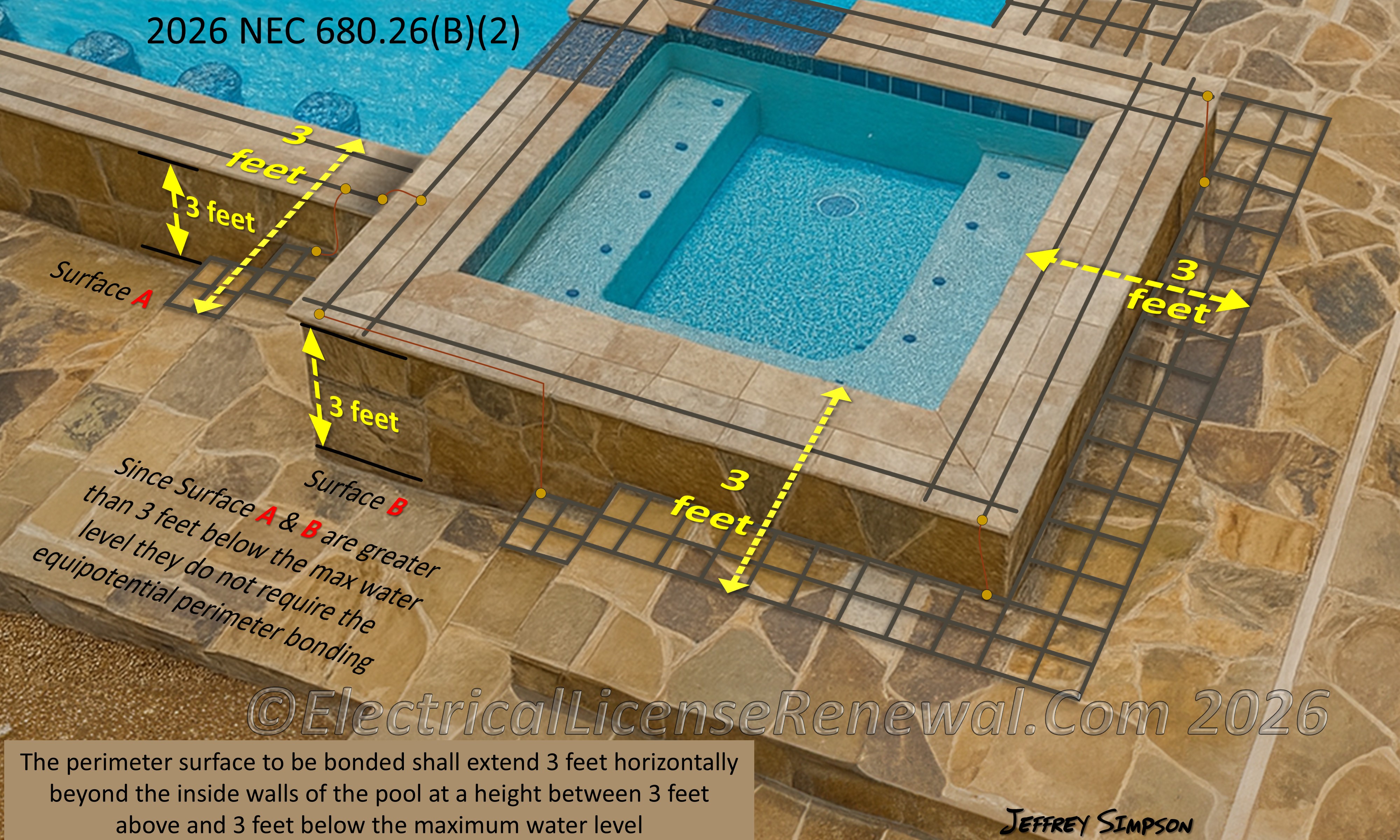
The perimeter surface to be bonded shall extend 3 feet horizontally beyond the inside walls of the pool at a height between 3 feet above and 3 feet below the maximum water level.
Code Change Summary: Section 680.26(B)(2) was revised to adjust the zone where perimeter surface bonding is required.
SME commentary: In the 2026 NEC®, Section 680.26(B)(2) receives an important clarification that directly affects how the zone for perimeter surface bonding is determined around permanently installed swimming pools. Earlier editions based the boundary of the bonding zone on a point located 2 feet below the maximum water level, combined with the established 3-foot horizontal dimension extending beyond the inside walls of the pool. While this method captured much of the area where a person might contact the pool deck, questions were raised during the 2026 development cycle about whether the earlier measurement consistently reflected a person’s physical reach when interacting with the water while standing outside the pool.
During the 2026 cycle, concerns were raised regarding whether this measurement accurately reflected the location of a person’s hands and arms when interacting with the pool water while standing outside the pool on surrounding surfaces. A user standing on a lower surface may place their hands into the water while the contact point between their feet and the perimeter surface is below the earlier measurement threshold. If a voltage gradient exists on that lower surface, the previous measurement could leave part of the reachable zone outside the bonding requirement.
To address this, the 2026 NEC® revises the vertical measurement used to define the bonding zone. Section 680.26(B)(2) now states that the perimeter surface to be bonded shall extend 3 feet horizontally beyond the inside walls of the pool at a height between 3 feet above and 3 feet below the maximum water level. This change replaces the previous 2-foot below reference with a more realistic representation of human reach based on typical standing height relative to the deck and waterline.
This change represents a more realistic representation of the height difference between the water surface and the standing position of a user leaning into the pool. The 3-foot vertical reference better aligns with the typical standing height above the deck when a person reaches into the water. This adjustment better captures the potential reach range and improves the alignment between human contact height and bonding coverage. By revising this value and integrating copper-clad steel throughout the section, the 2026 NEC® improves clarity while maintaining the safety intent of minimizing voltage gradients in pool environments.
Below is a preview of the NEC®. See the actual NEC® text at NFPA.ORG for the complete code section. Once there, click on their link to free access to the 2026 NEC® edition of NFPA 70.
2023 Code Language:
680.26(B)(2) Perimeter Surfaces. The perimeter surface to be bonded shall be considered to extend for 3 feet horizontally beyond the inside walls of the pool while also at a height between 3 feet above and 2 feet below the maximum water level. The perimeter surface shall include unpaved surfaces, concrete, and other types of paving. Perimeter surfaces separated from the pool by a permanent wall or building 1.5 m (5 ft) in height or more shall require equipotential bonding only on the pool side of the permanent wall or building.
2026 Code Language:
680.26(B)(2) Perimeter Surfaces. Bonding to perimeter surfaces shall be provided as specified in 680.26(B)(2)(a), 680.26(B)(2)(b), 680.26(B)(2)(c), and 680.26(B)(2)(d). The perimeter surface shall include unpaved surfaces, concrete, masonry pavers, and other types of paving. The perimeter surface to be bonded shall extend 3 feet horizontally beyond the inside walls of the pool at a height between 3 feet above and 3 feet below the maximum water level. Perimeter surfaces separated from the pool by a permanent wall or building 5 feet in height or more shall require equipotential bonding only on the pool side of the permanent wall or building.
