680.26(B) Equipotential Bonding.
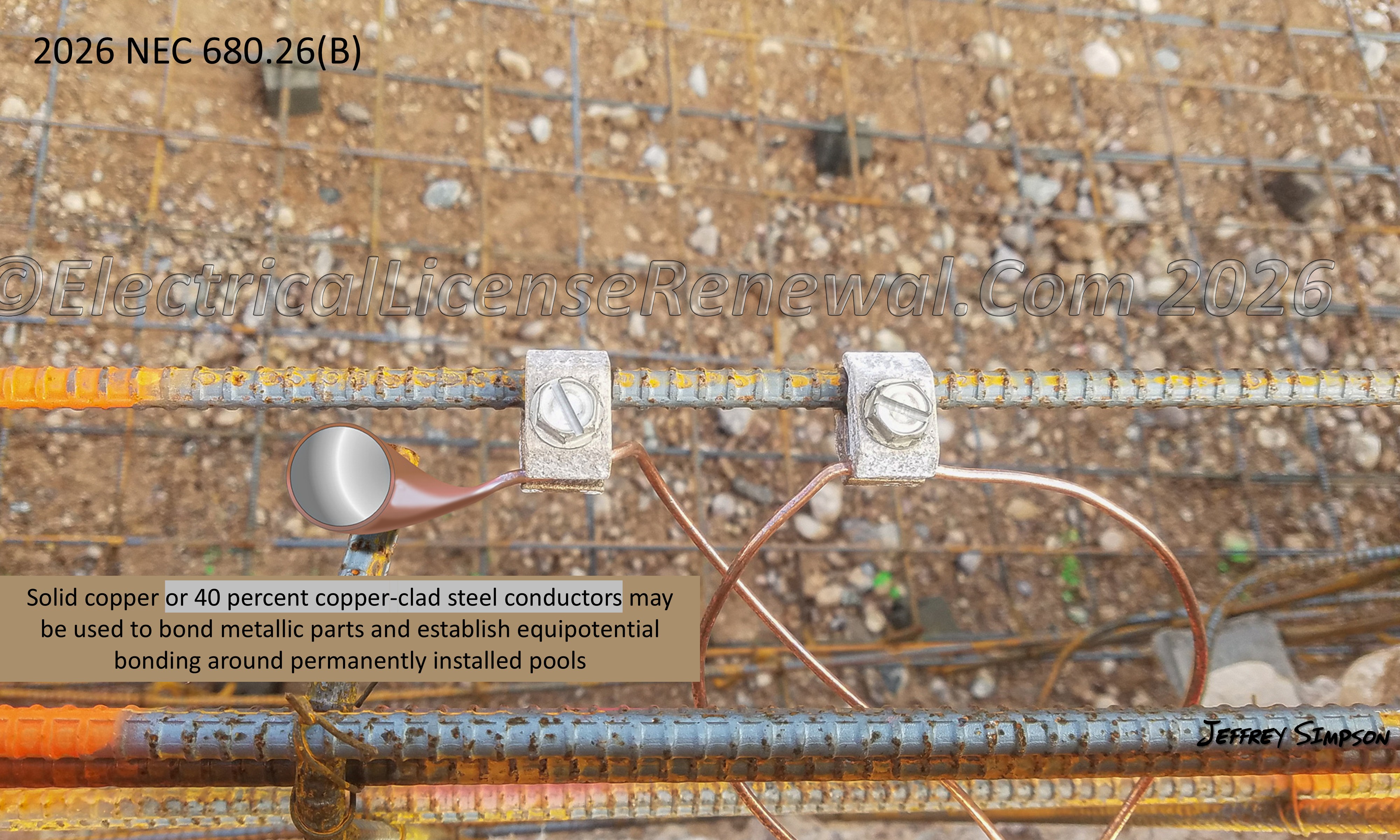
Solid copper or 40 percent copper-clad steel conductors may be used to bond metallic parts and establish equipotential bonding around permanently installed pools.
Code Change Summary: Section 680.26(B) was revised to permit 40 percent copper-clad steel for equipotential bonding.
SME commentary: In the 2026 NEC®, Section 680.26(B) expands the permitted materials used to bond metallic parts and establish equipotential bonding around permanently installed pools. Historically, Article 680 relied almost exclusively on solid copper conductors for equipotential bonding connections. As wiring materials and pool construction methods continue to evolve, proposed language was introduced to allow an alternative conductor material that still maintains the electrical integrity required to reduce voltage gradients through equipotential bonding.
For 2026, the Code now recognizes 40 percent copper-clad steel conductors meeting the same minimum size requirements applied to copper bonding conductors. The new text in 680.26(B)(1) specifies that solid copper or 40 percent copper-clad steel conductors, that are insulated, covered, or bare, and not smaller than 8 AWG can be used to bond the parts specified in 680.26(B)(1) through 680.26(B)(7). This recognition is significant because copper-clad steel combines the conductivity and corrosion resistance of copper with the mechanical strength and reduced cost profile of steel.
During the 2026 code development cycle, substantiation was submitted demonstrating that 40 percent copper-clad steel performs adequately for pool equipotential bonding applications. Test data presented to the code-making panel addressed conductivity, corrosion resistance, and long-term durability in typical pool environments. As a result, 680.26(B) now recognizes copper-clad steel conductors not smaller than 8 AWG, whether installed as a conductor grid under 680.26(B)(1)(b) or as part of the continuous bonding conductor specified in 680.26(B)(2). The approval of this material reflects the Code’s effort to expand material flexibility without compromising the performance characteristics essential for controlling voltage gradients in the pool environment.
Recognizing copper-clad steel provides installers with more flexibility, particularly in regions where copper prices fluctuate or where supply chain constraints affect availability. Designers of conductive pool shells or pool decks using perimeter bonding grids may also benefit from the increased tensile strength of copper-clad steel compared with solid copper, especially when longer conductor runs are required around the pool shell or across expansive deck layouts. Regardless of conductor material, all bonding connections must still comply with 250.8 and be made with listed components suitable for the environment.
Below is a preview of the NEC®. See the actual NEC® text at NFPA.ORG for the complete code section. Once there, click on their link to free access to the 2026 NEC® edition of NFPA 70.
2023 Code Language:
680.26(B) Bonded Parts. The parts specified in 680.26(B)(1) through (B)(7) shall be bonded together using solid copper conductors, insulated, covered, or bare, not smaller than 8 AWG or with rigid metal conduit of brass or other identified corrosion-resistant metal. Connections to bonded parts shall be made in accordance with 250.8. An 8 AWG or larger solid copper bonding conductor provided to reduce voltage gradients in the pool area shall not be required to be extended or attached to remote panelboards, service equipment, or electrodes.
2026 Code Language:
680.26(B) Bonded Parts. The parts specified in 680.26(B)(1) through 680.26(B)(7) shall be bonded together using one or more of the following:
(1) Solid copper or 40 percent copper-clad steel conductors, as follows:
a. Are insulated, covered, or bare, not smaller than 8 AWG
b. Are not required to be extended or attached to remote panelboard enclosures, service equipment, or electrodes
c. Are permitted to encircle the pool to facilitate bonding connections to portions of the perimeter covered in 680.26(B)(2)(a) and 680.26(B)(2)(b) that are not contiguous
