625.43 EVSE Disconnecting Means.
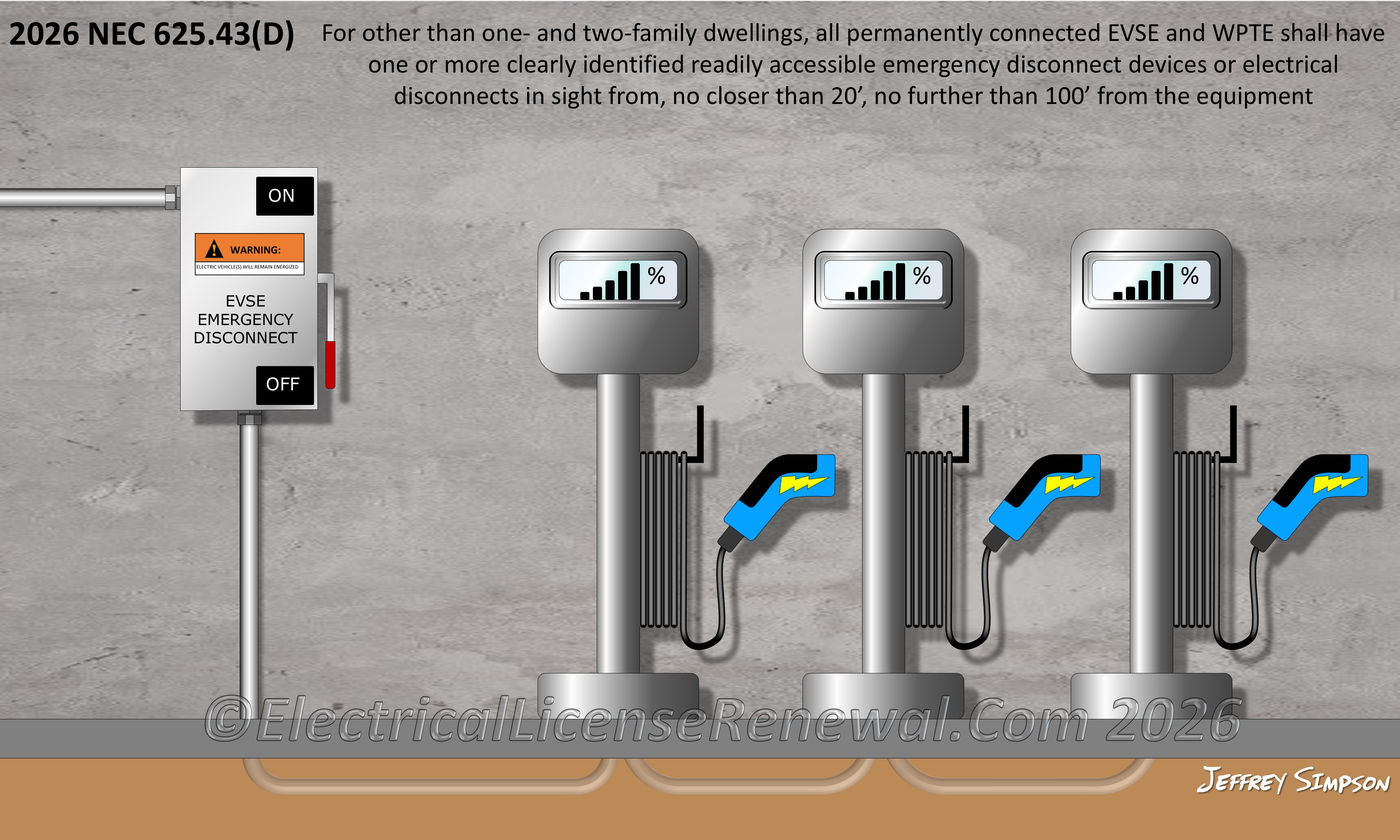
Emergency disconnects are now required in NEC 625.43.
Code Change Summary: Section 625.43 was reorganized and expanded in the 2026 NEC® to clarify EVSE and WPTE disconnecting-means requirements.
SME commentary: In the 2026 NEC®, the rules for disconnecting means for electric vehicle supply equipment (EVSE) and wireless power transfer equipment (WPTE) were completely reorganized into four subsections and expanded to address several installation conditions that were not well defined in earlier editions. Section 625.43 now contains general requirements, provisions for multifamily dwellings, rules for equipment disconnects, and new requirements for emergency shutoff devices. The previous thresholds of more than 60 amperes or more than 150 volts to ground were removed, and all EVSE and WPTE disconnects are now addressed under 625.43.
The new General requirement in 625.43(A) states that EVSE and WPTE shall be provided with one or more disconnecting means in accordance with 625.43(B) through (D), depending on the type of installation. This makes the disconnecting-means requirement universal instead of limited to certain voltage or ampere ratings. It also closes the gap that previously left some permanently connected 120/240-volt equipment without a required disconnecting means.
For multifamily dwellings, 625.43(B) requires that when multiple EVSE or WPTE are served through individual disconnects, a plaque or directory must be installed to identify which disconnect serves which unit. This assists service personnel and AHJs by making the relationship between the equipment and its disconnect clear, especially in parking structures or garages where multiple chargers may be grouped together.
The expansion of equipment disconnects appears in 625.43(C). All permanently connected EVSE and WPTE must now have a disconnecting means installed in a readily accessible location. If the disconnecting means is remote, a plaque or directory shall be installed at the equipment denoting the disconnecting means location. For cord- and plug-connected EVSE and WPTE, the attachment plug is permitted to serve as the disconnecting means for units rated not exceeding 60 amperes or not exceeding 150 volts to ground, and the disconnect must be lockable open in accordance with 110.25.
The most significant addition appears in 625.43(D), which introduces the requirement for clearly identified emergency shutoff devices for all permanently connected EVSE and WPTE installations in other than one- and two-family dwellings. These emergency disconnect devices must meet all of the following:
1. Be installed in a readily accessible location between 20 feet and 100 feet from the equipment and in sight from the equipment
2. Disconnect power to all EVSE and WPTE within sight of the emergency shutoff
3. Be marked “EVSE EMERGENCY DISCONNECT” and “WARNING: ELECTRIC VEHICLE(S) WILL REMAIN ENERGIZED” in accordance with 110.22(A)
4. Be a manual reset type
5. Disconnect all ungrounded conductors simultaneously from the supply source
Collectively, the reorganized structure and added detail in 625.43 give installers, AHJs, and emergency personnel clearer expectations and safer methods to control EV charging equipment during maintenance and emergency events.
Below is a preview of the NEC®. See the actual NEC® text at NFPA.ORG for the complete code section. Once there, click on their link to free access to the 2026 NEC® edition of NFPA 70.
2023 Code Language:
625.43 Disconnecting Means. For EVSE and WPTE rated more than 60 amperes or more than 150 volts to ground, the disconnecting means shall be provided and installed in a readily accessible location. If the disconnecting means is installed remote from the equipment, a plaque shall be installed on the equipment denoting the location of the disconnecting means. The disconnecting means shall be lockable open in accordance with 110.25.
2026 Code Language:
625.43 Disconnecting Means.
N (A) General. EVSE and WPTE shall be provided with one or more disconnecting means in accordance with 625.43(B) through 625.43(D), as applicable.
N (B) Multifamily Dwellings. For multifamily dwellings where multiple EVSE or WPTE are each served through individual disconnecting means, a plaque or directory shall be attached to each EVSE or WPTE and its corresponding disconnect clearly identifying which disconnect serves which EVSE or WPTE.
N (C) Equipment Disconnects. For permanently connected EVSE and WPTE, a disconnecting means shall be provided and installed in a readily accessible location. If the disconnecting means is installed remote from the equipment, a plaque or directory shall be installed on the equipment denoting the location of the disconnecting means. For cord- and plug-connected EVSE and WPTE, with a rating not exceeding 60 amperes or not exceeding 150 volts to ground, the cord and plug shall be permitted to serve as the disconnecting means. The disconnecting means shall be lockable open in accordance with 110.25.
N (D) Emergency Shutoff.
(1) Emergency Disconnect Devices. For other than one- and two-family dwellings, all permanently connected EVSE and WPTE shall be provided with one or more clearly identified emergency disconnect devices or electrical disconnects that meet all of the following:
(1) Be installed in a readily accessible location not less than 20 feet nor more than 100 feet from the equipment and in sight from the equipment
(2) Disconnect power to all EVSE and WPTE within sight of emergency shutoff
(3) Be marked “EVSE EMERGENCY DISCONNECT” and “WARNING: ELECTRIC VEHICLE(S) WILL REMAIN ENERGIZED” in accordance with 110.22(A)
(4) Be a manual reset type
(5) Disconnect all ungrounded conductors of the circuits simultaneously from the source of supply
(2) Disconnecting Means Serving as Emergency Shutoff. The disconnecting means required in accordance with 625.43(C) shall be permitted to serve as the emergency disconnect if it complies with all the requirements of 625.43(D).
