Article 624 Electric Self-Propelled Vehicle Power Transfer Systems (ESVSEs).
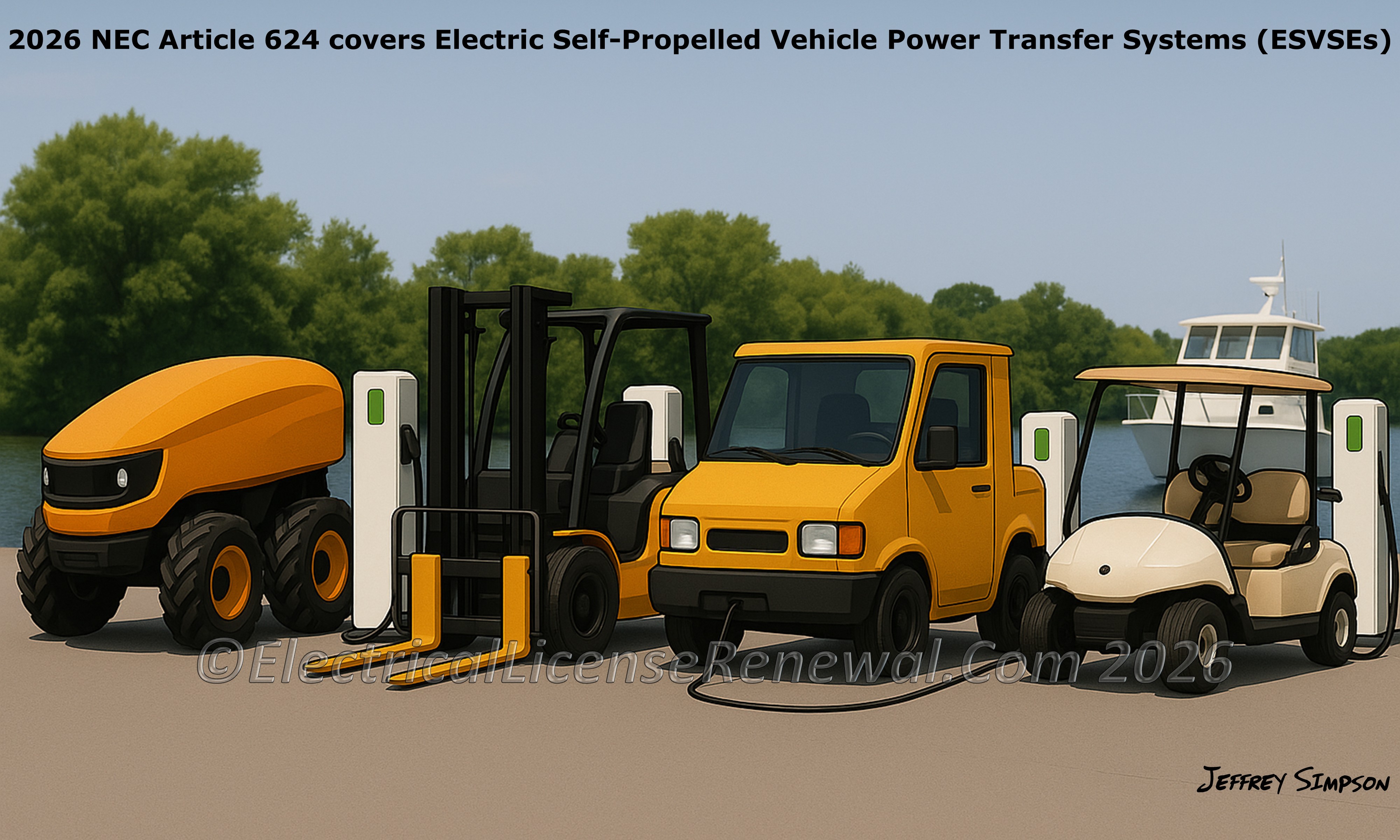
NEC Article 624 covers Electric Self-Propelled Vehicle Power Transfer Systems (ESVSEs).
Code Change Summary: A new Article 624 was added to provide requirements for power transfer systems serving Electric Self-Propelled Vehicles (ESVs).
SME commentary: The 2026 NEC® introduces new Article 624 titled Electric Self-Propelled Vehicle Power Transfer Systems (ESVSEs) to complement the scope of existing Article 625, which remains dedicated to electric vehicles intended for on-road use. Article 624 establishes electrical installation requirements for charging, power export, and safety functions related to a rapidly expanding class of non-roadgoing, battery-powered equipment defined in Article 100 as Electric Self-Propelled Vehicles (ESVs).
The scope of the new article in 624.1 states that the article covers the electrical conductors and equipment connecting an ESV to premises wiring for the purposes of charging, power export, or bidirectional current flow.
Prior to this addition, Article 625 addressed only electric vehicles and defined them in Article 100 making it clear that it only applied to vehicles for “on-road use”. That left a broad range of industrial and commercial equipment without specific NEC® coverage even though these systems often involved comparable charging voltages and current capacities. Examples include electric forklifts, airport ground-support equipment, construction tractors, golf carts, and marine vessels such as electric ferries or workboats. While these were clearly electrical vehicles by nature, their exclusion from Article 625 created uncertainty for designers, installers, and inspectors when evaluating wiring methods, charging systems, and safety disconnecting means.
In the 2026 NEC®, new Article 624 closes this regulatory gap by providing dedicated rules for non-road ESV technology. The substantiation for the new article emphasized the growing need for standardized installation methods as industries increasingly use electric propulsion in off-road and specialized environments. Airports, seaports, amusement facilities, agricultural operations, and industrial plants now employ fleets of electrically powered vehicles that rely on regulated charging and bidirectional power-transfer equipment similar in principle to traditional EV supply equipment. New Article 624 ensures these systems achieve equivalent levels of personnel protection, grounding, overcurrent coordination, and equipment listing as those required for highway EV use.
New definitions for Electric Self-Propelled Vehicle Power Export Equipment (ESVPE) and Electric Self-Propelled Vehicle Supply Equipment (ESVSE) appear in Article 100 to support new Article 624. Together they describe both sides of the charging interface, the equipment that transfers power from premises wiring system to the vehicle, and the equipment on the vehicle that can return power to external loads or premises wiring systems. This dual capability mirrors the bidirectional “vehicle-to-grid” functions emerging in Article 625 but tailored for ESVs operating in controlled or private locations rather than on public roadways.
Below is a preview of the NEC®. See the actual NEC® text at NFPA.ORG for the complete code section. Once there, click on their link to free access to the 2026 NEC® edition of NFPA 70.
2023 Code Language:
Article 624 did not exist
2026 Code Language:
N Article 624 Electric Self-Propelled Vehicle Power Transfer Systems (ESVSEs)
