590.6(E) Lamp Protection for Temporary Installations.
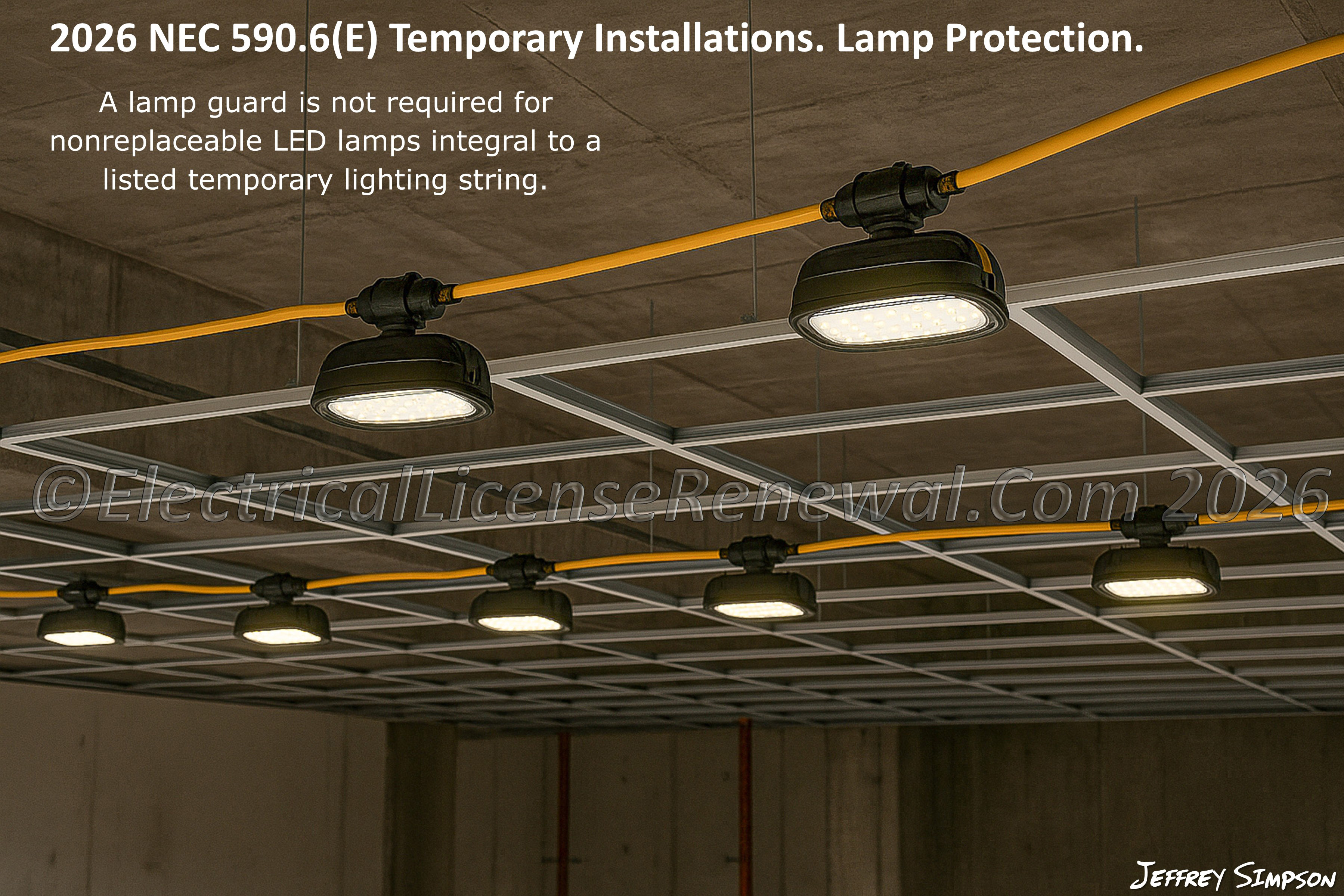
A lamp guard is not required for nonreplaceable LED lamps integral to a listed temporary lighting string.
Code Change Summary: Revised language adds clarity and introduces an exception for listed LED temporary lighting strings with non-replaceable lamps.
SME commentary: In the 2026 NEC®, Section 590.6(E) (formerly 590.4(F)) was revised to simplify terminology, improve clarity, and align with modern product standards for temporary lighting. The word sockets was deleted, as it reflects an outdated term historically used since the earliest edition of the NEC® in 1897 to describe both lampholders and receptacles. Current industry terminology now distinguishes between these components, and the code language has been modernized accordingly.
A new exception to 590.6(E) states that “a guard shall not be required for nonreplaceable LED lamps integral to a listed temporary lighting string”. This change is intended to recognize certain listed LED temporary lighting strings that do not require protective guards. This language aligns the NEC® with the product safety requirements in UL 1088, Standard for Temporary Lighting Strings, which now permits unguarded, non-replaceable LED lamps when the assembly passes crush and impact resistance tests and when no exposed surfaces exceed 90 °C. The UL 1088 Technical Committee formally adopted these provisions in 2013, acknowledging that the lower surface temperatures and integral design of modern LED assemblies provide equivalent protection to that formerly achieved through mechanical guards on incandescent lamps.
Traditional temporary lighting systems relied on glass incandescent lamps that could easily be broken or become extremely hot during operation. Guards were necessary to protect both workers and nearby materials from burns, impact, or electrical contact. By contrast, listed LED lighting strings incorporate robust polymeric housings and integral drivers that are sealed against environmental damage and mechanical impact. Because these luminaires cannot be re-lamped, the historic hazards of hot-surface exposure and guard removal after bulb replacement no longer apply.
The updated section also clarifies bonding and grounding requirements for metallic guards. When used, metal guards of lampholders and metal guards secured to conductive enclosure parts shall be connected to the circuit equipment grounding conductor. This maintains continuity with UL 1088 Clause 18.1.4 and ensures that any conductive guard in contact with energized components remains effectively grounded. Editorial cleanup also removed an awkward double negative (“shall not be used unless”), improving readability without altering technical intent.
By formally acknowledging the evolution of temporary lighting products, the revised 2026 NEC® language in 590.6(E) reinforces compatibility between code language and current UL standards. The revision promotes safer, more efficient installation practices by removing outdated guarding requirements for inherently protected LED designs while maintaining grounding safeguards for metallic components still in use.
Below is a preview of the NEC®. See the actual NEC® text at NFPA.ORG for the complete code section. Once there, click on their link to free access to the 2026 NEC® edition of NFPA 70.
2023 Code Language:
590.4(F) Lamp Protection. All lamps for general illumination shall be protected from accidental contact or breakage by a suitable luminaire or lampholder with a guard.
Metal guarded sockets shall not be used unless the metal guard is connected to the circuit equipment grounding conductor.
2026 Code Language:
590.6(E) Lamp Protection. All lamps for general illumination shall be protected from accidental contact or breakage by a guard.
Metal guards of lampholders and metal guards secured to conductive enclosure parts shall be connected to the circuit equipment grounding conductor.
Exception: A guard shall not be required for nonreplaceable LED lamps integral to a listed temporary lighting string.
