517.15 Multiwire Branch Circuits.
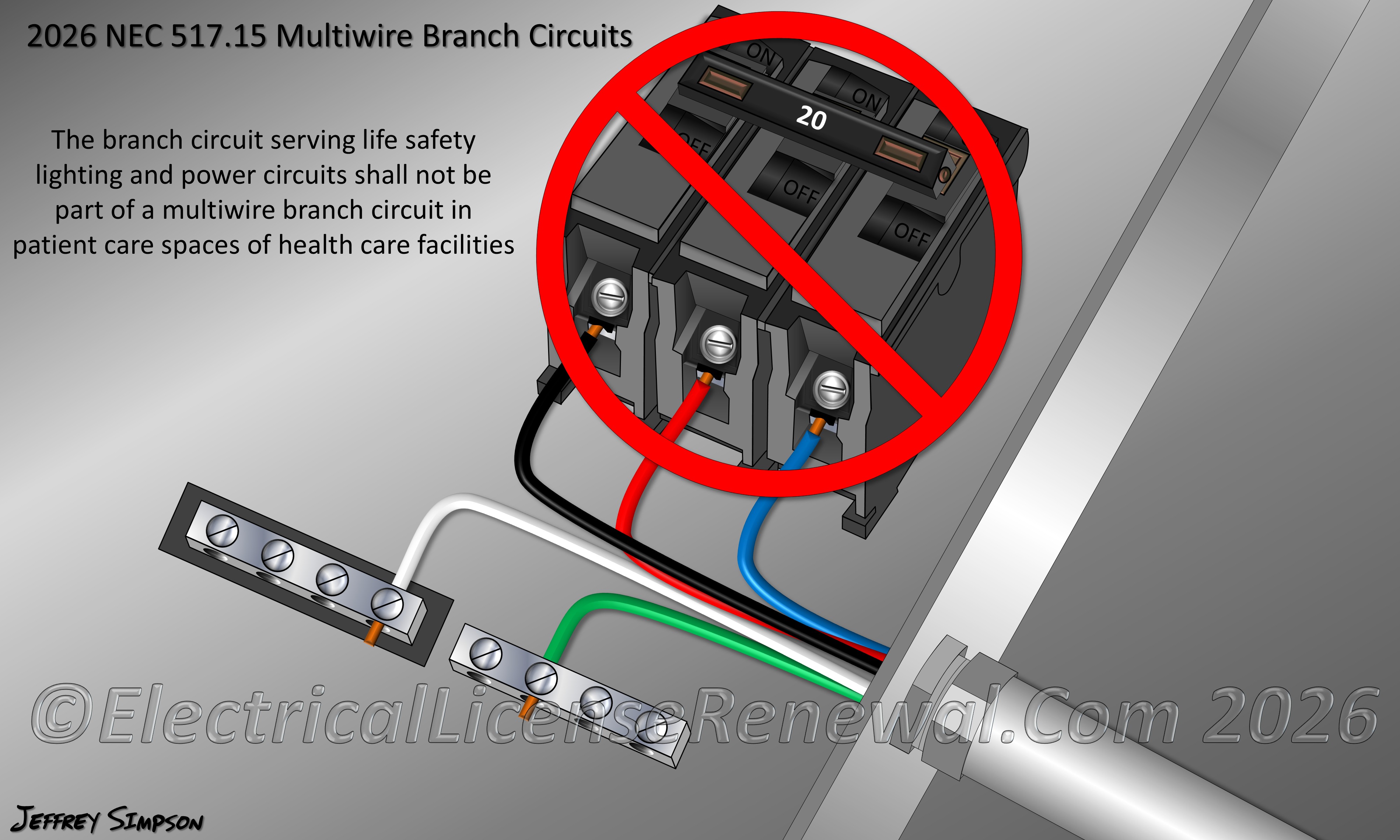
The branch circuit serving life safety lighting and power circuits shall not be part of a multiwire branch circuit in patient care spaces of health care facilities.
Code Change Summary: A new code section prohibits the use of multiwire branch circuits for life safety lighting and power circuits in patient care spaces of health care facilities.
SME commentary: The 2026 NEC® introduces new Section 517.15 to clarify that life safety lighting and power branch circuits cannot be part of a multiwire branch circuit. This new provision continues the overall refinement of Article 517 to strengthen reliability and operational continuity of the important electrical systems in health care facilities.
In previous editions, Section 517.26 in Part III of the Article pertained to the essential electrical system (EES) and required the life safety branch of the EES to comply with Article 700, with several exceptions. In the 2026 NEC®, that language was replaced with the concise statement that “the requirements of Article 700 shall not apply.” While this removed redundant references, it also created the need to reintroduce key operational provisions back into Article 517 that were previously governed by Article 700. New Section 517.15 fills that gap by specifically addressing the use of multiwire branch circuits for life safety lighting and power.
A multiwire branch circuit is a wiring method where two or more ungrounded conductors with voltage potential between them, share a common neutral conductor and are connected to a circuit breaker with a handle-tie. While this design is efficient for general electrical distribution, it introduces risks for emergency systems. In a multiwire configuration, if one ungrounded conductor requires servicing or tripping of the breaker, the common neutral and other connected circuits may also lose power. This could temporarily disable emergency egress lighting or critical power circuits in patient care areas during a fault or maintenance event.
Life safety lighting and power circuits are required to remain energized to ensure safe egress during emergencies and to maintain power to critical systems. Allowing these circuits to share a neutral through a multiwire configuration increases the chance of simultaneous power loss to multiple circuits, defeating the redundancy required for patient and occupant safety.
By prohibiting multiwire branch circuits for life safety lighting and power circuits, Section 517.15 ensures that each circuit serving patient care spaces is independent and maintains continuity even when adjacent circuits are de-energized. This aligns with the core intent of Part II of Article 517, which governs wiring methods in patient care spaces and supports uninterrupted operation of important systems during fault or maintenance conditions.
This change enhances system reliability, eliminates a potential failure point, and reinforces the NEC’s commitment to protecting life safety and maintaining continuous operation in health care environments where electrical continuity is critical.
Below is a preview of the NEC®. See the actual NEC® text at NFPA.ORG for the complete code section. Once there, click on their link to free access to the 2026 NEC® edition of NFPA 70.
2023 Code Language:
This code section did not exist in Part II of Article 517.
2026 Code Language:
N 517.15 Multiwire Branch Circuits. The branch circuit serving life safety lighting and power circuits shall not be part of a multiwire branch circuit.
