514.11(A) Emergency Electrical Disconnects.
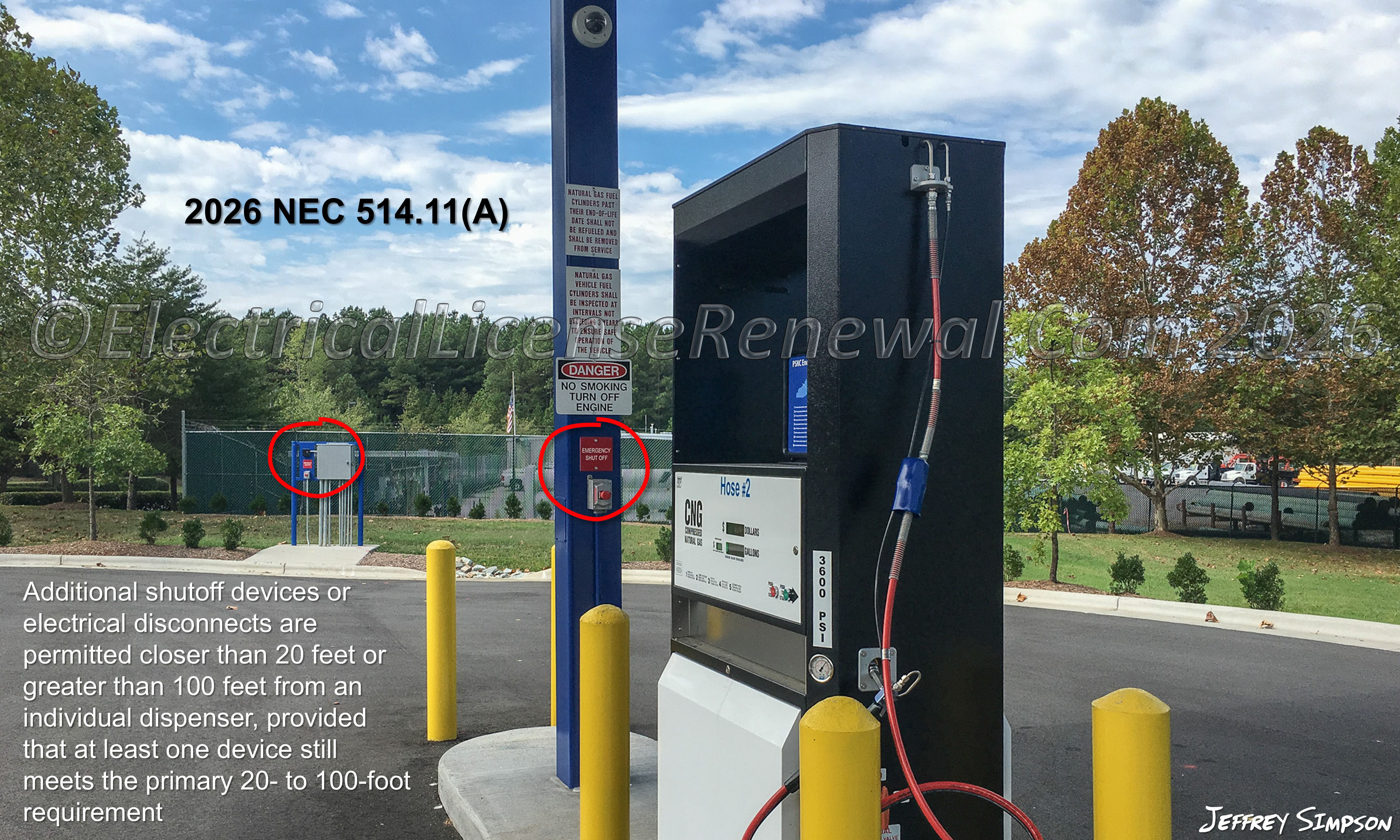
Additional shutoff devices or electrical disconnects are permitted closer than 20 feet or greater than 100 feet from an individual dispenser, provided that at least one device still meets the primary 20- to 100-foot requirement.
Code Change Summary: Section 514.11(A) was revised to align with NFPA 30A and to clarify placement and coverage of emergency electrical disconnects for fuel dispensing systems.
SME commentary: The 2026 NEC® revises Section 514.11(A) to better coordinate with the language and intent of NFPA 30A, Code for Motor Fuel Dispensing Facilities and Repair Garages. The changes address confusion about the required number and location of emergency shutoff devices, especially in large fleet fueling operations where fuel dispensers may be located well beyond the traditional 20- to 100-foot range from a building or main control area where the shutoff devices are usually installed.
Previously, the NEC® required each fuel dispensing system to have one or more clearly identified emergency shutoff devices located not closer than 20 feet and not more than 100 feet from the dispensers they serve. This created challenges for large fueling layouts such as truck or bus depots where fueling islands may extend hundreds of feet from the nearest building, making the canopy columns the only practical and code-compliant location for mounting shutoff devices. The 2026 revision resolves this by permitting additional shutoff devices or electrical disconnects to be installed closer than 20 feet or greater than 100 feet from an individual dispenser, provided that at least one device still meets the primary 20- to 100-foot requirement. This clarification eliminates misinterpretation by some authorities having jurisdiction who previously disallowed any shutoff within 20 feet of a dispenser, even when that device served a different dispenser located 30 feet away.
The section also clarifies what must be disconnected when the emergency shutoff device is activated. Emergency shutoff devices or electrical disconnects must disconnect all power to dispensing devices not supplied by intrinsically safe circuits, remote pumps serving those dispensers, all associated power, control, and signal circuits, and other electrical equipment within the hazardous (classified) locations. In the 2026 NEC®, this now also includes receptacles located over or adjacent to the hazardous area. Nearby receptacles that supply portable tools, chargers, or other equipment can introduce a potential ignition source within the classified area, including those powered through an extension cord plugged into a receptacle located outside of, but adjacent to, the hazardous area. However, intrinsically safe circuits and equipment are specifically exempt from this disconnection requirement.
These refinements remove ambiguity, promote consistency with NFPA 30A, and acknowledge practical installation constraints encountered in large outdoor fueling operations. Electricians and inspectors now have clearer guidance regarding acceptable shutoff locations and which circuits must be isolated during an emergency stop event.
Below is a preview of the NEC®. See the actual NEC® text at NFPA.ORG for the complete code section. Once there, click on their link to free access to the 2026 NEC® edition of NFPA 70.
2023 Code Language:
514.11(A) Emergency Electrical Disconnects. Fuel dispensing systems shall be provided with one or more clearly identified emergency shutoff devices or electrical disconnects. Such devices or disconnects shall be installed in approved locations but not less than 20 feet or more than 100 feet from the fuel dispensing devices that they serve. Emergency shutoff devices or electrical disconnects shall disconnect power to all dispensing devices; to all remote pumps serving the dispensing devices; to all associated power, control, and signal circuits; and to all other electrical equipment in the hazardous (classified) locations surrounding the fuel dispensing devices. See the NEC® for remaining text…
2026 Code Language:
514.11(A) Emergency Electrical Disconnects. Fuel dispensing systems shall be provided with one or more clearly identified emergency shutoff devices or electrical disconnects. Such devices or disconnects shall be installed in approved locations not less than 20 feet or more than 100 feet from the fuel dispensing devices that they serve. Additional shutoff devices or electrical disconnects shall be permitted to be located less than 20 feet or greater than 100 feet from an individual dispenser. Emergency shutoff devices or electrical disconnects shall disconnect power to all dispensing devices not supplied by circuits that are identified to be intrinsically safe; to all remote pumps serving the dispensing devices; to all associated power, control, and signal circuits; to all other electrical equipment in the hazardous (classified) locations; and to electrical receptacles over or adjacent to the hazardous (classified) locations. Emergency shutoff devices or electrical disconnects shall mechanically or electrically isolate other fluid transfer systems serving the fuel dispensing area. Intrinsically safe electrical equipment shall not be required to be disconnected by the emergency shutoff device or the electrical disconnect. See the NEC® for remaining text…
