501.15(A)(4) Class I, Division 1 Boundary Conduit Seals.
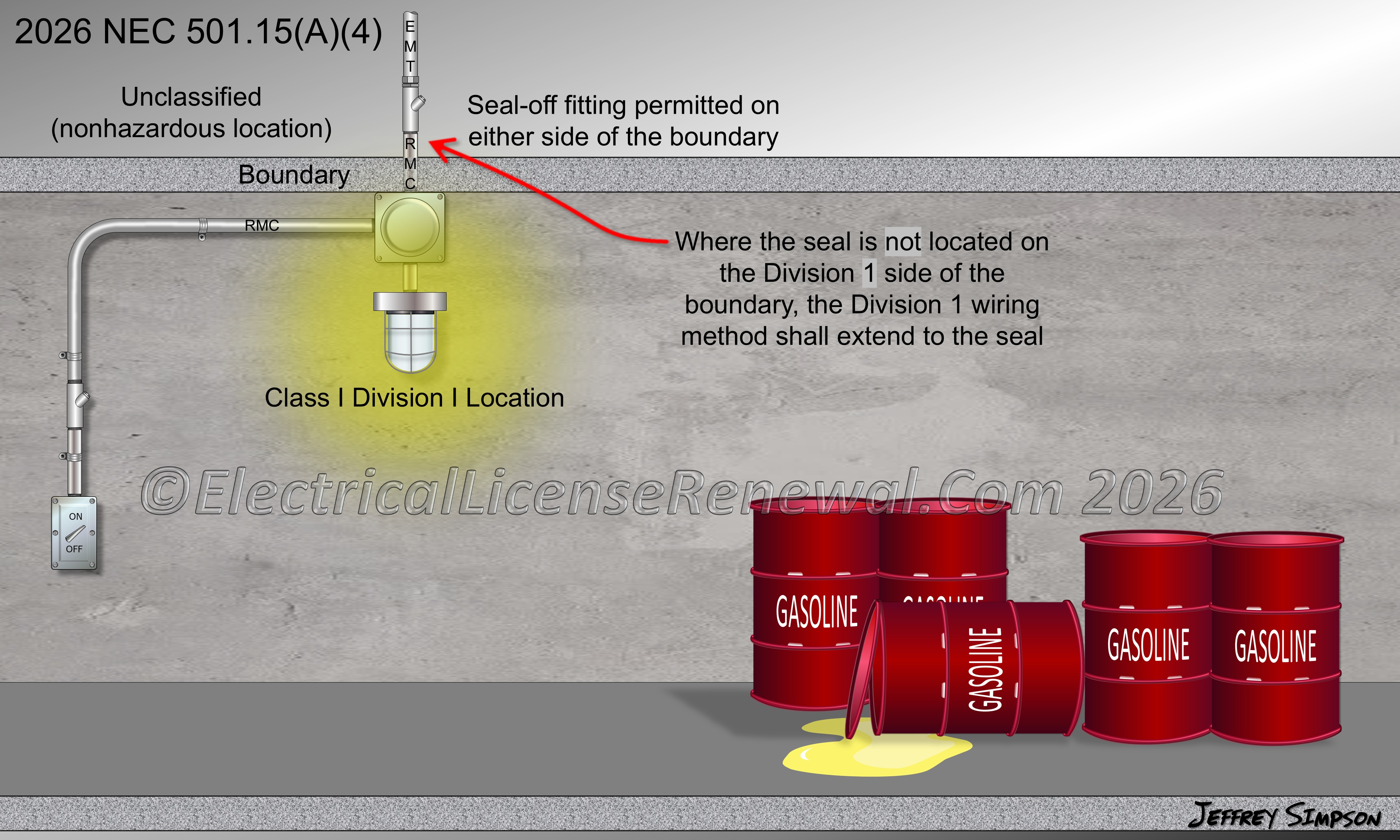
Where the seal is not located on the Division 1 side of the boundary, the Division 1 wiring method shall extend to the seal.
Code Change Summary: Section 501.15(A)(4) was revised to clarify sealing requirements where a Class I, Division 1 location abuts an unclassified area.
SME commentary: In the 2026 NEC®, Section 501.15(A)(4) was revised to address wiring transitions from Class I, Division 1 locations to areas that are not always classified as Division 2. The change ensures that the Division 1 wiring method continues to the required conduit seal even when the adjoining space is unclassified. This revision resolves a gray area in previous code editions where the boundary condition between Division 1 and an unclassified location was not clearly covered since the seal-off fitting is permitted to be on either side of the boundary.
Prior to the 2026 change, Section 501.15(A)(4) specifically addressed situations where a Division 1 location transitioned to a Division 2 location. The rule required that when the seal was located on the Division 2 side of the boundary, the Division 1 wiring method extend into the Division 2 area up to the seal. However, it did not explicitly state what was required if a Division 1 area directly bordered an unclassified space, such as an exterior wall or a block separation between process areas. As a result, inspectors and designers often applied differing interpretations in those cases, creating potential inconsistencies in enforcement and installation practice.
In the 2026 NEC®, the revised wording now states that “Where the seal is not located on the Division 1 side of the boundary, the Division 1 wiring method shall extend to the seal.” This subtle change broadens the application of the rule so that it applies in any situation where the conduit seal is placed outside the Division 1 boundary, whether that seal is in a Division 2 or an unclassified location. The intent is to ensure that the wiring method designed for the Division 1 environment continues up to the seal, maintaining the integrity of explosion protection across the entire conduit segment.
This clarification recognizes that not every Class I, Division 1 area has an adjacent Division 2 zone. In many installations, a measurement, a wall, ceiling, or other physical barrier forms the separation between a Division 1 area and an unclassified space. When this occurs, the conduit seal is often placed just beyond the boundary in the unclassified area. By requiring the Division 1 wiring method to extend up to that seal, the NEC® eliminates uncertainty and prevents potentially hazardous configurations where non–Division 1 wiring could otherwise enter the unsealed boundary space.
The 2026 revision reinforces consistent application of sealing requirements and aligns the language in 501.15(A)(4) with real-world installation practices. This change improves code usability, reduces misinterpretation, and maintains the fundamental goal of preventing the passage of flammable gases or vapors beyond the sealed boundary of Class I, Division 1 locations.
Below is a preview of the NEC®. See the actual NEC® text at NFPA.ORG for the complete code section. Once there, click on their link to free access to the 2026 NEC® edition of NFPA 70.
2023 Code Language:
501.15(A)(4) Class I, Division 1 Boundary (in part). A conduit seal shall be required in each conduit run leaving a Division 1 location. The sealing fitting shall be permitted to be installed on either side of the boundary within 10 feet of the boundary…
Where the seal is located on the Division 2 side of the boundary, the Division 1 wiring method shall extend into the Division 2 area to the seal.
2026 Code Language:
501.15(A)(4) Class I, Division 1 Boundary (in part). A conduit seal shall be required in each conduit run leaving a Division 1 location. The sealing fitting shall be permitted to be installed on either side of the boundary within 10 feet of the boundary…
Where the seal is not located on the Division 1 side of the boundary, the Division 1 wiring method shall extend to the seal.
