500.30 Bonding in Hazardous (Classified) Locations.
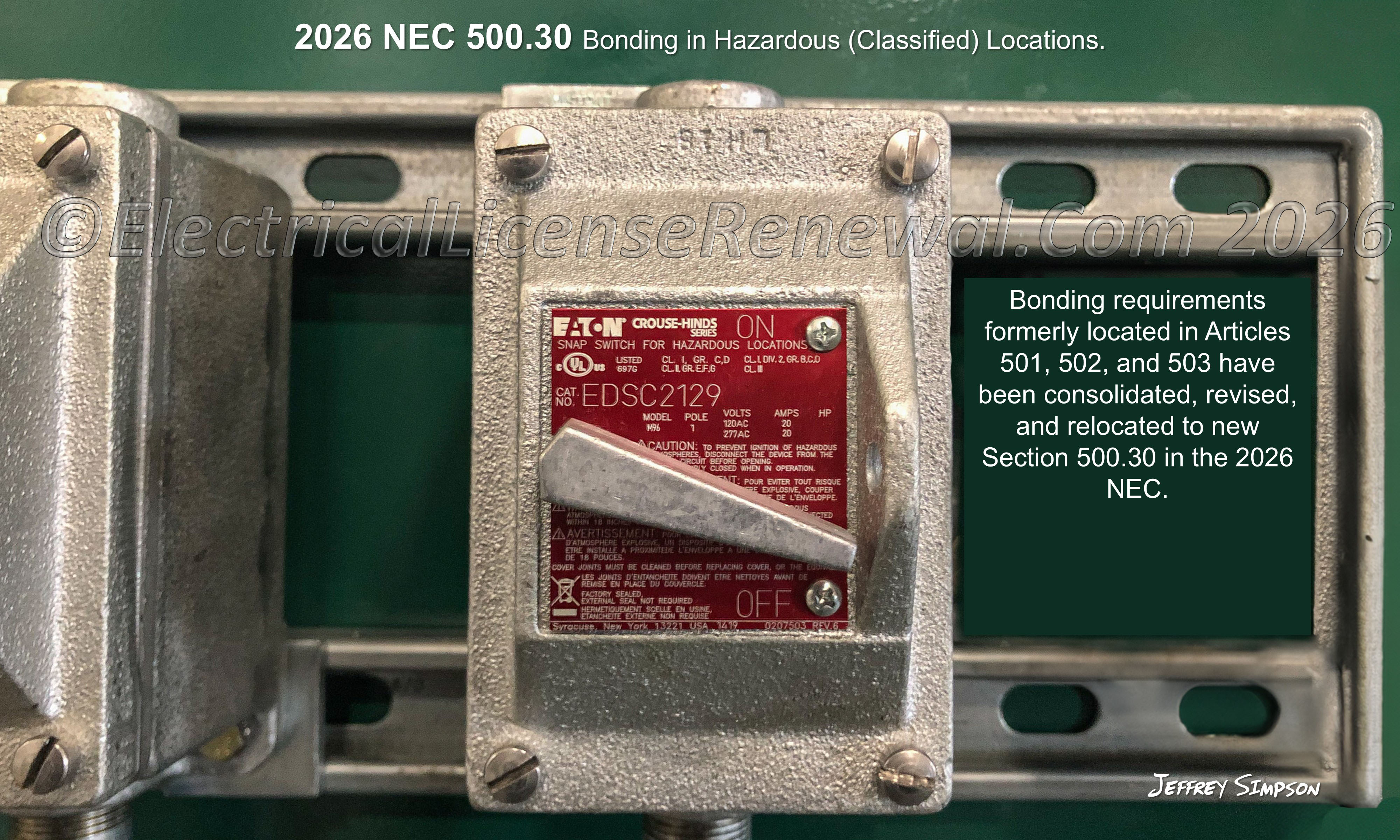
Bonding requirements formerly located in Articles 501, 502, and 503 have been consolidated, revised, and relocated to new Section 500.30 in the 2026 NEC.
Code Change Summary: Bonding requirements formerly located in Articles 501, 502, and 503 have been consolidated, revised, and relocated to new Section 500.30 in the 2026 NEC®.
SME commentary: In the 2026 NEC®, the bonding provisions that appeared separately in Sections 501.30, 502.30, and 503.30 were removed and consolidated into new Section 500.30, Bonding in Hazardous (Classified) Locations. The change was introduced to eliminate repetitive language, improve usability, and ensure uniform application of bonding requirements across all hazardous location classes and divisions.
Historically, Articles 501 through 503 previously contained nearly identical text under the .30 heading “Grounding and Bonding.” Each required bonding in accordance with Parts I and V of Article 250, prohibited the use of locknut-bushing or double-locknut contacts for bonding purposes, and detailed conditions under which a wire-type equipment bonding jumper was required when using flexible metal conduit or liquidtight flexible metal conduit. This approach produced consistency in content but unnecessary duplication in format. The 2026 revision centralizes those requirements into a single section within Article 500, which now governs bonding for Class I, II, and III locations collectively.
Section 500.30 is divided into three clear parts:
Subsection (A) identifies the specific bonding means that are permitted, including threaded couplings, threaded entries, listed threaded hubs on enclosures, threadless fittings, and other listed devices, such as bonding-type locknuts or bushings, while requiring all threaded connections to be made up wrench-tight.
Subsection (B) lists bonding methods that are NOT permitted, reiterating that locknut-bushings and double-locknut connections, or any bonding locknut used around impaired connections such as reducing washers or oversized, concentric, or eccentric knockouts, cannot be relied upon for bonding continuity.
Subsection (C) addresses bonding of flexible metal conduit and liquidtight flexible metal conduit, requiring an equipment bonding jumper of the wire type in accordance with 250.122. The familiar exception allowing omission of the jumper for short (6 ft or less) listed liquidtight flexible metal conduit in Division 2 locations with 10-ampere or smaller overcurrent protection and instrument-type loads was retained.
A new exception in 500.30(A) clarifies that uninsulated exposed parts meeting the protection techniques described in 501.25, 502.25, or 503.25 are not subject to the bonding requirements of this section. This language prevents redundant bonding of parts that are already protected in accordance with other hazardous-location rules. Notably, the “grounding” portion formerly combined with the bonding language in the 2023 NEC® has been deleted rather than relocated, since grounding requirements are already comprehensively covered in Article 250 for all hazardous locations.
Below is a preview of the NEC®. See the actual NEC® text at NFPA.ORG for the complete code section. Once there, click on their link to free access to the 2026 NEC® edition of NFPA 70.
2023 Code Language:
This code section did not exist in Article 500
2026 Code Language:
N 500.30 Bonding in Hazardous (Classified) Locations.
(A) Specific Bonding Means Permitted. Regardless of the voltage of the electrical system, the bonding of normally non-current-carrying metal parts of electrical equipment, raceways, metal-clad cable, and metal enclosures containing electrical equipment in any hazardous (classified) location through the point of grounding for service equipment or point of grounding for a separately derived system shall be provided by one or more of the following bonding means whether or not equipment grounding conductors of the wire type are installed in the raceway or in a multiconductor cable assembly:
(1) Connections made up wrenchtight using threaded couplings, threaded entries, or listed threaded hubs on enclosures
(2) Threadless couplings and connectors if made up tight for metal raceways and metal-clad cables
(3) Other listed devices, such as bonding-type locknuts, bushings, or bushings with bonding jumpers
Exception: Uninsulated exposed parts meeting the requirements of 501.25, 502.25, or 503.25 shall not be subjected to this bonding requirement.
(B) Specific Bonding Means Not Permitted. The following bonding means shall not be permitted:
(1) Locknuts-bushings and double-locknut types of connections
(2) Bonding locknuts used around impaired connections, such as reducing washers or oversized, concentric, or eccentric knockouts
(C) Specific Bonding for Flexible Metal Conduit and Liquidtight Flexible Metal Conduit. Flexible metal conduit and liquidtight flexible metal conduit shall comply with 500.30(C)(1) and 500.30(C)(2).
(1) Equipment Bonding Jumper. FMC and LFMC shall include an equipment bonding jumper of the wire type in accordance with 250.122.
(2) Equipment Bonding Jumper Not Required. In Class I, Class II, or Class III, Division 2 locations, the bonding jumper shall not be required where all of the following are met:
(1) Listed liquidtight flexible metal conduit 1.8 m (6 ft) or less in length, with fittings listed for grounding is used.
(2) Overcurrent protection is limited to 10 amperes or less.
(3) The load is part of a meter, instrument, or relay circuit.
