Article 480 Stationary Batteries.
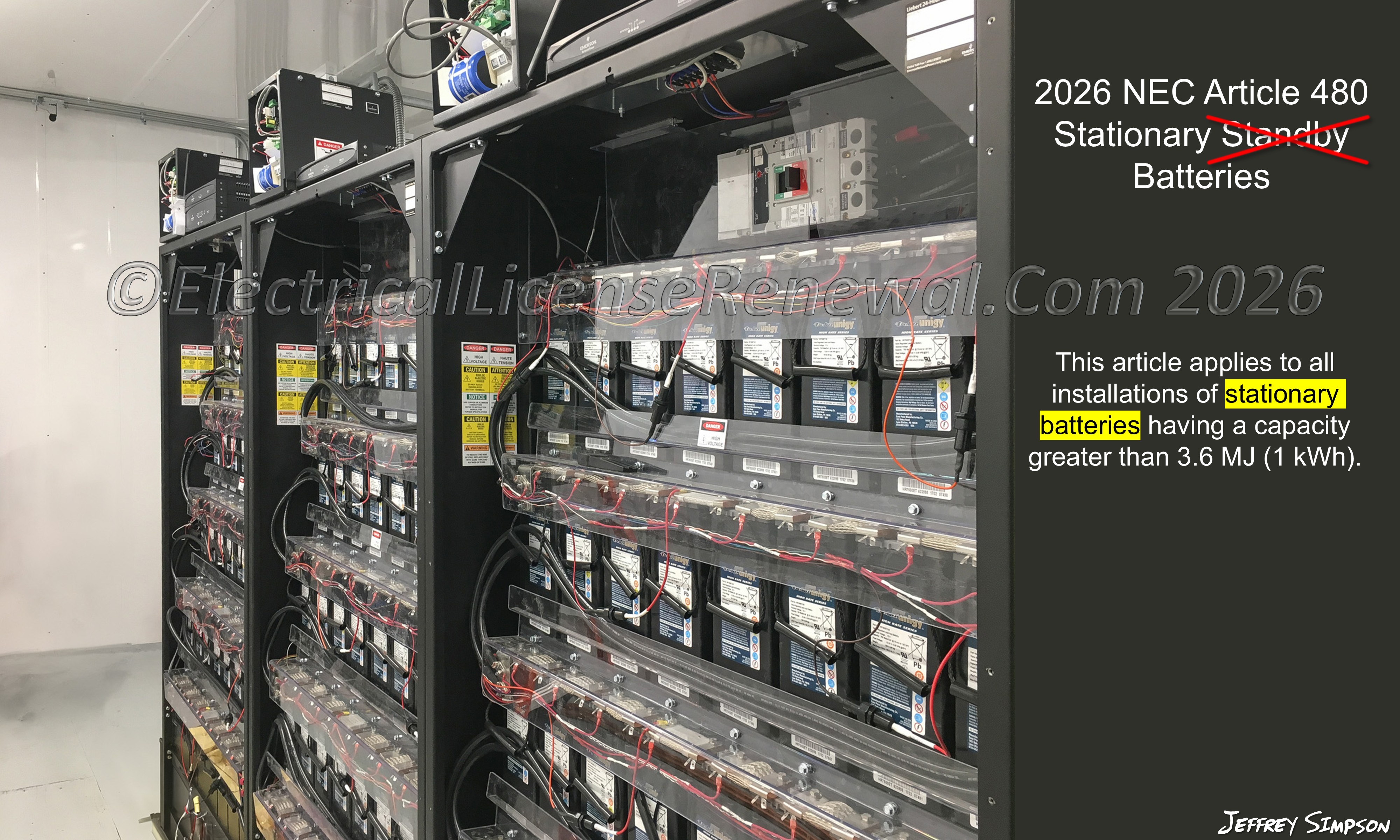
This article applies to all installations of stationary batteries having a capacity greater than 3.6 MJ (1 kWh).
Code Change Summary: Article 480 was revised to clarify that its requirements apply to all stationary batteries, not just standby batteries, and to introduce new listing and overcharge control provisions.
SME commentary: In the 2026 NEC®, the title and scope of Article 480 were updated to apply broadly to all stationary batteries rather than the narrower category of stationary standby batteries. This change eliminates ambiguity and ensures that all stationary battery installations, whether for standby, load leveling, renewable energy support, or other continuous-duty applications, fall within the article’s requirements. The revision recognizes that many modern battery systems operate cyclically, charging and discharging repeatedly to meet fluctuating energy demand, rather than being used exclusively as standby sources during power interruptions.
The term “standby” was deliberately removed from the article’s title and scope to reflect the intent of the article. The change clarifies that the provisions of Article 480 apply to all installations of stationary batteries having a capacity greater than 3.6 MJ (1 kWh) regardless of whether the system is intended for backup power or ongoing energy usage applications. To prevent overlap with Article 706, which covers listed energy storage systems, Informational Note No. 1 was revised to direct users straight to Article 706 when installations meet the definition of an energy storage system rather than a conventional stationary battery system.
Another notable update appears in Section 480.2, which now introduces clear listing requirements for stationary batteries and associated battery management equipment. Under this revision, all battery management equipment and stationary batteries, except for vented lead-acid or nickel-cadmium types, must be listed. This aligns Article 480 with modern product standards and reinforces the importance of verified safety performance in battery system components. The inclusion of battery management systems in the listing requirement ensures that control and monitoring devices are also tested to recognized safety standards, supporting reliable operation and thermal management.
A completely new section, 480.14 Overcharge Control, was also added. This section requires provisions to prevent stationary batteries from becoming overcharged, addressing a deficit in Article 480. Overcharging can result in excessive heat, reduced lifespan, and in severe cases, fire or explosion hazards. The addition of this section codifies a critical safety expectation for all stationary battery installations, requiring that systems incorporate suitable means, whether through charge controllers, voltage regulation, or automated cutoff devices, to prevent overcharge conditions.
These revisions bring Article 480 into closer alignment with current battery technologies and usage patterns. With the expanded article scope, additional listing requirements, and introducing specific overcharge control measures, the 2026 NEC® provides more comprehensive safety coverage for a rapidly evolving segment of the electrical industry.
Below is a preview of the NEC®. See the actual NEC® text at NFPA.ORG for the complete code section. Once there, click on their link to free access to the 2026 NEC® edition of NFPA 70.
2023 Code Language:
Article 480 Stationary Standby Batteries
480.1 Scope. This article applies to all installations of stationary standby batteries having a capacity greater than 3.6 MJ (1 kWh).
Informational Note No. 1: See Article 706 for installations that do not meet the definition of stationary standby batteries.
480.3 Equipment. Storage batteries and battery management equipment shall be listed. This requirement shall not apply to lead-acid batteries.
2026 Code Language:
Article 480 Stationary Batteries
480.1 Scope. This article applies to all installations of stationary batteries having a capacity greater than 3.6 MJ (1 kWh).
Informational Note No. 1: See Article 706 for listed energy storage systems.
480.2 Listing Requirements. Stationary batteries and battery management equipment shall be listed. This requirement shall not apply to vented lead-acid or nickel-cadmium batteries.
N 480.14 Overcharge Control. Provisions shall be provided to prevent batteries from becoming overcharged.
