450.12(A) Grounding and Bonding Dry-Type Transformer Enclosures.
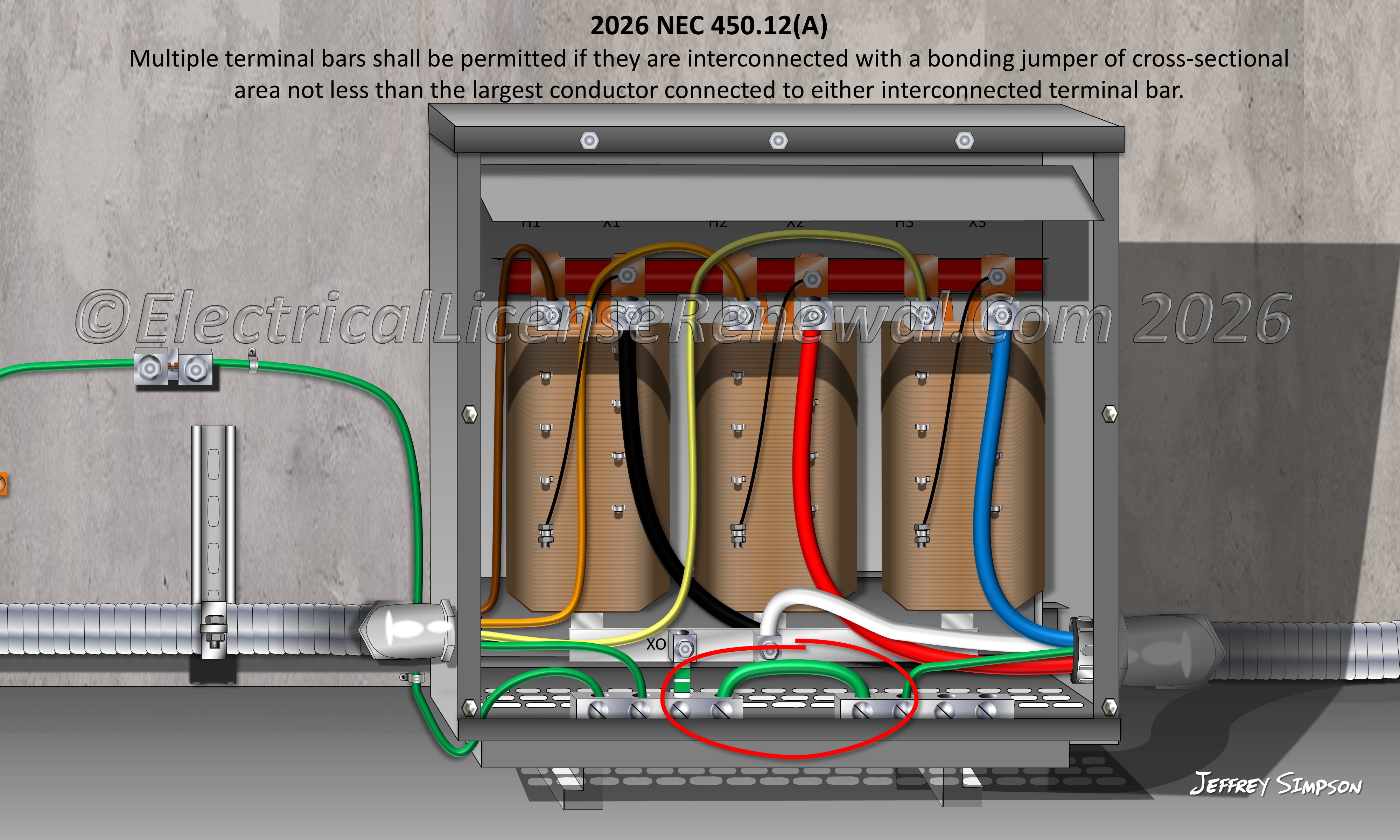
Multiple terminal bars shall be permitted if they are interconnected with a bonding jumper of cross-sectional area not less than the largest conductor connected to either interconnected terminal bar.
Code Change Summary: Revised code language now permits multiple terminal bars in a transformer enclosure for grounding and bonding if properly interconnected.
SME commentary: In the 2026 NEC®, Section 450.10(A) was renumbered to 450.12(A) and reformatted into a list for improved clarity and usability. A key change appears in new item (4), which introduces a practical allowance permitting multiple grounding/bonding terminal bars within a dry-type transformer enclosure, provided they are interconnected with a bonding jumper of cross-sectional area not less than the largest conductor connected to either interconnected terminal bar. This adjustment recognizes the physical and design constraints encountered in modern transformer installations, particularly those involving multiple equipment grounding conductors or bonding jumpers that must terminate within the enclosure.
Under previous code editions, the section was worded in a way that limited installations to a single terminal bar for all grounding and bonding conductors inside the transformer. This led to confusion and unnecessary installation challenges, especially in large transformer enclosures or applications where several sets of conductors exit the enclosure in parallel. Multiple supply-side bonding jumpers, a grounding electrode conductor, a system bonding jumper, and an equipment grounding conductor from the primary supply wires can easily warrant the need to have more than one grounding and bonding terminal bar in the transformer enclosure. When several conductors had to terminate at one location, the single-bar limitation could create congestion and make proper conductor terminations difficult.
The updated language brings flexibility without compromising the grounding integrity required by the NEC®. By mandating that any additional terminal bars be interconnected with a bonding jumper of sufficient cross-sectional area, the rule ensures electrical continuity across all grounding and bonding terminal bars. This maintains a low-impedance path for fault current and keeps the grounding and bonding system performance consistent regardless of which bar a conductor terminates on. The bonding jumper requirement is critical, as it effectively makes multiple terminal bars act as a single bonded assembly within the transformer enclosure.
The 2026 revision also retains existing provisions from the 2023 NEC®. Terminal bars must still be bonded to the enclosure in accordance with 250.12 and installed only where they do not obstruct ventilation openings. These requirements prevent overheating and preserve the electrical and mechanical integrity of the transformer enclosure.
Below is a preview of the NEC®. See the actual NEC® text at NFPA.ORG for the complete code section. Once there, click on their link to free access to the 2026 NEC® edition of NFPA 70.
2023 Code Language:
450.10(A) Dry-Type Transformer Enclosures. Where separate equipment grounding conductors and supply-side bonding jumpers are installed, a terminal bar for all grounding and bonding conductor connections shall be secured inside the transformer enclosure. The terminal bar shall be bonded to the enclosure in accordance with 250.12 and shall not be installed on or over any vented portion of the enclosure.
2026 Code Language:
450.12(A) Dry-Type Transformer Enclosures. Terminal bars shall comply with all of the following:
(1) Where separate equipment grounding conductors and supply-side bonding jumpers are installed, a terminal bar for all grounding and bonding conductor connections shall be secured inside the transformer enclosure.
(2) The terminal bar shall be bonded to the enclosure in accordance with 250.12.
(3) The terminal bars shall be installed where it does not obstruct any ventilation openings.
(4) Multiple terminal bars shall be permitted if they are interconnected with a bonding jumper of cross-sectional area not less than the largest conductor connected to either interconnected terminal bar.
