440.15 Split-System Indoor Unit Identification.
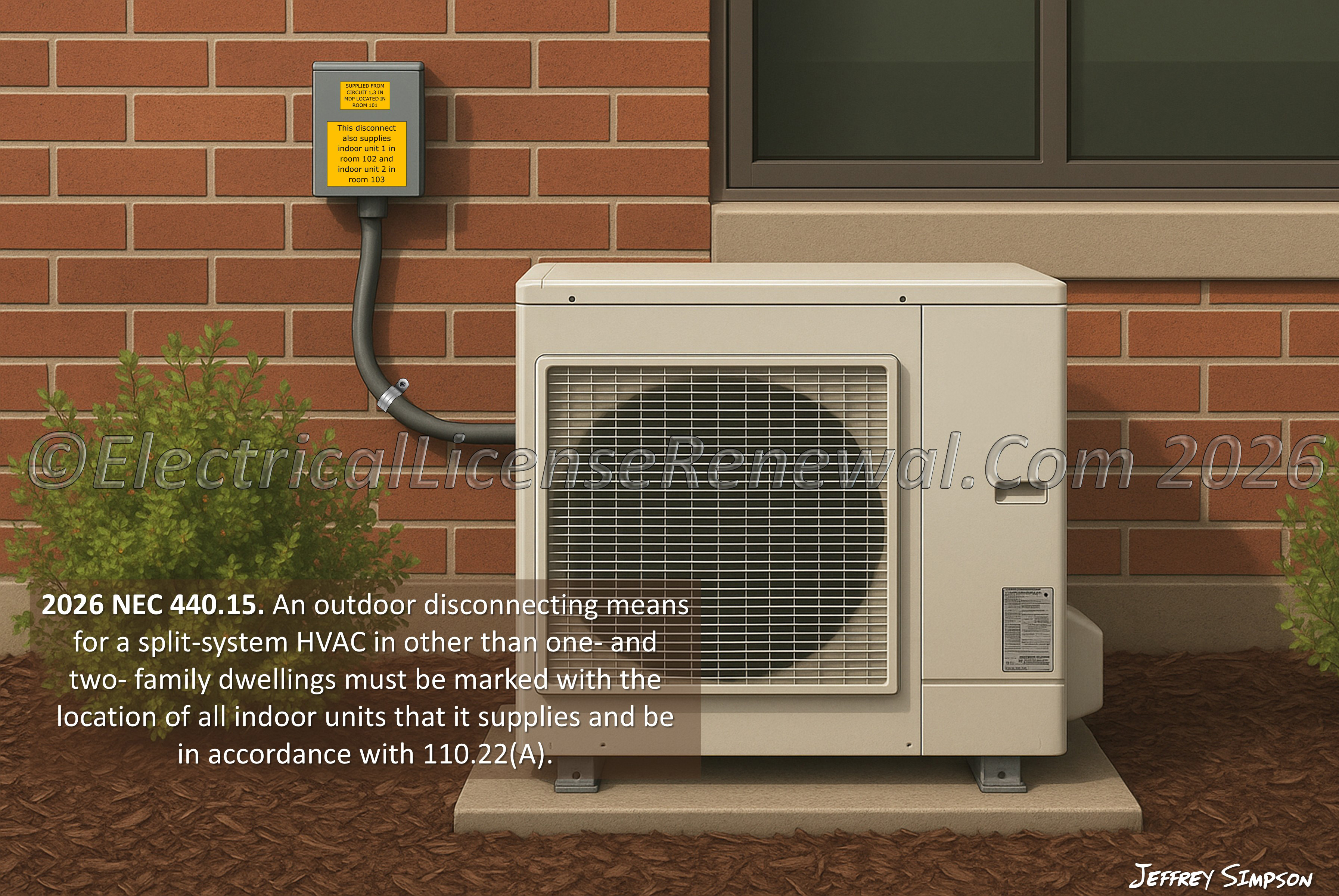
An outdoor disconnecting means for a split-system HVAC in other than one- and two- family dwellings must be marked with the location of all indoor units that it supplies.
Code Change Summary: New code section on marking the outdoor disconnect for split-system HVAC units.
SME commentary: In the 2026 NEC®, new Section 440.15 was added to make it easier for service technicians by requiring the “outdoor disconnecting means for a split-system HVAC in other than 1 & 2- family dwellings” to “be marked with the location of all indoor units that it supplies and be in accordance with 110.22(A)”.
This new code section is well intended but may require further refinement in future cycles to prevent misinterpretation.
Not all split-system HVAC installations are supplied by a single branch circuit that feeds both the outdoor condenser and the indoor air-handling unit. Some ductless mini-split systems are designed this way, but many installations instead use two separate circuits, one supplying the outdoor unit disconnect and another supplying the indoor unit disconnect. In some configurations, however, a single circuit serves both components, meaning that opening the outdoor disconnect also de-energizes the indoor unit. It is this type of installation to which the new code language applies.
For occupancies other than one- and two-family dwellings, the 2026 code requires that the outdoor disconnecting means for a split-system HVAC be marked with the location of all indoor units that “it” supplies. The word “it” refers to the disconnecting means. If the indoor and outdoor units of a split system are supplied by different circuits (as is typical in most cases), the outdoor disconnect does not technically supply the indoor unit. The indoor unit will still have a low voltage control circuit, but it is not run through the outdoor unit’s power disconnect. While the indoor unit might cease to heat or cool if the outdoor disconnect is opened, that does not mean the indoor unit is actually “supplied” by it.
If the purpose of this new requirement is to help service technicians identify which outdoor disconnect corresponds to which indoor unit, the new code language will only be enforceable in installations where both components share the same circuit. In systems using separate circuits, the marking requirement becomes less applicable under the current wording.
The International Mechanical Code already includes similar language intended to assist HVAC installers in identifying appliance connections:
IMC 304.12 “Area served. Appliances serving different areas of a building other than where they are installed shall be permanently marked in an approved manner that uniquely identifies the appliance and the area it serves.”
Below is a preview of the NEC®. See the actual NEC® text at NFPA.ORG for the complete code section. Once there, click on their link to free access to the 2026 NEC® edition of NFPA 70.
2023 Code Language:
The code section did not exist.
2026 Code Language:
N 440.15 Split-System Indoor Unit Identification. Outdoor disconnecting means for a split-system HVAC in other than 1 & 2- family dwellings shall be marked with the location of all indoor units that it supplies and be in accordance with 110.22(A).
