440.11 HVAC Disconnecting Means.
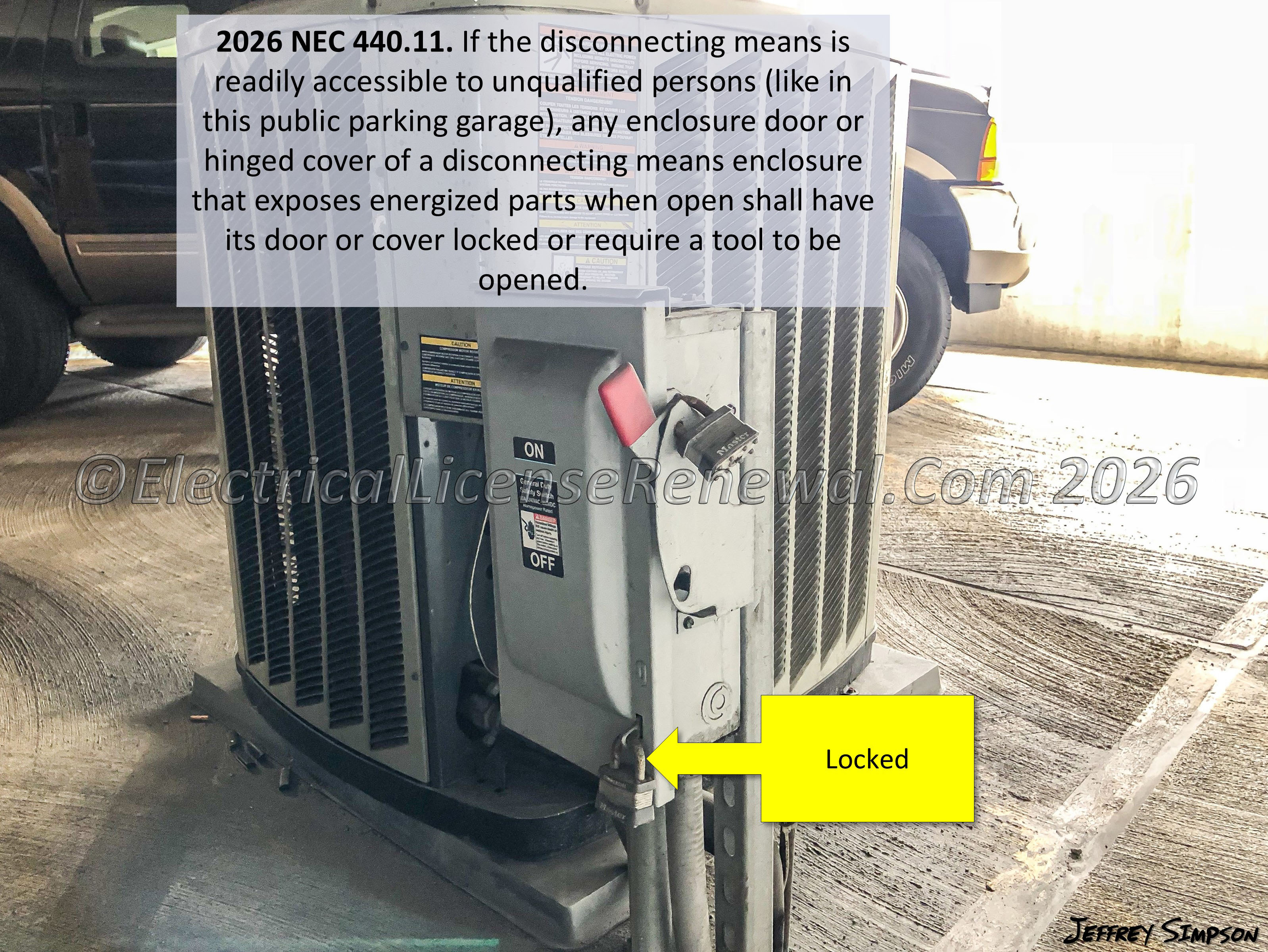
An HVAC disconnecting means must now have its door locked or require a tool to be opened whenever it is located in an area that is readily accessible to unqualified persons and exposes energized parts when open.
Code Change Summary: Section 440.11 was revised to clarify safety requirements for HVAC disconnect enclosures readily accessible to unqualified persons.
SME commentary: The 2026 NEC® continues the effort to improve electrical safety by refining the requirements in Section 440.11 to strengthen protection against accidental contact with live parts in HVAC disconnects. The revision clarifies that an HVAC disconnecting means must now have its door locked or require a tool to be opened whenever it is located in an area that is readily accessible to unqualified persons and exposes energized parts when open. This moves the section from allowing passive provisions for safety to requiring active physical prevention of access.
This clarification was driven by consistent enforcement challenges since the 2023 NEC® first introduced language addressing HVAC disconnect enclosures. Prior editions stated that the door or hinged cover “shall require a tool to open or be capable of being locked,” which allowed for an overly broad interpretation. Under the previous NEC®, installations were code compliant if they had a disconnect switch with a lockable hasp since they were “capable of being locked”, even if no actual locking device was used. The 2026 revision eliminates this ambiguity by requiring that the enclosure be locked or require a tool for opening when energized parts are exposed.
This update aligns Section 440.11 with the intent of Section 404.30, which applies similar safety measures for enclosed switches. Both sections now provide solid language, ensuring the guarding of enclosed devices that can expose live components when opened. The revised language recognizes that identical hazards exist whether the energized components belong to an enclosed switch or pullout used for the required HVAC disconnecting means. When located in areas readily accessible to the public, these enclosures must physically prevent inadvertent or unauthorized exposure to live electrical parts.
The change also helps inspectors and installers by removing subjective enforcement interpretations. It eliminates the “provisions for locking” loophole that allowed installations to technically comply on paper while failing to meet the practical safety objective. Now, compliance depends on an observable physical condition: either the cover requires a tool or it is locked shut.
Below is a preview of the NEC®. See the actual NEC® text at NFPA.ORG for the complete code section. Once there, click on their link to free access to the 2026 NEC® edition of NFPA 70.
2023 Code Language:
440.11 General. Disconnecting means shall be capable of disconnecting air-conditioning & refrigerating equipment, including motor-compressors and controllers, from the circuit conductors. If the disconnecting means is readily accessible to unqualified persons, any enclosure door or hinged cover of a disconnecting means enclosure that exposes energized parts when open shall require a tool to open or be capable of being locked.
2026 Code Language:
440.11 General. A disconnecting means shall be provided to disconnect air-conditioning & refrigerating equipment, including motor-compressors and controllers. If the disconnecting means is readily accessible to unqualified persons, any enclosure door or hinged cover of a disconnecting means enclosure that exposes energized parts when open shall have its door or cover locked or require a tool to be opened.
