440.4 Marking on Hermetic Refrigerant Motor-Compressors and Equipment.
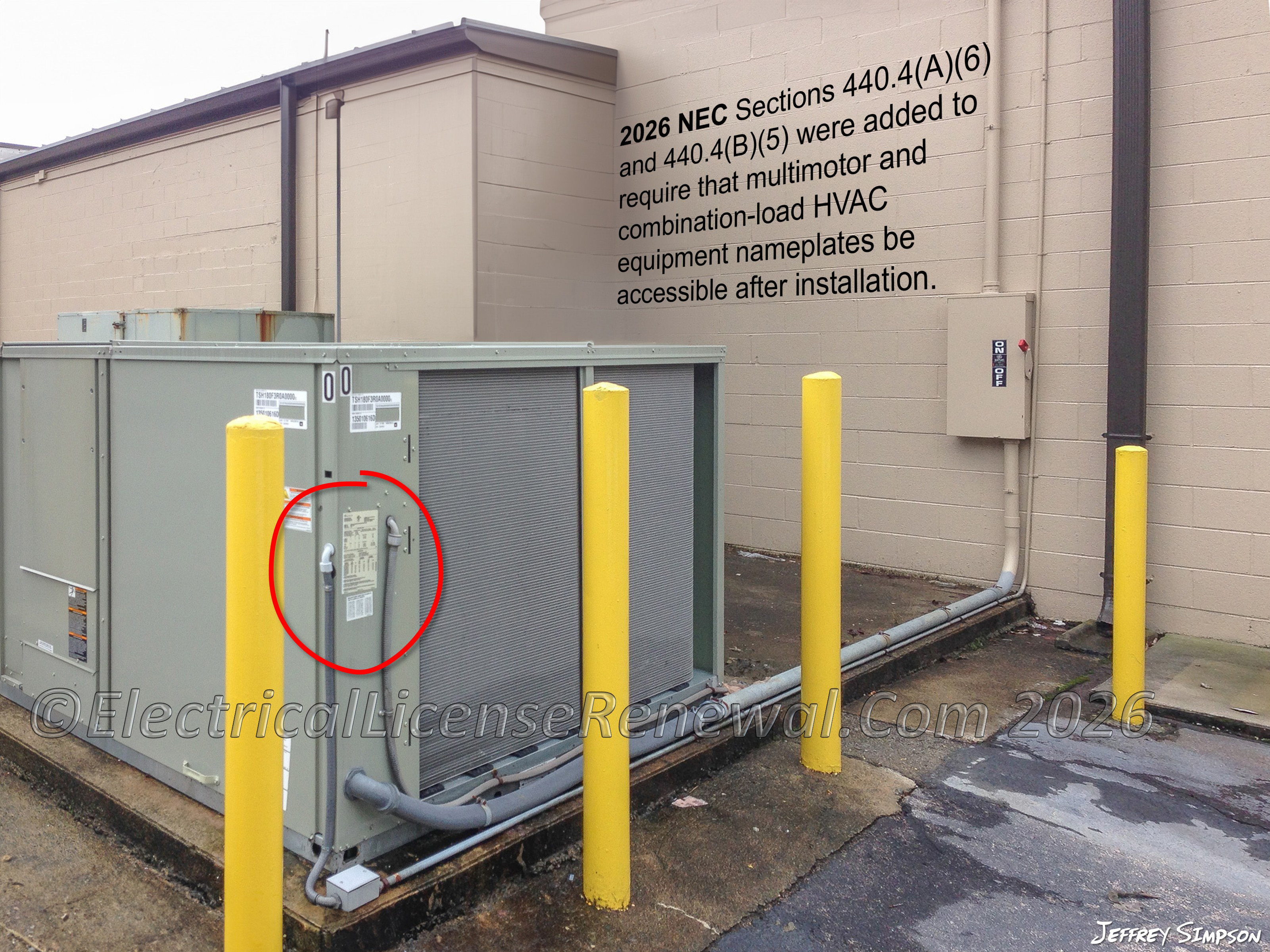
Sections 440.4(A)(6) and 440.4(B)(5) were added to require that multimotor and combination-load HVAC equipment nameplates be accessible after installation.
Code Change Summary: HVAC equipment nameplates must now remain visible and accessible after installation.
SME commentary: In the 2026 NEC®, new Sections 440.4(A)(6) and 440.4(B)(5) were added to require that multimotor and combination-load HVAC equipment nameplates be accessible after installation. This addition addresses a recurring problem in the field where equipment is installed so close to walls or other obstructions that the nameplate information cannot be read or verified.
The term accessible (as applied to equipment) is defined in Article 100 as “capable of being reached for operation, renewal, and inspection.” Applying that definition here means the HVAC nameplate must be positioned so that it can be seen and reached without dismantling the equipment or removing barriers. This change enhances both enforceability and maintenance by ensuring that the information necessary to verify compliance with Article 440 and other NEC® sections remains available throughout the life of the installation.
Historically, HVAC units are often mounted with the nameplate facing a wall or structural obstruction. Once in place, inspectors and service personnel may have no practical way to verify critical data such as the minimum circuit ampacity (MCA), maximum overcurrent protective device (MOCP) rating, or whether field-installed heater kits were installed in accordance with the equipment listing. These markings directly influence conductor sizing, overcurrent protection, and the verification of field-installed accessories. When the nameplate is hidden, the inspector has no reliable means to confirm that the field installed wiring and OCPD matches the manufacturer’s instructions, creating both compliance and safety concerns.
The new requirement ensures that electrical inspectors, service technicians, and maintenance personnel can readily confirm the proper application of NEC® 440.22, 440.32, and 440.35 during installation and future servicing. It also helps verify that any added components, such as supplemental heat strips or control accessories, align with the equipment’s original listing and do not exceed the specified electrical ratings.
In practical terms, this means the installer must now consider nameplate visibility when selecting the equipment’s final location or orientation. An HVAC unit installed flush against an exterior wall with its identification label facing the wall would no longer meet the accessibility requirement. This change gives enforcement authorities clear grounds to require correction before approval, avoiding the unsafe practice of guessing electrical ratings or relying solely on submittal data.
This update also highlights the ongoing coordination needed between electrical and mechanical trades. While mechanical codes focus on equipment clearances for airflow and maintenance, the NEC® now establishes clear accessibility expectations for electrical nameplate data vital to a code compliant installation. By requiring nameplates to remain accessible, the 2026 NEC® strengthens field verification, reduces installation errors, and supports long-term equipment safety and compliance.
Below is a preview of the NEC®. See the actual NEC® text at NFPA.ORG for the complete code section. Once there, click on their link to free access to the 2026 NEC® edition of NFPA 70.
2023 Code Language:
These code requirements did not exist
2026 Code Language:
N 440.4(A)(6) Accessible. Multimotor and combination-load equipment nameplates shall be accessible after the installation.
N 440.4(B)(5) Accessible. Multimotor and combination-load equipment nameplates shall be accessible after the installation.
