427 Fixed Electric Heating Equipment for Pipelines, Vessels, and Other Applications for Trace Heating.
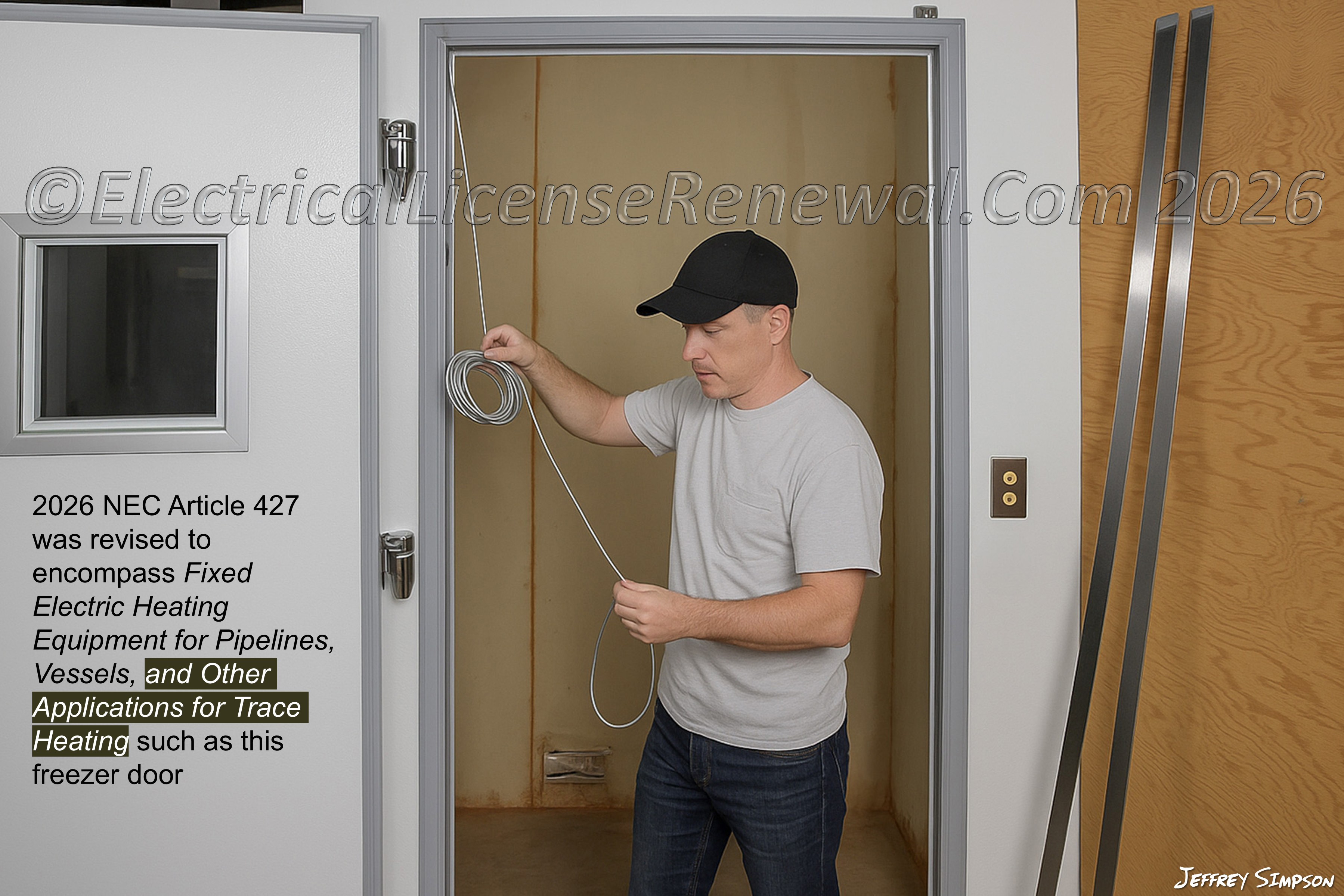
2026 NEC Article 427 was revised to encompass Fixed Electric Heating Equipment for Pipelines, Vessels, and Other Applications for Trace Heating such as this freezer door.
Code Change Summary: The scope and title of Article 427 were expanded to include trace heating systems used for applications beyond pipelines and vessels, such as heat trace installations on commercial freezer doors and similar equipment.
SME commentary: In the 2026 NEC®, the title and scope of Article 427 were revised to encompass fixed electric heating equipment for pipelines, vessels, and other applications for trace heating. This change clarifies that the article applies not only to pipeline and vessel heat tracing but also to other fixed heating installations that use similar technology and materials. These systems include those designed to prevent freezing on commercial and industrial freezer doors, condensate drain lines, and other specialized equipment.
Trace heating, also known as heat trace, is an electrical system that maintains or raises the temperature of pipes, surfaces, or equipment through the use of resistive heating cables. Historically, Article 427 was titled “Fixed Electric Heating Equipment for Pipelines and Vessels,” which caused uncertainty regarding its applicability to other types of trace heating installations. For instance, when heating cable was installed along the perimeter of a freezer door jamb to prevent the door gasket from freezing shut, inspectors and installers often had to determine whether Article 427 applied or if the installation was outside the article’s intended scope. The former language created inconsistent interpretations because the equipment and methods used for these systems were essentially identical to those used for pipeline heat tracing and heat trace for vessels (containers such as barrels, drums, or tanks for holding fluids or other material).
The updated title and scope resolve that ambiguity. The new phrase “and other applications for trace heating” ensures that heat trace installations on surfaces such as commercial freezer doors, condensate drain lines, and similar temperature-maintenance systems fall squarely under the provisions of Article 427. This gives Authorities Having Jurisdiction (AHJs) and installers clear enforcement and compliance guidance when encountering these common but previously undefined applications.
This revision aligns the NEC® with current industry practices, recognizing that electric heat tracing has become widely used beyond industrial piping systems. In commercial food storage, for example, trace heating prevents ice accumulation that could compromise door seals and interfere with refrigeration efficiency. By extending the article’s coverage, the NEC® now provides a uniform standard for the wiring methods, materials, and protection requirements associated with all fixed trace heating installations, regardless of whether they serve a pipeline, vessel, or equipment surface.
Below is a preview of the NEC®. See the actual NEC® text at NFPA.ORG for the complete code section. Once there, click on their link to free access to the 2026 NEC® edition of NFPA 70.
2023 Code Language:
Article 427 Fixed Electric Heating Equipment for Pipelines and Vessels
427.1 Scope. This article covers electrically energized heating systems and the installation of these systems used with pipelines and vessels.
2026 Code Language:
Article 427 Fixed Electric Heating Equipment for Pipelines, Vessels, and Other Applications for Trace Heating
427.1 Scope. This article covers electrically energized heating systems and the installation of these systems used with pipelines, vessels, and other applications for trace heating.
