426 Part VI Conductive Pavement Heating Systems.
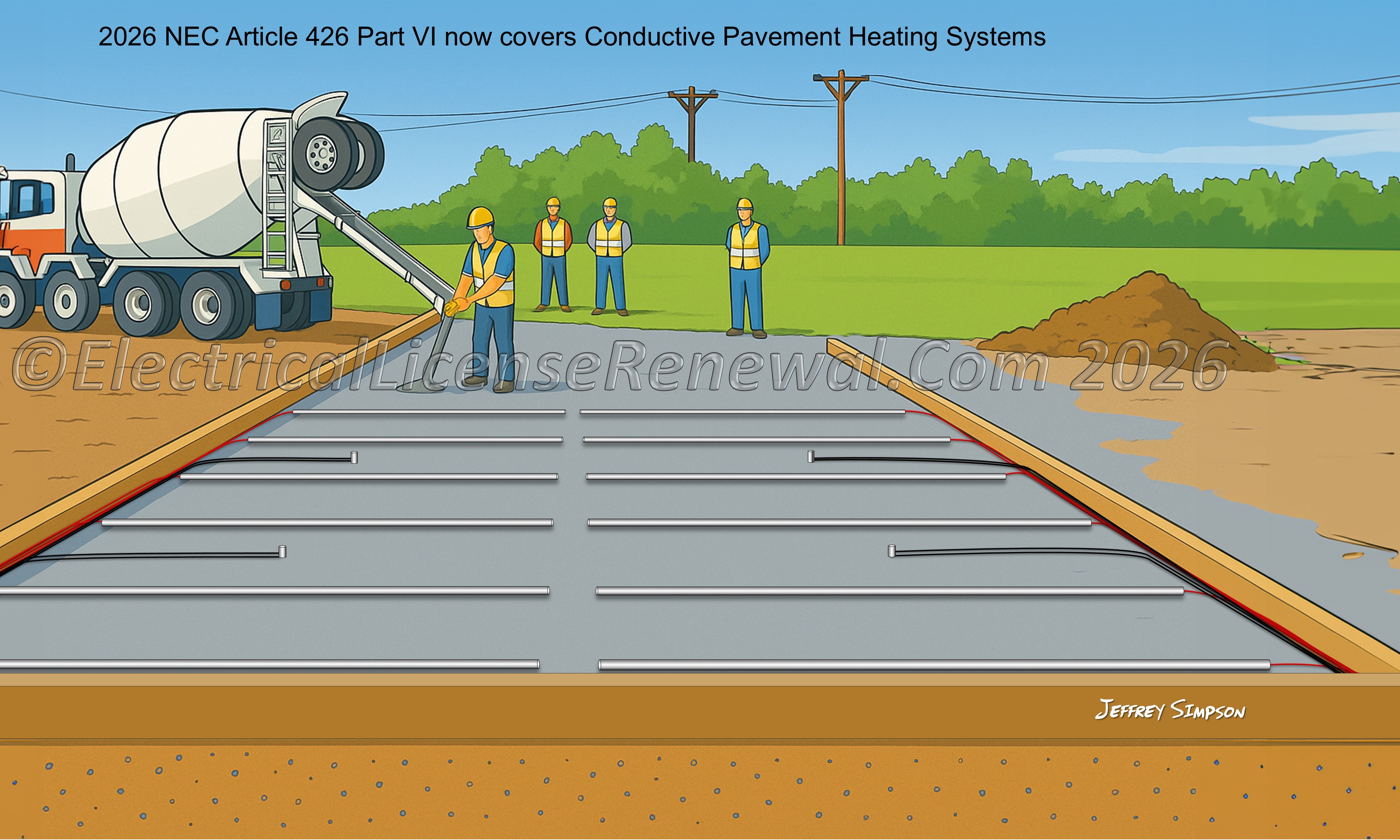
Article 426 Part VI now covers Conductive Pavement Heating Systems.
Code Change Summary: New language was added to Part VI of Article 426 establishing comprehensive requirements for conductive pavement heating systems.
SME commentary: The 2026 NEC® relocates the control and protection requirements of Article 426 to new Part VII to accommodate a new Part VI addressing conductive pavement heating systems. These installations generate heat by passing current through the pavement between embedded heating electrodes that enable snow and ice melting without traditional resistance cables. The pavement mixture itself includes additives, such as carbon fiber, to enhance and increase the pavement conductivity. This new section provides much needed direction for a technology emerging from research at Iowa State University Department of Civil, Construction and Environmental Engineering with several pilot installations.
The rules begin in Article 100 with a new definition:
Conductive Pavement Heating System. A system in which heat is generated by passing current through the pavement material and between electrodes embedded within the pavement material.
Select highlights from new Part VI in Article 426:
- Section 426.60 requires conductive pavement heating systems to comply with Parts I, II, VI, and VII of Article 426 which includes listing, thermal protection, identification, disconnection methods, and temperature control.
- Section 426.62 prohibits conductive pavement heating systems in hazardous (classified) locations and in areas covered by Article 680 such as pools and fountains. These limitations reduce the risk of ignition in flammable environments and electric shock near water.
- Section 426.64 requires each installation to be a site-specific engineered design prepared by both a licensed professional civil engineer and a licensed professional electrical engineer. The design must remain within the limits of the product listing, and detailed documentation, such as mixture specifications, conductivity test results, as-built drawings, and commissioning reports, must be furnished to both the system owner and the authority having jurisdiction.
- Section 426.66 requires the installation to occur under the direct supervision of the design engineers, and the electrical engineer is responsible for conducting or witnessing commissioning of the system.
- Section 426.68 requires listed overtemperature protection that limits the surface temperature of the pavement to no more than 43°C (109°F), balancing effective deicing with safe touch limits.
- Section 426.72 limits system operating voltage to 30 volts ac or 60 volts dc, while Section 426.74 mandates that the power supply be ungrounded. Together, these restrictions minimize touch-potential hazards at the pavement surface.
- Installation details are spelled out in Section 426.70. Embedded electrodes must have at least 2 inches of conductive pavement cover, must be supported by nonmetallic means, and cannot bridge expansion joints unless movement provisions are made. Electrodes and associated components must have sufficient flexibility to tolerate pavement movement.
- Section 426.76 addresses all supply, sensor, and control conductors located in or penetrating the pavement, and prohibits any metallic raceways above the pavement from contacting the conductive surface.
- Section 426.78 covers the connections to the buried heating electrodes and permits only exothermic welds or irreversible compression connectors listed for direct burial or concrete encasement, using stainless hardware. These buried connections need not remain accessible after inspection.
- The conductive pavement mixture must be tested for its electrical resistance as it is placed to verify alignment with the engineered design per Section 426.82.
- To prevent future hazards from attachments, Section 426.84 allows only nonmetallic anchors or isolated metallic structures on or in the pavement, and Section 426.88 requires warning signs stating that the pavement contains conductive elements and must not be penetrated with metal components.
The new language in part VI provides a complete framework for design accountability, construction supervision, product listing, and field verification of conductive pavement heating systems. It intends to ensure consistent oversight, clear documentation, and protective measures that control surface temperature and voltage limits while maintaining safe, reliable snow-melting operation in public and private installations.
