406.12(D) Receptacle Replacements.
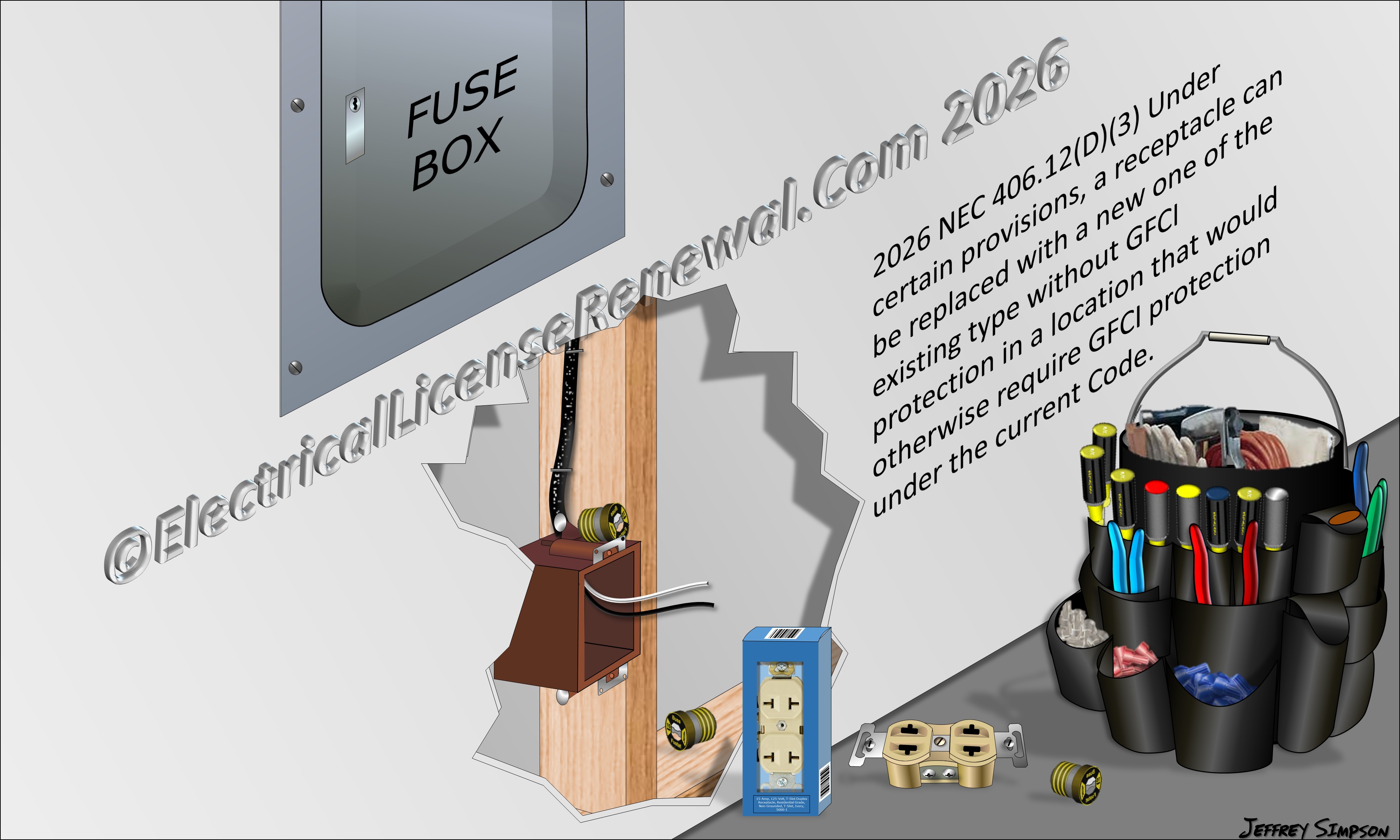
Under certain provisions, a receptacle can be replaced with a new one of the existing type without GFCI protection in a location that would otherwise require GFCI protection under the current Code.
Code Change Summary: Revised code language now requires that all practical options be exhausted before omitting GFCI protection entirely for replacement receptacles.
SME commentary: In the 2026 NEC®, the exception under Section 406.12(D)(3) (previously 406.4(D)(3) in the 2023 edition) has been expanded to clarify when a replaced receptacle may omit GFCI protection altogether. The revision provides a clear, three-part test that must be met before a receptacle can be replaced with a new one of the existing type without GFCI protection in a location that would otherwise require GFCI protection under the current Code.
Historically, this exception addressed older installations in which the existing outlet boxes were too small to accept a GFCI receptacle and where the branch-circuit wiring lacked an equipment grounding conductor. In the 2023 NEC®, the exception permitted a receptacle replacement with a new receptacle of the existing type only if GFCI protection was supplied elsewhere, such as by a GFCI circuit breaker or an upstream GFCI device. In such cases, the receptacle had to be marked “GFCI Protected” and “No Equipment Ground” in accordance with 406.4(D)(2)(b), or 406.4(D)(2)(c), as applicable. That approach preserved personnel protection while acknowledging space and wiring limitations in older installations that were code compliant at the time of the original installation.
Field experience, however, revealed situations where even those provisions could not be met without significant upgrading. Some installations contain obsolete or shallow outlet boxes where a GFCI device physically cannot fit. Others may lack an accessible upstream outlet box to host a GFCI receptacle, and many older fuse boxes and panelboards will not accept a GFCI circuit breaker that matches the vintage of the existing equipment. The revised 2026 NEC® language in 406.12(D)(3) formally recognizes these realities and now allows a receptacle to be replaced with a new receptacle of the existing type and omission of GFCI protection is permissible only when all three of the following conditions are satisfied:
- The outlet box size will not permit installation of a GFCI receptacle.
- No electrically upstream outlet box will permit installation of a GFCI receptacle.
- A GFCI circuit breaker cannot provide the required GFCI protection.
By replacing the prior “where GFCI protection is provided …” language with these explicit criteria, the revised exception intends to eliminate ambiguity and provide a practical yet safety-oriented compromise for retrofit work. The new text also deletes the marking requirement, recognizing that such labeling serves little purpose when no form of GFCI protection can be achieved.
This change acknowledges the technical and physical limitations of aging electrical systems, particularly those predating the widespread use of GFCI protection beginning in the mid-to-late 1970s. It ensures that electricians and inspectors have a defined path forward when upgrading receptacles in existing structures while maintaining the expectation that every reasonable method of providing GFCI protection must first be considered. Ultimately, the 2026 revision improves clarity and reinforces the Code’s guiding principle: omit GFCI protection only as a last resort, and only after confirming that none of the available methods can feasibly be applied.
Below is a preview of the NEC®. See the actual NEC® text at NFPA.ORG for the complete code section. Once there, click on their link to free access to the 2026 NEC® edition of NFPA 70.
2023 Code Language:
406.4(D)(3) Ground-Fault Circuit-Interrupter Protection. GFCI protection for receptacles shall be provided where replacements are made at receptacle outlets that are required to be so protected elsewhere in this Code. GFCIs shall be listed.
Exception: Where the outlet box size will not permit the installation of the GFCI receptacle, the receptacle shall be permitted to be replaced with a new receptacle of the existing type, where GFCI protection is provided and the receptacle is marked “GFCI Protected” and “No Equipment Ground,” in accordance with , (D)(2)(b), or (D)(2)(c), as applicable.
2026 Code Language:
406.12(D)(3) Ground-Fault Circuit-Interrupter Protection. GFCI protection for receptacles shall be provided where replacements are made at receptacle outlets that are required to be so protected elsewhere in this code.
Exception: The receptacle shall be permitted to be replaced with a new receptacle of the existing type if all of the following conditions exist:
(1) The outlet box size will not permit installation of a GFCI receptacle.
(2) No electrically upstream outlet box will permit installation of a GFCI receptacle.
(3) A GFCI circuit breaker cannot provide the required GFCI protection.
