406.1 Wiring Devices.
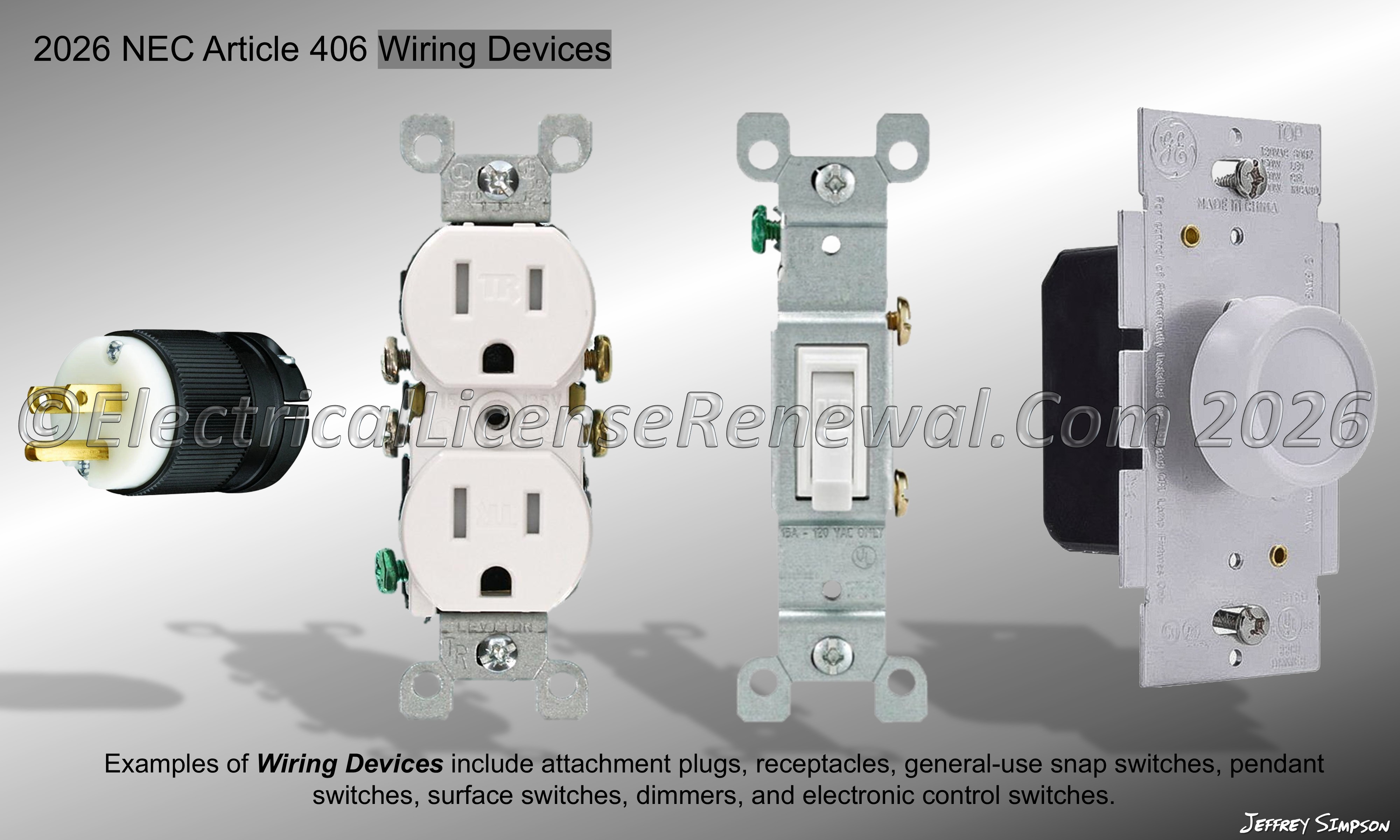
Examples of Wiring Devices include attachment plugs, receptacles, general-use snap switches, pendant switches, surface switches, dimmers, and electronic control switches.
Code Change Summary: The 2026 NEC® expands Article 406 to include switches previously covered under Article 404, aligning the organization of the Code with the new Article 100 definition of a Wiring Device.
SME commentary: In the 2026 NEC®, Article 406 has been significantly expanded to include the types of switches that were formerly addressed in Article 404. This restructuring aligns the Code with the new Article 100 definition of a Wiring Device and clearly separates the usual box-mounted switches from larger or specialized switch types now remaining in Article 404.
Prior to this change, Article 404 addressed all switches and switching devices operating at 1000 volts ac or less, including snap switches, pendant switches, surface switches, dimmers, and electronic control switches. With the 2026 NEC®, Article 404 has been refocused to apply only to general-use switches, motor-circuit switches, isolating switches, pullout switches, circuit breakers used as switches, and molded-case switches operating at voltages not over 1000 volts ac or 1500 volts dc. All other switch types that share the physical and installation characteristics of receptacles have been moved to Article 406, which now provides unified rules for these devices under the broader category of “wiring devices”.
The newly added definition in Article 100 describes a Wiring Device as “an electrical device with a yoke or used with flexible cord or cable that serves as either a connection point to facilitate the flow of current or as a control device in general distribution and branch circuits.” Examples of Wiring Devices include attachment plugs, receptacles, general-use snap switches, pendant switches, surface switches, dimmers, and electronic control switches. These devices are typically installed within outlet boxes using mounting straps or yokes, which makes their relocation to Article 406 both logical and consistent with real-world practices.
The restructured Article 406 is now divided into three parts:
- Part I contains general requirements that apply to both switches and receptacles.
- Part II retains the previous provisions for Receptacles, Cord Connectors, and Attachment Plugs (Caps) from earlier editions of the NEC®.
- Part III is new and now covers General-Use Snap Switches, Dimmers, and Electronic Control Switches that were formerly located in Article 404.
By reorganizing these sections, the NEC® now provides a cohesive framework for devices that share similar construction and mounting methods. This makes it easier for designers, installers, and inspectors to locate applicable rules and reduces redundancy across articles.
This realignment also strengthens consistency with NFPA 70B, Standard for Electrical Equipment Maintenance, which separately categorizes “Switches” and “Wiring Devices.” In NFPA 70B, Chapter 17 addresses switches, while Chapter 24 covers wiring devices. Adopting this same structure in the NEC® improves cross-referencing and promotes uniformity across NFPA codes and standards.
Below is a preview of the NEC®. See the actual NEC® text at NFPA.ORG for the complete code section. Once there, click on their link to free access to the 2026 NEC® edition of NFPA 70.
2023 Code Language:
406.1 Scope. This article covers the rating, type, and installation of receptacles, cord connectors, and attachment plugs (or cord caps).
2026 Code Language:
406.1 Scope. This article covers the rating, type, and installation of wiring devices.
