404.30 Switch Enclosures with Doors or Hinged Covers.
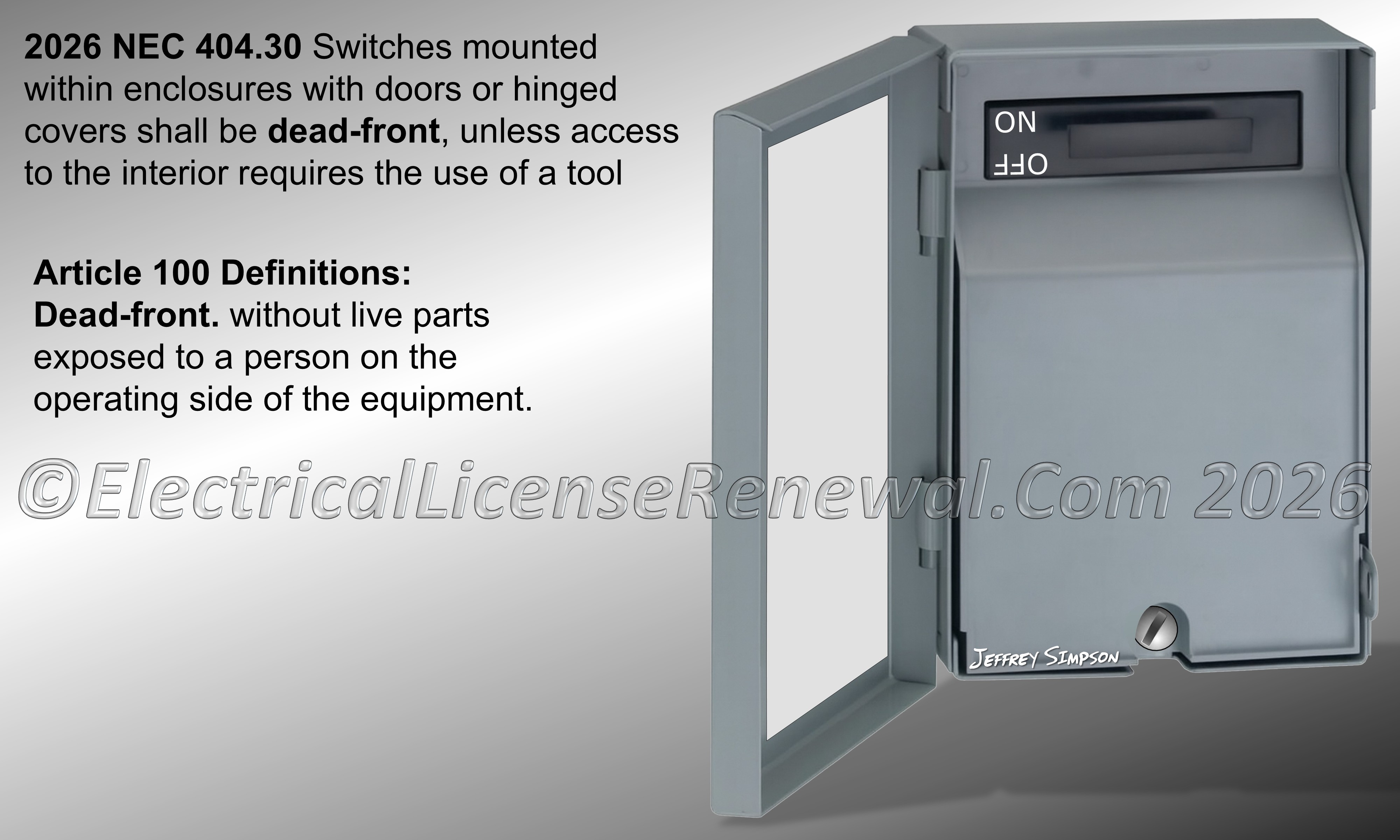
Switches mounted within enclosures with doors or hinged covers must be dead-front, unless gaining access to the interior requires a tool.
Code Change Summary: Section 404.30 was revised to require enclosed switches with doors or hinged covers to be dead-front unless access to the interior requires the use of a tool.
SME commentary: The 2026 NEC® revision to Section 404.30 strengthens safety requirements for switch enclosures with doors or hinged covers by removing ambiguity and mandating that such enclosures be dead-front, unless access to the interior requires the use of a tool. This update makes switch enclosure safety rules easier to apply and helps keep unqualified people from coming in contact with live parts.
In the 2023 NEC®, Section 404.30 contained detailed text describing how enclosed switches were to be constructed to prevent contact with uninsulated live parts when the switch was in the “on” position. It also included allowances for designs that provided “equivalent protection” against accidental contact. However, that version allowed access to uninsulated live parts when the switch was in the “off” position, creating a potential hazard if the enclosure door was opened while the circuit remained energized on the line side. The language was lengthy and difficult to enforce, particularly the provision allowing for “approved designs that provide equivalent protection,” which left interpretation largely to the authority having jurisdiction.
During the 2026 code cycle, a public input highlighted the inconsistency of the 2023 language with the actual hazard present inside energized enclosures. Regardless of the switch position, live conductors connected to the line side remain energized. As such, access should not be conditional upon whether the switch is open or closed. The revised 2026 wording resolves this by requiring enclosed switches to be dead-front, defined in Article 100 as “without live parts exposed to a person on the operating side of the equipment.” The only allowance in the revised language to not be “dead-front” is when a tool is required to gain access, which implies that access is limited to qualified persons.
This update also eliminates the vague allowance for “approved designs,” replacing it with clear, enforceable language. By doing so, the NEC® aligns Section 404.30 with other protective provisions throughout the code that require a tool or locked access whenever energized parts could be exposed. The simplicity of the new language ensures that installers, inspectors, and equipment manufacturers all interpret and apply the section uniformly.
Below is a preview of the NEC®. See the actual NEC® text at NFPA.ORG for the complete code section. Once there, click on their link to free access to the 2026 NEC® edition of NFPA 70.
2023 Code Language:
404.30 Switch Enclosures with Doors. Switch mechanisms mounted within enclosures with doors that, when opened, expose uninsulated live parts shall be constructed so that when the switch is in the closed position access to the switch interior is restricted. Access to the interior with the switch in the closed position shall require the use of a tool or an approved design that provides equivalent protection from access by unqualified persons.
2026 Code Language:
404.30 Switch Enclosures with Doors or Hinged Covers. Switches mounted within enclosures with doors or hinged covers shall be dead-front, unless access to the interior requires the use of a tool.
