392.18(F) Cable Tray Access.
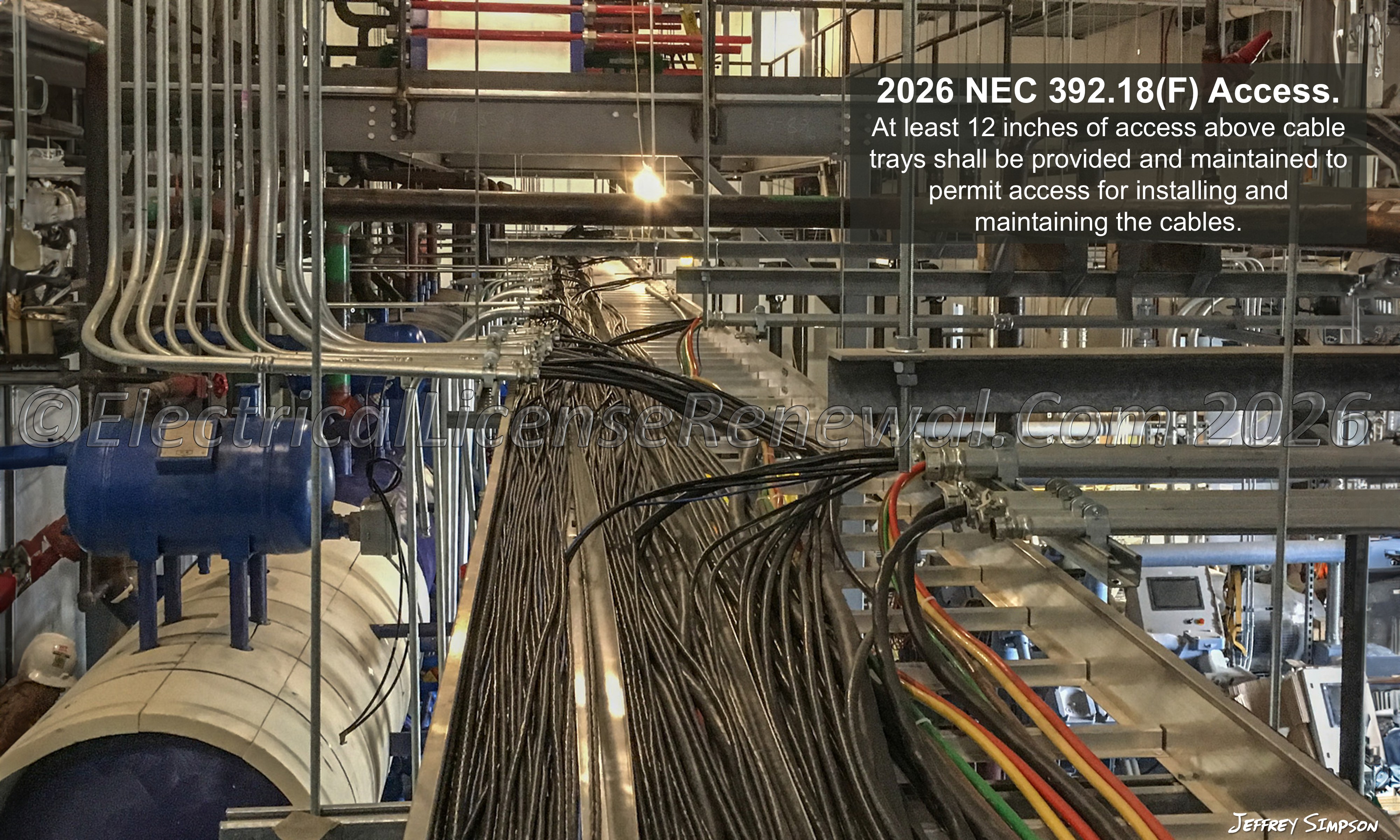
At least 12 inches of access above cable trays shall be provided and maintained to permit access for installing and maintaining the cables.
Code Change Summary: Revised code language in Section 392.18(F) now specifies a minimum of 12 inches of space above cable trays to ensure access for installation and maintenance.
SME commentary: Section 392.18(F) in the 2026 NEC® introduces a much-needed clarification regarding access above cable trays. Previous editions of the Code used subjective language, requiring “sufficient space” to provide “adequate access” about cable trays, leaving the determination of what was “adequate” to the discretion of the installer or authority having jurisdiction (AHJ). That ambiguity led to wide variation in enforcement and design interpretation. The 2026 revision resolves this by defining a specific measurement: a minimum of 12 inches of space above cable trays must be provided and maintained to permit access for installing and maintaining cables unless the exceptions apply.
The new requirement establishes a clear benchmark, reducing the guesswork that previously surrounded cable tray installations. The substantiation behind this change noted that what may seem adequate to a 6-foot, lean installer may not be so for a shorter or larger individual, illustrating the impracticality of relying solely on judgment. By adopting the 12-inch requirement, the NEC® aligns Section 392.18(F) with the ANSI/TIA/EIA-569-A Standard for Telecommunications Pathways and Spaces, which uses the same measurement. This ensures a consistent industry standard for clearance above trays in both electrical and communication applications.
Four exceptions provide flexibility for specific conditions:
Exception 1 permits reduced space where the installation complies with 645.5 for information technology equipment rooms, recognizing that IT environments may have controlled access and specialized design.
Exception 2 allows smaller clearances in industrial establishments where ongoing maintenance and supervision ensure that only qualified persons service the installed cable tray.
Exception 3 authorizes smaller distances by special permission of the AHJ.
Exception 4 applies when equipment crosses at any angle above the tray, acknowledging that equipment may temporarily encroach on the 12-inch space without violating the intent of the rule.
Before this update, installers and inspectors often debated what constituted “adequate access,” resulting in inconsistent approvals and potential rework. The absence of a defined measurement left inspectors to rely on field judgment, which could differ between jurisdictions. The new language brings objectivity and consistency to design, construction, and inspection practices.
Below is a preview of the NEC®. See the actual NEC® text at NFPA.ORG for the complete code section. Once there, click on their link to free access to the 2026 NEC® edition of NFPA 70.
2023 Code Language:
392.18(F) Adequate Access. Sufficient space shall be provided and maintained about cable trays to permit adequate access for installing and maintaining the cables.
2026 Code Language:
392.18(F) Access. The minimum space of 12 inches of access above cable trays shall be provided and maintained to permit access for installing and maintaining the cables.
Exception No. 1: Where the installation complies with 645.5 for IT equipment room.
Exception No. 2: In industrial establishments, where conditions of maintenance and supervision ensure that only qualified persons service the installed cable tray.
Exception No. 3: By special permission, smaller distance spaces shall be permitted.
Exception No. 4: For equipment crossing at any angle.
