344.29 Terminations.
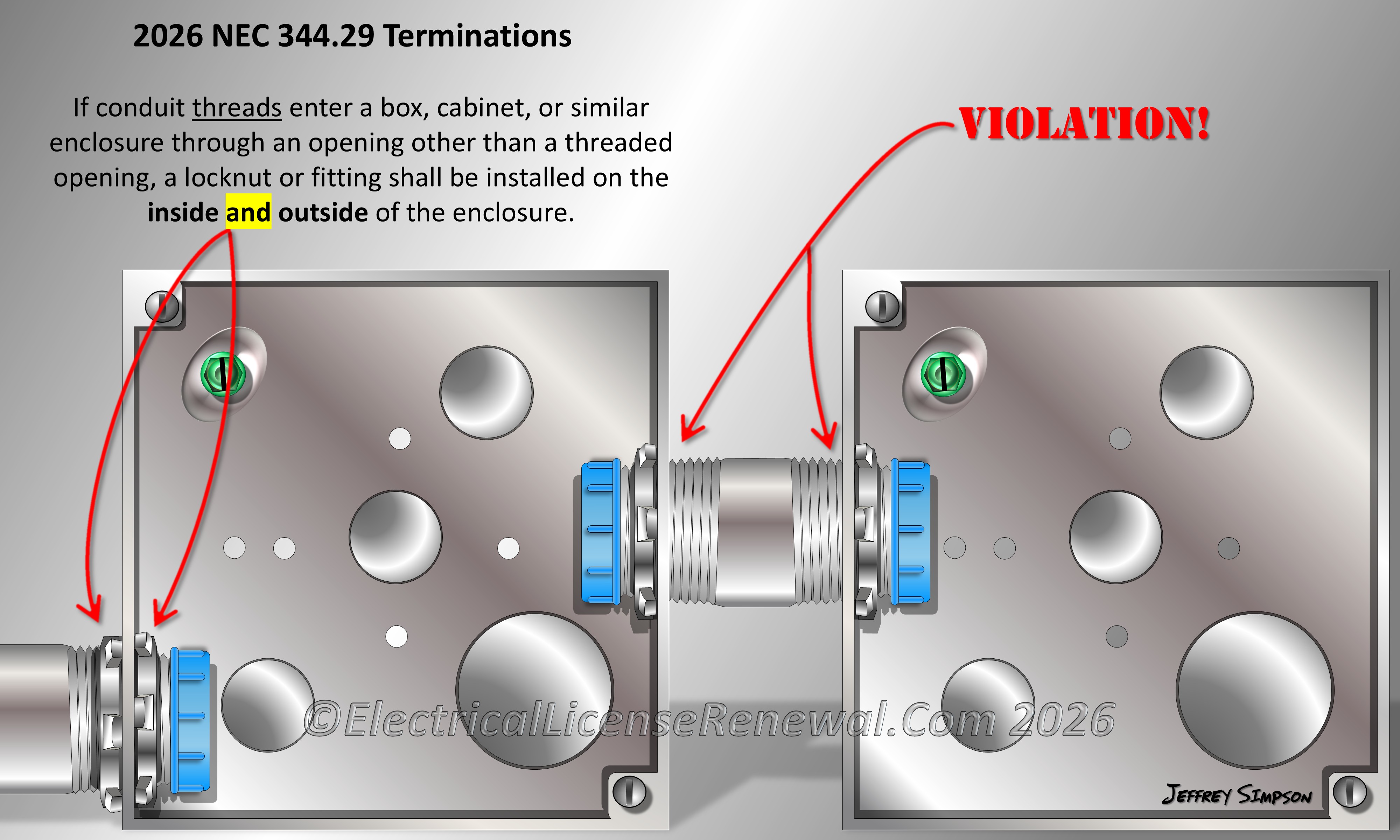
If conduit threads enter a box, cabinet, or similar enclosure through an opening other than a threaded opening, a locknut or fitting shall be installed on the inside and outside of the enclosure.
Code Change Summary: A new section was added requiring a locknut or fitting on both the inside and outside of an enclosure when rigid metal conduit (RMC) threads enter through a non-threaded opening.
SME commentary: Section 344.29 is a new addition in the 2026 NEC® that addresses a common field issue involving rigid metal conduit (RMC) terminations. Prior to this change, Article 344 offered no explicit direction on whether one or two locknuts were needed when RMC conduit threads entered an enclosure through an unthreaded knockout. Many installers used a single locknut on the inside of the cabinet, assuming it provided sufficient mechanical and electrical continuity. However, that practice often resulted in damaged enclosures, loose fittings, and unreliable bonding paths.
If a single locknut on the inside of the enclosure wall is overtightened, without a second locknut on the outside of the enclosure wall, it can distort the box wall or even crack non-ferrous enclosures. The result can be a poor bond between the conduit and the box, violating the intent of Sections 110.12(B) and 250.120(A) regarding electrical equipment integrity and grounding continuity. The new language in 344.29 corrects that weakness by requiring the conduit threads to be secured on both sides, inside and outside, so that the locknuts or fittings effectively “sandwich” the enclosure wall. This provides a firm mechanical connection and maintains a low-impedance grounding path.
The new language in 344.29 reads: “If conduit threads enter a box, cabinet, or similar enclosure through an opening other than a threaded opening, a locknut or fitting shall be installed on the inside and outside of the enclosure.” The rule applies specifically to installations where RMC conduit threads enter an enclosure but does not prohibit the use of listed threadless fittings. The intent is to address only situations where threaded RMC conduit is used with non-threaded enclosure openings, such as field drilled holes or standard knockouts.
Field inspectors have noted cases where a threaded RMC nipple connecting two boxes was tightened with only one locknut per nipple instead of two. This arrangement can leave the connection loose, cause mechanical stress, and compromise the grounding path. The new code language removes ambiguity by clearly requiring a pair of locknuts, one set for each enclosure, to ensure rigidity and grounding continuity. A similar requirement was added in Section 342.29 for Intermediate Metal Conduit (IMC), reinforcing the same principle.
The substantiation provided to the Code-Making Panel highlighted that a single-locknut connection could bend or distort the enclosure, especially when torque was applied to achieve a tight fit. By specifying a locknut or fitting on both sides of the enclosure wall, Section 344.29 aligns with practical installation methods that ensure structural integrity and electrical safety.
In the field, compliance will be straightforward: whenever RMC threads pass through a drilled, punched, or non-threaded hole, secure the connection with locknuts or other listed fittings both inside and outside the enclosure. The change enhances bonding reliability, reduces enclosure damage, and provides inspectors with a clear, enforceable standard.
Below is a preview of the NEC®. See the actual NEC® text at NFPA.ORG for the complete code section. Once there, click on their link to free access to the 2026 NEC® edition of NFPA 70.
2023 Code Language:
This code section did not exist.
2026 Code Language:
N 344.29 Terminations. If conduit threads enter a box, cabinet, or similar enclosure through an opening other than a threaded opening, a locknut or fitting shall be installed on the inside and outside of the enclosure.
