334.24 Bending Radius.
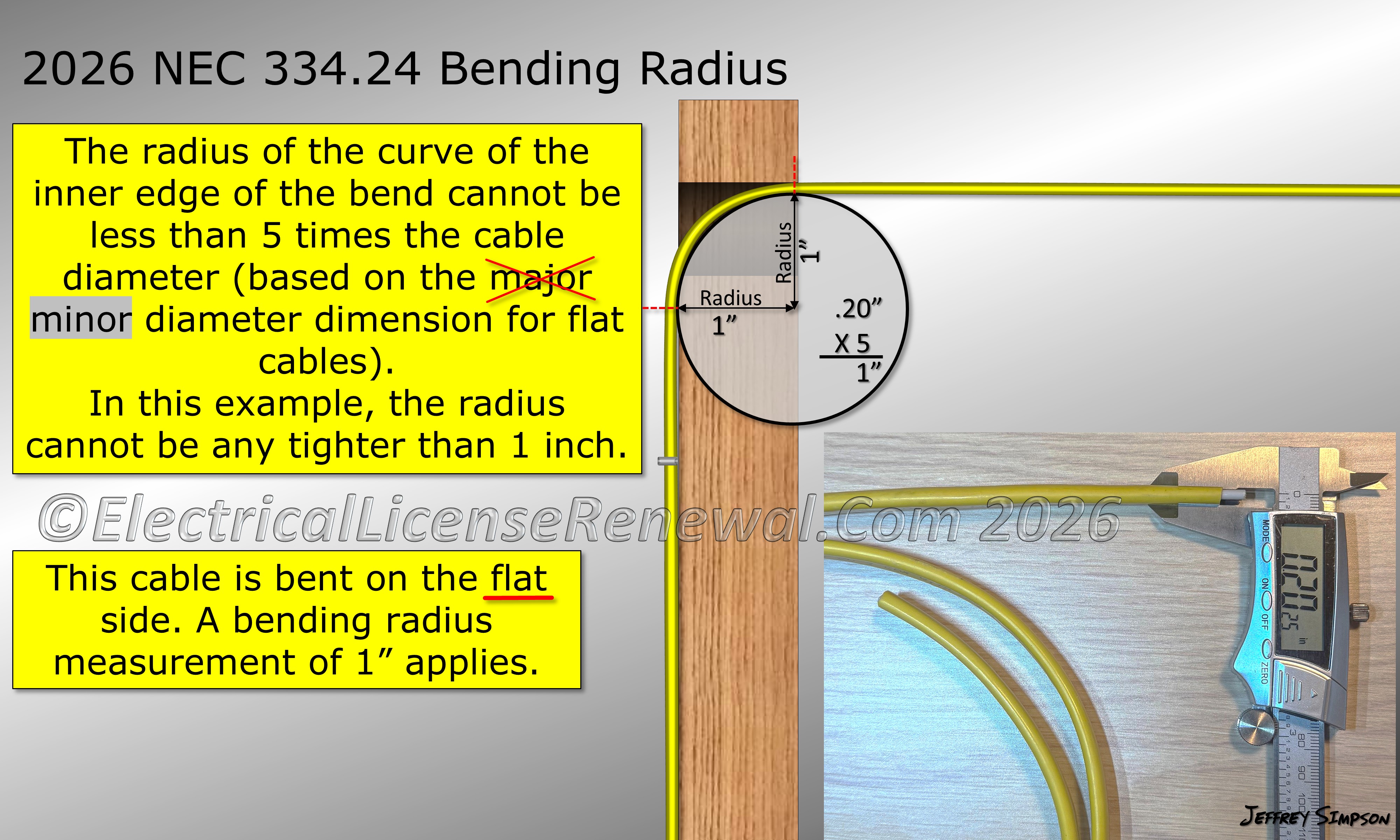
For flat cables bent on the flat side, the smaller dimension can be used to determine the bending radius.
Code Change Summary: Revised code language clarifies how the bending radius is determined for flat-type NM cable, permitting a tighter bend when the cable is bent on its flat side.
SME commentary: In the 2026 NEC®, Section 334.24 was modified to provide an important clarification on how to determine the bending radius for flat-type nonmetallic-sheathed (NM) cable. The revised text now specifies: “For flat cables, the minor diameter dimension of the cable shall be used to determine the bending radius when bending on the flat side of the cable. For all other bends, the major diameter dimension shall be used”.
This change originated from confusion introduced during the 2023 NEC® cycle. The 2023 language had required that bends in Types NM and NMC cable be made so that the radius of the inner edge of any bend is not less than five times the diameter of the cable and required the major dimension of a flat cable to be used when determining the minimum bending radius. Because a flat NM cable has both a narrow (minor) and wide (major) dimension, the earlier rule left installers confused as to why the larger diameter was used to determine the bending radius when a flat-type cable was bent on its flat side.
Public input during the 2023 cycle suggested that the thickness (minor dimension) of the flat cable should be used for determining the bending radius if the cable was bent on its flat side. The code-making panel agreed that additional language was warranted, but clarified that for general bends the major dimension still governs, and only when the cable is bent on the flat side may the minor dimension be used.
The 2026 revision corrects this by adding explicit wording to allow the minor diameter dimension when bending the cable on the flat side. This provides important practical relief in the field. Since 2023, electricians have struggled to comply with 334.24 when running flat NM cables through bored holes in framing members or into conduit bodies without violating the bending radius rule. Because the cable’s major dimension is much wider, using it to calculate the bend radius would often require excessively large holes or conduit bodies. By recognizing that the cable experiences less mechanical stress when bent on its flat side, the code now allows a smaller bend radius for this common condition.
This update also improves consistency across wiring methods. Parallel revisions were made to Section 338.24 for Types SE and USE cable and to Section 340.24 for Type UF cable, ensuring that bending-radius rules are applied uniformly across similar flat-type cables.
This 2026 change brings clarity and practical flexibility to installers while maintaining the intended protection needed against potential cable damage. When NM cable is bent on its flat side, the minor diameter dimension governs the minimum bending radius. For all other configurations, the major dimension continues to apply. This clear distinction resolves prior ambiguity and aligns field practice with the true geometry of flat NM cable.
Below is a preview of the NEC®. See the actual NEC® text at NFPA.ORG for the complete code section. Once there, click on their link to free access to the 2026 NEC® edition of NFPA 70.
2023 Code Language:
334.24 Bending Radius. Bends in Types NM and NMC cable shall be so made that the cable will not be damaged. The radius of the curve of the inner edge of any bend during or after installation shall not be less than five times the diameter of the cable. For flat cables, the major diameter dimension of the cable shall be used to determine the bending radius.
2026 Code Language:
334.24 Bending Radius. Bends in Types NM and NMC cable shall be so made that the cable will not be damaged. The radius of the curve of the inner edge of any bend during or after installation shall not be less than five times the diameter of the cable. For flat cables, the minor diameter dimension of the cable shall be used to determine the bending radius when bending on the flat side of the cable. For all other bends, the major diameter dimension shall be used.
