314.16(B) Box Fill Calculations.
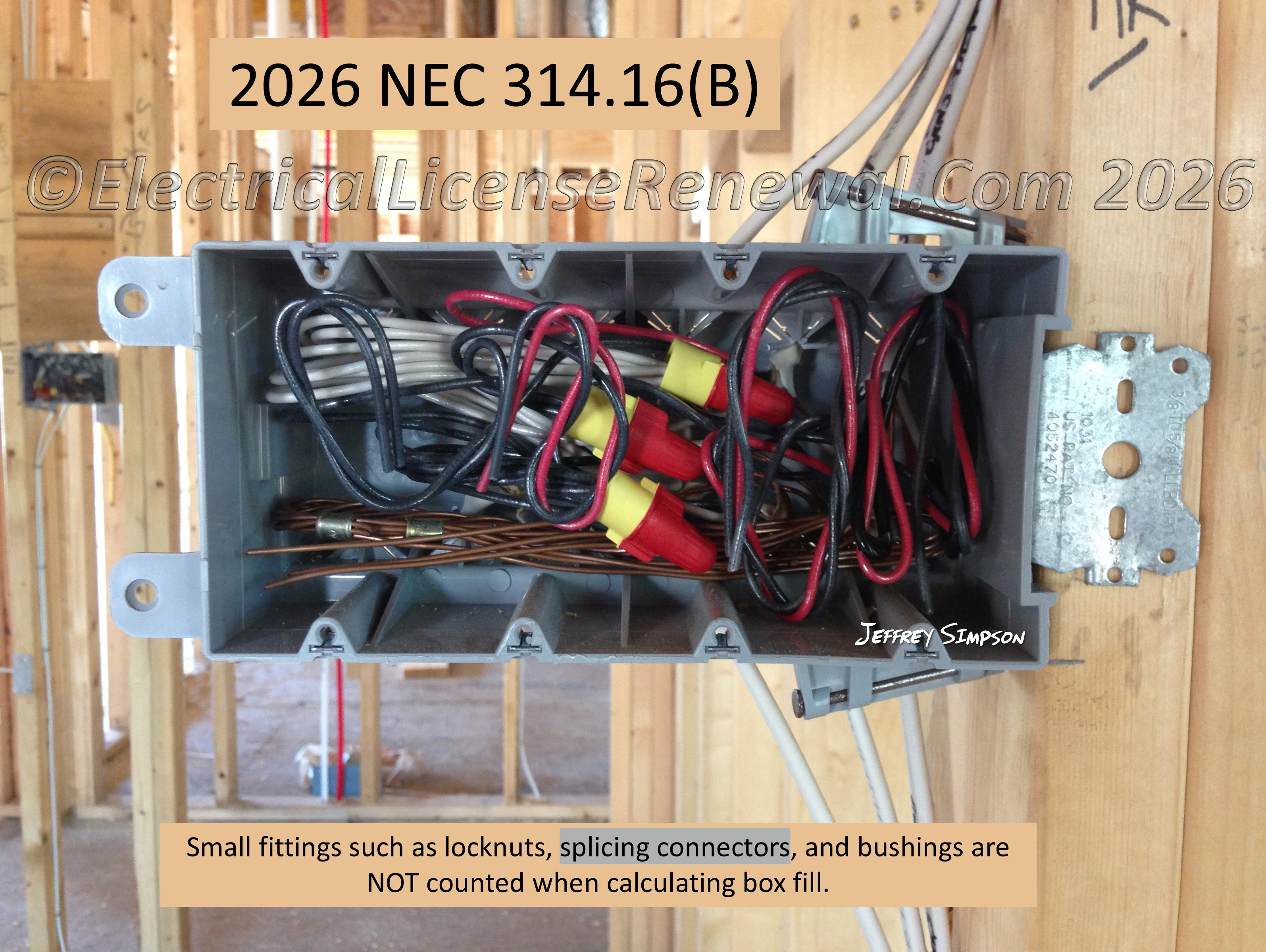
Small fittings such as locknuts, splicing connectors, and bushings are NOT counted when calculating box fill.
Code Change Summary: Revised language in 314.16(B) clarifies that splicing connectors, such as wire nuts and push-in connectors, are not counted when calculating box fill.
SME commentary: In the 2026 NEC®, Section 314.16(B) was updated to explicitly include the term “splicing connectors,” confirming that devices such as wire nuts, push-in connectors, and similar fittings are not required to be counted when performing box fill calculations. This clarification resolves any confusion as to whether these common wire connectors should be treated as contributing volume within the box. The 2026 language in 314.16(B) now makes it clear that no allowance is required for small fittings such as locknuts, splicing connectors, and bushings.
Prior editions of the NEC® referenced “small fittings such as locknuts and bushings” but did not expressly mention splicing devices, leaving some uncertainty about their status. The addition of the term “splicing connectors” removes this ambiguity and aligns the language with how these products are identified in other NEC® sections and UL product standards. Although the term “splicing connector” is not defined in Article 100, it is commonly understood and already appears in Section 110.14, which governs the making of electrical connections and splices.
Splicing connectors are widely used in the field to join conductors within boxes and enclosures. Under UL Category Code ZMVV, these connectors are evaluated for single-polarity use with copper, aluminum, or copper-clad aluminum conductors, and they provide insulation or protection for the joined conductors to prevent contact with other current-carrying parts. These devices often include twist-on wire connectors, lever-actuated connectors, or push-in types. These are considered small fittings that do not contribute significant measurable volume beyond the conductors they enclose; therefore, they are not required to be counted when determining box fill.
The 2026 revision also reinforces that no volume allowance is needed for other small fittings, such as locknuts or bushings, and that each space within a box containing a barrier is calculated separately. This ensures consistency with the general intent of box fill provisions, which are designed to prevent overcrowding and maintain sufficient free space for conductor insulation integrity and heat dissipation.
By specifically referencing “splicing connectors,” the NEC® now mirrors actual installation practices and product terminology. Electricians can confidently omit these connectors from box fill calculations without fear of noncompliance, while inspectors have clear text to reference during field inspections. The result is a cleaner, more enforceable rule that enhances clarity for both design and inspection professionals working under Article 314.
Below is a preview of the NEC®. See the actual NEC® text at NFPA.ORG for the complete code section. Once there, click on their link to free access to the 2026 NEC® edition of NFPA 70.
2023 Code Language:
314.16(B) Box Fill Calculations. The volumes in 314.16(B)(1) through (B)(6), as applicable, shall be added together. No allowance shall be required for small fittings such as locknuts and bushings. Each space within a box installed with a barrier shall be calculated separately.
2026 Code Language:
314.16(B) Box Fill Calculations. The volumes in 314.16(B)(1) through 314.16(B)(6), as applicable, shall be added together. No allowance shall be required for small fittings such as locknuts, splicing connectors, and bushings. Each space within boxes installed with barriers shall be calculated separately.
