312.11(A) Splices, Taps, and Feed-Through Conductors.
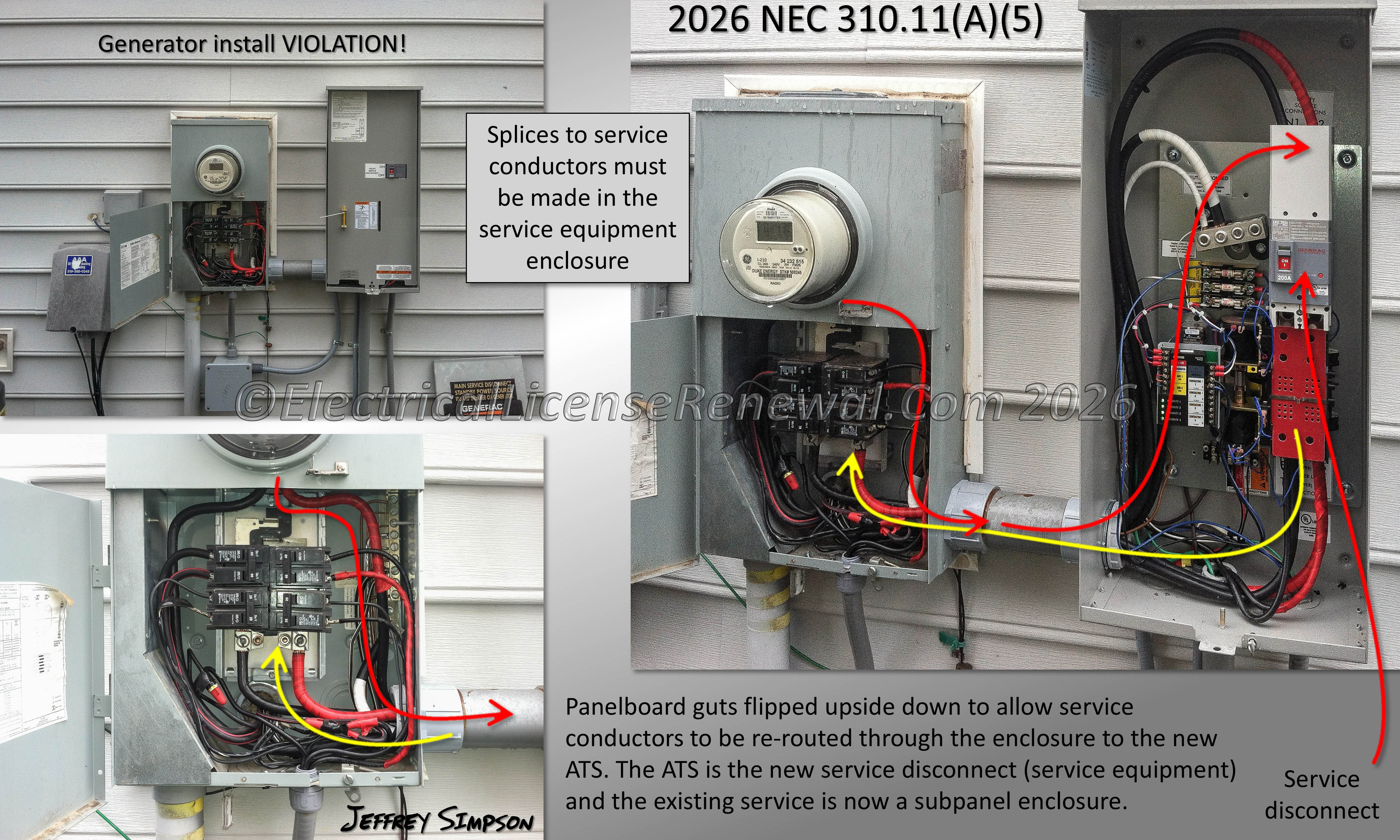
Violation! Splices to service conductors must be made in the service equipment enclosure.
Code Change Summary: A new list item was added to address splices, taps, and feed-through conductors for enclosures covered by NEC® Article 312.
SME commentary: In the 2026 NEC®, Section 312.8(A) has been renumbered as 312.11(A), and a new list item (5) has been added to the conditions that must be satisfied when splices, taps, or feed-through conductors are located within switch enclosures or overcurrent device enclosures such as cabinets or cutout boxes. The new provision clarifies that when service conductors are involved, any splicing or tapping of the service conductors must located within the service equipment.
Section 312.11 applies to the wiring space of enclosures containing overcurrent devices such as cabinets and cutout boxes where conductors may be fed through, spliced, or tapped off to other enclosures, switches, or overcurrent protective devices. The section permits these practices only if the specific conditions of 312.11(A)(1) through (5) are met, addressing both physical space limitations and safety considerations. The newly added item (5) is the result of a proposal intended to correct misinterpretations that have arisen in the field.
The original substantiation behind item (5) was based on installations where existing services were being modified to incorporate an automatic transfer switch (ATS) for a standby generator. In such situations, electricians sometimes spliced and rerouted the existing service conductors inside the existing service cabinet and extended them to the new ATS, which then became the service disconnect. From the new ATS, feeder conductors were routed back to the existing service cabinet to resupply the main breaker. By doing so, the existing service disconnect breaker technically became a feeder disconnect, and the rerouted service conductors within the enclosure remained energized even when the breaker handle was in the “off” position. This presented a serious safety concern, as a worker might mistakenly assume the conductors were de-energized, unaware that the only way to remove power would be to request a utility shutdown or pull the meter, an unsafe and non-Code-compliant practice due to the potential for severe arc flash energy.
At the first draft stage of the 2026 NEC®, early wording of new condition (5) was overly restrictive and could have inadvertently prohibited legitimate line-side photovoltaic (PV) interconnections that are commonly made within service equipment enclosures. Recognizing this, the Code-Making Panel revised the language at the second draft to achieve the intended purpose without hindering acceptable PV or optional power source connections. The final version simply states, “The service conductors are located within the service equipment.”
This concise phrasing reinforces that service conductors cannot pass through other enclosures located ahead of the service equipment, while still permitting properly listed line-side connections within the service equipment itself. The committee’s second draft statement confirms this intent: to clarify the five conditions necessary for splicing, tapping, or feeding through conductors while maintaining allowances such as line-side photovoltaic connections.
In practical application, using the generator and ATS example, interrupting the existing service conductors within a former service cabinet to route them through that cabinet and into the new ATS (which now serves as the service equipment) will render the original cabinet a feeder-supplied panelboard enclosure. Under the revised language of 312.11(A)(5), this configuration would be a violation, since service conductors are required to be “located within the service equipment” enclosure.
Ultimately, the 2026 NEC® revision to 312.11(A) intends to enhance both clarity and safety by resolving field confusion, preventing unsafe splicing of service conductors outside of service equipment, and ensuring continued flexibility for modern energy systems such as photovoltaic installations and backup generators.
Below is a preview of the NEC®. See the actual NEC® text at NFPA.ORG for the complete code section. Once there, click on their link to free access to the 2026 NEC® edition of NFPA 70.
2023 Code Language:
312.8(A) Splices, Taps, and Feed-Through Conductors. The wiring space of enclosures for switches or overcurrent devices shall be permitted for conductors feeding through, spliced, or tapping off to other enclosures, switches, or overcurrent devices where all of the following conditions are met:
(1) The total of all conductors installed at any cross section of the wiring space does not exceed 40 percent of the cross-sectional area of that space.
(2) The total area of all conductors, splices, and taps installed at any cross section of the wiring space does not exceed 75 percent of the cross-sectional area of that space.
(3) The bending space for conductors 4 AWG and larger complies with 314.28(A)(2).
(4) A warning label complying with 110.21(B) is applied to the enclosure that identifies the closest disconnecting means for any feed-through conductors.
2026 Code Language:
312.11(A) Splices, Taps, and Feed-Through Conductors. The wiring space of enclosures for switches or OCPDs shall be permitted for conductors feeding through, spliced, or tapping off to other enclosures, switches, or OCPDs where all of the following conditions are met:
(1) The total of all conductors installed at any cross section of the wiring space does not exceed 40 percent of the cross-sectional area of that space.
(2) The total area of all conductors, splices, and taps installed at any cross section of the wiring space does not exceed 75 percent of the cross-sectional area of that space.
(3) The bending space for conductors 4 AWG and larger complies with 314.28(A)(2).
(4) A warning label complying with 110.21(B) is applied to the enclosure that identifies the closest disconnecting means for any feed-through conductors.
(5) The service conductors are located within the service equipment.
