312.8(C) Cables Entering Cabinets Cutout Boxes and Meter Socket Enclosures.
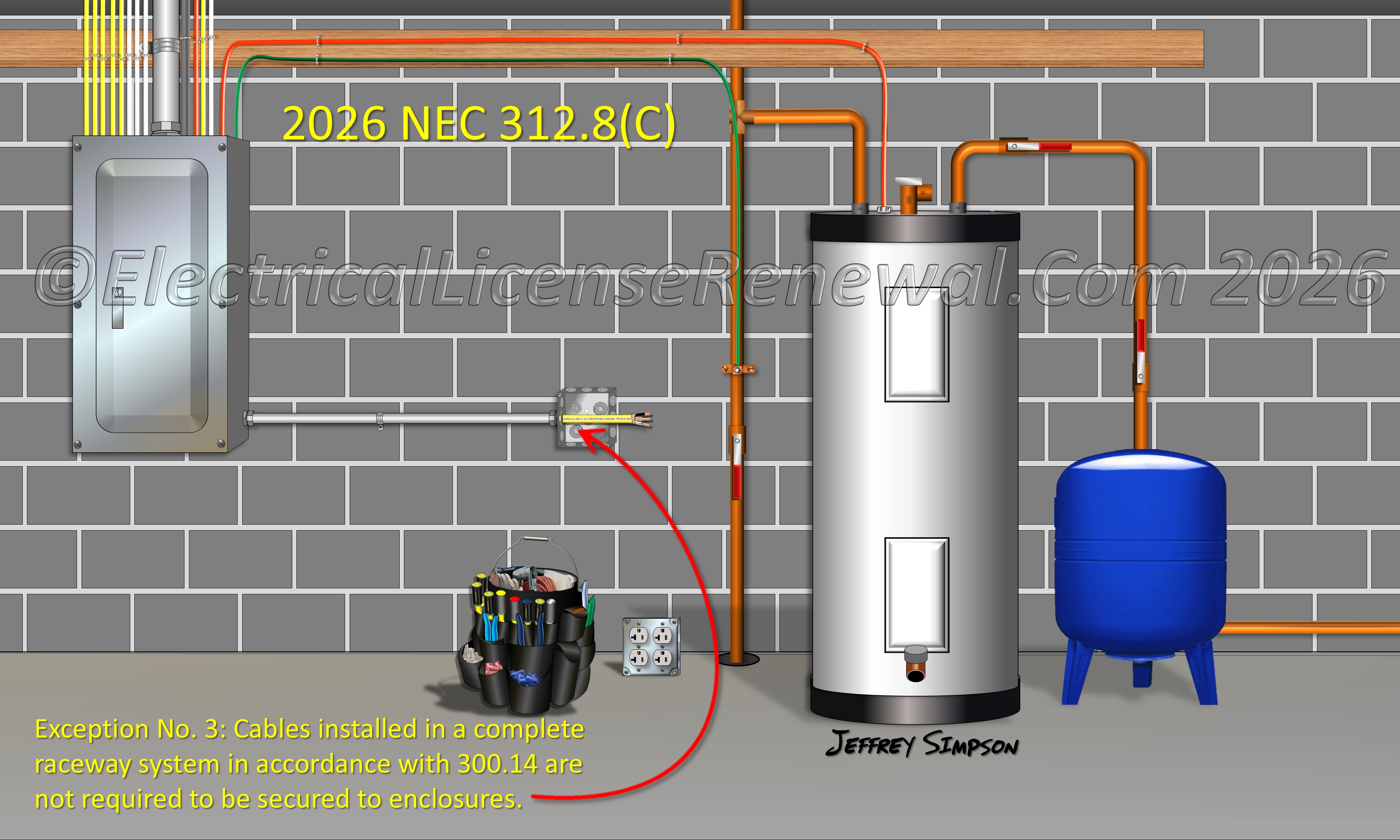
Cables installed in a complete raceway system in accordance with 300.14 are not required to be secured to enclosures.
Code Change Summary: A new Exception No. 3 was added to 312.8(C) permitting cables installed in a complete raceway system in accordance with 300.14 to not be secured to enclosures.
SME commentary: In the 2026 NEC®, Section 312.5(C) has been relocated and renumbered as 312.8(C), and a new Exception No. 3 has been added. This new provision addresses situations where multiple cables are routed through a complete raceway system and emerge into an enclosure, making it impractical to secure each individual cable directly to the cabinet, cutout box, or meter socket enclosure as otherwise required by the parent rule.
The parent text of 312.8(C) is clear: “Where a cable wiring method is used, each cable shall be secured to the cabinet, cutout box, or meter socket enclosure.” This has long been a basic rule of the NEC®, intended to protect against mechanical strain and maintain the physical integrity of the installation. However, the industry has long recognized challenges in applying this requirement to installations where multiple cables are drawn through raceways and enter an enclosure through a single fitting. For example, running several home-run cables into a recessed panelboard cabinet through a chase nipple or conduit fitting (technically a code violation) often meant that it was physically impossible to secure each cable individually to the enclosure. Historically, this situation was often handled by local NEC® amendments to allow the practice or enforcement discretion, but the base NEC® rule remained unchanged.
Prior to 2026, the only explicit exceptions in 312.5(C) (now 312.8(C)) were Exception No. 1, which permitted cables with nonmetallic sheaths to enter the top of a surface-mounted enclosure through a short nonflexible raceway if seven detailed conditions were met, and Exception No. 2, which addressed single conductors or multiconductor cables in cable trays permitted by 392.46(A) or (B). Both of these exceptions were limited in application and did not provide relief for complete raceway systems where cables emerge directly into an enclosure without being individually secured.
The new Exception No. 3 closes this gap. It states: “Cables installed in a complete raceway system in accordance with 300.14 shall not be required to be secured to enclosures.” This new language recognizes that when a raceway system is continuous between enclosures, the cables are already mechanically protected by the raceway itself. In such cases, requiring individual cable securement at the enclosure provides little additional benefit, as the complete raceway system ensures both mechanical protection and any needed strain relief.
It is important to note the distinction between existing Exception No. 1 and the new Exception No. 3. Exception 1 is highly restrictive, requiring a surface-mounted cabinet, a nonflexible raceway entering the TOP with a length between 18 inches and 10 feet, and several additional conditions. In contrast, new Exception 3 is broader, applying to any complete raceway system installed in accordance with 300.14. This means the type of cable is not limited, and both nonmetallic and metallic sheathed cables are covered. The key condition is that the raceway must be complete between enclosures, eliminating the possibility of loose or unprotected cable spans.
By adding this new exception, the NEC® provides practical relief for common installation practices while maintaining the safety intent of the original requirement. It prevents unnecessary violations where installers were previously unable to comply with the literal text of the rule, and it aligns code requirements with field practices that have been safely implemented for years.
Below is a preview of the NEC®. See the actual NEC® text at NFPA.ORG for the complete code section. Once there, click on their link to free access to the 2026 NEC® edition of NFPA 70.
2023 Code Language:
312.5(C) Cables. Where cable is used, each cable shall be secured to the cabinet, cutout box, or meter socket enclosure.
Exception No. 1: Cables with entirely nonmetallic sheaths shall be permitted to enter the top of a surface-mounted enclosure through one or more nonflexible raceways not less than 18 inches and not more than 10 feet in length, provided all of the following conditions are met:
(1) Each cable is fastened within 12 inches, measured along the sheath, of the outer end of the raceway.
(2) The raceway extends directly above the enclosure and does not penetrate a structural ceiling.
(3) A fitting is provided on each end of the raceway to protect the cable(s) from abrasion and the fittings remain accessible after installation.
(4) The raceway is sealed or plugged at the outer end using approved means so as to prevent access to the enclosure through the raceway.
(5) The cable sheath is continuous through the raceway and extends into the enclosure beyond the fitting not less than 1⁄4 inch.
(6) The raceway is fastened at its outer end and at other points in accordance with the applicable article.
(7) Where installed as conduit or tubing, the cable fill does not exceed the amount that would be permitted for complete conduit or tubing systems by Table 1 of Chapter 9 of this Code and all applicable notes thereto. Note 2 to the tables in Chapter 9 does not apply to this condition.
Informational Note: See Chapter 9, Table 1, including Note 9, for allowable cable fill in circular raceways. See 310.15(C)(1) for required ampacity reductions for multiple cables installed in a common raceway.
Exception No. 2: Single conductors and multiconductor cables shall be permitted to enter enclosures in accordance with 392.46(A) or (B).
2026 Code Language:
312.8(C) Cables. Where a cable wiring method is used, each cable shall be secured to the cabinet, cutout box, or meter socket enclosure.
Exception No. 1: Cables with entirely nonmetallic sheaths shall be permitted to enter the top of a surface-mounted enclosure through one or more nonflexible raceways not less than 18 inches and not more than 10 feet in length if all of the following conditions are met:
(1) Each cable is fastened within 12 inches, measured along the sheath, of the outer end of the raceway.
(2) The raceway extends directly above the enclosure and does not penetrate a structural ceiling.
(3) A fitting is provided on each end of the raceway to protect the cable(s) from abrasion and the fittings remain accessible after installation.
(4) The raceway is sealed or plugged at the outer end using approved means to prevent access to the enclosure through the raceway.
(5) The cable sheath is continuous through the raceway and extends into the enclosure beyond the fitting not less than 1⁄4 inch.
(6) The raceway is fastened at its outer end and at other points in accordance with the applicable article.
(7) Where installed as conduit or tubing, the cable fill does not exceed the amount that would be permitted for complete conduit or tubing systems by Chapter 9 Table 1 and all applicable notes thereto. Note 2 of the Chapter 9 tables does not apply to this condition.
Informational Note: See Chapter 9 Table 1, including Note 9, for allowable cable fill in circular raceways. See 310.15(C)(1) for required ampacity reductions for multiple cables installed in a common raceway.
Exception No. 2: Single conductors and multiconductor cables shall be permitted to enter enclosures in accordance with 392.46(A) or 392.46(B).
Exception No. 3: Cables installed in a complete raceway system in accordance with 300.14 shall not be required to be secured to enclosures.
