312.3 Reconditioned Equipment.
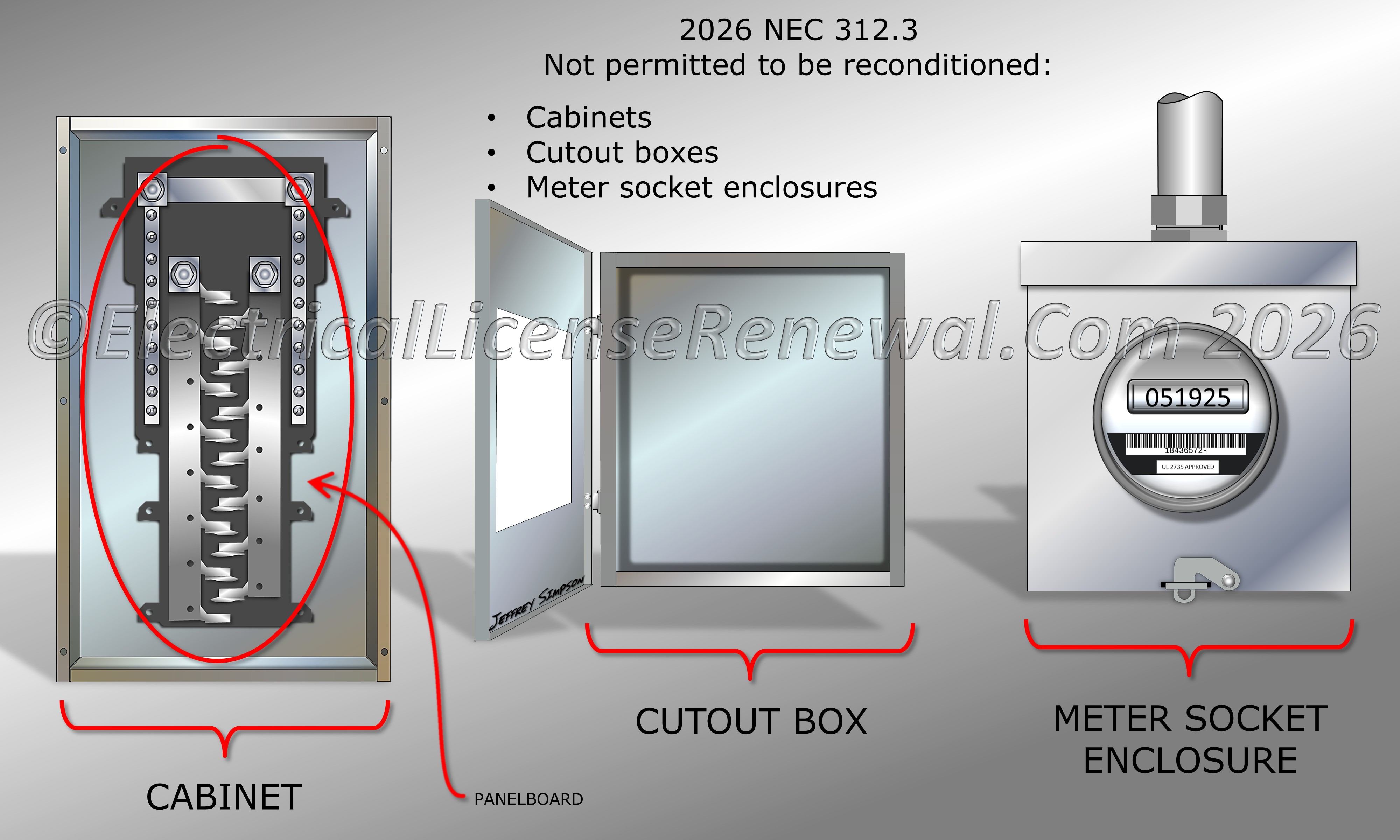
Reconditioned cabinets, cutout boxes, and meter socket enclosures are NOT permitted to be installed.
Code Change Summary: A new Section 312.3 was added to prohibit the reconditioning of cabinets, cutout boxes, and meter socket enclosures.
SME commentary: The 2026 NEC® introduces a new provision in Article 312 that explicitly prohibits the reconditioning of certain equipment types. New Section 312.3 establishes rules for reconditioned equipment, with part (A) reserved for any future allowances of reconditioned products and part (B) clearly identifying what is NOT permitted. Specifically, cabinets, cabinet cutout boxes, and cabinet meter socket enclosures may not be reconditioned and then reinstalled in the field.
This change was necessary because the Code previously allowed reconditioning by default unless a specific prohibition was stated. Section 110.20 indicates that electrical equipment is permitted to be reconditioned unless otherwise prohibited, which created uncertainty regarding equipment that lacked defined industry reconditioning standards. The absence of recognized programs for reconditioning cabinets, cutout boxes, and meter sockets meant that older enclosures could potentially be placed back into service without adequate assurance of safety. Section 312.3(B) now closes that gap with solid and enforceable language.
The decision to prohibit reconditioning of these enclosure types is grounded in the unique construction and safety functions they perform. Cabinets and meter sockets are designed with strict performance considerations including containment of arcs and sparks, spacing for wiring, separation between live parts, ventilation, bonding and grounding integrity, barrier placement, resistance to corrosion, and the ability to withstand short-circuit forces. Over time, exposure to moisture, weather, corrosion, mechanical stress, or other environmental conditions can degrade these properties. Unlike certain types of circuit breakers or switchgear assemblies that have established reconditioning processes and standards through recognized industry bodies, there are no standardized programs that verify reconditioned enclosures can still meet the intended design performance.
For example, an older cabinet may have field drilled holes or sharp edges that could compromise conductor insulation. A corroded or modified meter socket enclosure may not provide adequate clamping force, arc containment, or dielectric strength. Without nationally recognized reconditioning standards, there is no reliable way to evaluate whether such equipment would perform safely under fault conditions. Reinstalling such equipment could compromise safety for both installers and occupants.
By reserving 312.3(A) without listing any items, the Code leaves open the possibility of recognizing reconditioned enclosures in the future if acceptable industry programs are developed. However, until such programs exist, 312.3(B) serves as a safeguard that prevents unsafe reconditioning practices.
Ultimately, this addition strengthens Article 312 by aligning it with the broader NEC® initiative to clarify where reconditioning is acceptable and where it is not. The prohibition in 312.3(B) supports compliance and maintains electrical safety by requiring that equipment critical to housing overcurrent devices, conductors, terminations, and meter bases be installed only in a condition that has not been compromised through reconditioning.
Below is a preview of the NEC®. See the actual NEC® text at NFPA.ORG for the complete code section. Once there, click on their link to free access to the 2026 NEC® edition of NFPA 70.
2023 Code Language:
This code section did not exist.
2026 Code Language:
N 312.3 Reconditioned Equipment.
(A) Permitted to be Installed. (Reserved)
(B) Not Permitted to be Installed. The installation of the following reconditioned equipment shall not be permitted:
(1) Cabinets
(2) Cabinet cutout boxes
(3) Cabinet meter socket enclosures
