310.15(E) Neutral Conductors.
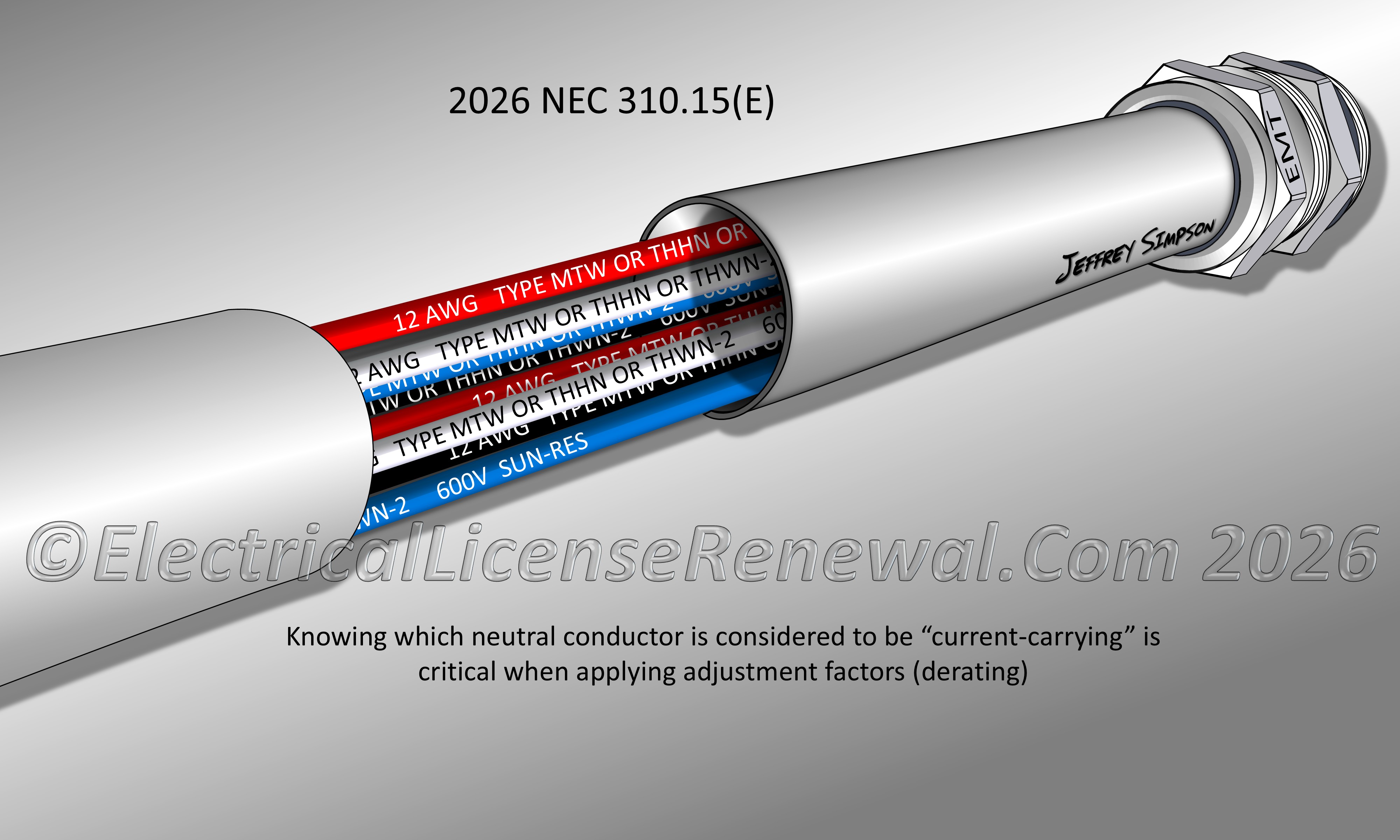
If all 8 conductors in the raceway are “current-carrying” then a 70% adjustment factor applies per Table 310.15(C)(1).
Code Change Summary: Section 310.15(E) was revised to reorganize and clarify the conditions under which a neutral conductor is considered current-carrying.
SME commentary: In the 2026 NEC®, Section 310.15(E) underwent an important reorganization to clarify when a neutral conductor is considered as “current-carrying” for the purpose of applying ampacity adjustment factors in Table 310.15(C)(1). This section is critical because it determines which neutral conductors in a raceway or cable must be included when applying adjustment factors (derating). If more than three current-carrying conductors are installed in a raceway or cable without maintaining spacing for a continuous length longer than 24 inches, the allowable ampacity of each conductor must be adjusted, and a misinterpretation in this area can lead to undersized wiring or overheating conditions.
Previously, the language in 310.15(E) contained both requirements and exceptions intertwined within the three rules, which created confusion. In the 2023 NEC®, the section opened with mandatory language identifying which neutrals are considered current-carrying, but immediately in 310.15(E)(1) shifted to language about neutrals that are not counted, before returning in 310.15(E)(2) and (3) to identify when neutrals must be counted. This back-and-forth between “shall be” and “shall not be” created contradictory phrasing that often led to inconsistent interpretation in the field.
To address this, the 2026 NEC® divides the requirements into two subsections: (1) Current-Carrying and (2) Non-Current-Carrying.
Subsection (1) lists three specific circuit conditions where the neutral is considered current-carrying:
- A 2-wire circuit consisting of one ungrounded and one neutral conductor.
- A 3-wire circuit consisting of two ungrounded conductors and the neutral of a 4-wire, 3-phase, wye-connected system.
- A 4-wire, 3-phase wye circuit where the major portion of the load consists of nonlinear loads which subject the neutral conductor to significant harmonic currents.
Informational notes were also added for items (2) and (3) to provide clarity. For instance, the note under (2) explains that the neutral carries approximately the same current as the line-to-neutral load currents of the ungrounded conductors, while the note under (3) reminds the user that harmonic currents are present in neutrals serving nonlinear loads.
Subsection (2) now separately covers the non-current-carrying scenario for circuits not covered in 310.15(E)(1), stating that if a neutral only carries the unbalanced current from other conductors of the same circuit, it shall not be required to be counted when applying Table 310.15(C)(1). This separation of rules from exceptions improves readability and reduces the chance of misapplication.
This revision gives electricians and inspectors a much clearer roadmap for determining when to count a neutral as current-carrying to properly apply adjustment factors. With the growing presence of nonlinear loads in both commercial and residential electrical systems, it is increasingly important to properly identify neutrals that are subject to harmonic currents. These changes enhance safety, reduce ambiguity, and ensure consistent application of ampacity adjustment rules specified in the NEC®.
Below is a preview of the NEC®. See the actual NEC® text at NFPA.ORG for the complete code section. Once there, click on their link to free access to the 2026 NEC® edition of NFPA 70.
2023 Code Language:
310.15(E) Neutral Conductor. Neutral conductors shall be considered current carrying in accordance with any of the following:
(1) A neutral conductor that carries only the unbalanced current from other conductors of the same circuit shall not be required to be counted when applying the provisions of 310.15(C)(1).
(2) In a 3-wire circuit consisting of two phase conductors and the neutral conductor of a 4-wire, 3-phase, wye-connected system, the neutral conductor carries approximately the same current as the line-to-neutral load currents of the other conductors and shall be counted when applying 310.15(C)(1).
(3) On a 4-wire, 3-phase wye circuit where the major portion of the load consists of nonlinear loads, harmonic currents are present in the neutral conductor; the neutral conductor shall therefore be considered a current-carrying conductor.
2026 Code Language:
310.15(E) Neutral Conductor. When applying 310.15(C), neutrals shall comply with 310.15(E)(1) or 310.15(E)(2).
(1) Current-Carrying. A neutral conductor shall be considered as current-carrying in any of the following circuits:
(1) A 2-wire circuit consisting of one ungrounded and one neutral conductor
(2) A 3-wire circuit consisting of two ungrounded conductors and the neutral conductor of a 4-wire, 3-phase, wye connected system
Informational Note: When two ungrounded conductors and a neutral originate from a 4-wire, 3-phase, wye connected system, the neutral conductor carries approximately the same current as the line-to-neutral load current of the other conductors.
(3) A 4-wire, 3-phase wye circuit where the major portion of the load consists of nonlinear loads
Informational Note: Where the major portion of the loads consists of nonlinear loads in a 4-wire, 3-phase wye circuit, harmonic currents are present in the neutral conductor.
(2) Non-Current-Carrying. For circuits not covered in 310.15(E)(1), a neutral conductor that carries only the unbalanced current from the other conductors of the same circuit shall not be considered current-carrying.
